Can a completion certificate show whether a writer can produce instructions that a technician can safely follow? It can't show that alone. Technical writing courses need a stronger test: graded documents, relevant assignments, and evidence of improvement.
A useful comparison separates content skills from production skills. Clear sentences matter, but writers must also verify facts, manage reviews, and deliver usable files. The best course choice matches the learner's role and tests both kinds of work.
Table of Contents
- Score Courses Against Six Criteria
- Match Course Topics to Your Role
- Hands-On Practice That Builds Real Deliverables
- Controlled Language and STE Coverage
- Credentials Versus Practical Skills
- Check Workload, Format and Your Own Text
Score Courses Against Six Criteria
Course evaluation scorecard
| Criterion | Strong course shows | Weak sign |
|---|---|---|
| Topic coverage | Audience analysis, information architecture, technical accuracy, tools and planning | Only grammar and essay exercises |
| Hands-on practice | A complete documentation project with milestones and review | Prose exercises only |
| Feedback | Expert rubric feedback on repeated revisions | Automated quizzes or peer comments only |
| Controlled language | Defined rules, named standard and worked rewrites | No mention of controlled language or style rules |
| Outcome evidence | Scored deliverables or pre and post measures | Satisfaction surveys and completion certificates only |
| Credential | Named issuer, stated credit value and learning outcomes | Vague award wording with no outcomes listed |
What each criterion reveals
Topic coverage should connect writing decisions to user tasks. A syllabus limited to grammar and essays doesn't explain how learners will verify technical claims or organize reference material.
Hands-on practice should include a complete documentation project. Isolated paragraph exercises can develop editing skills, but they don't test scope, review, or delivery decisions.
Feedback should explain why a document succeeds or fails against defined criteria. Automated quizzes and peer comments alone don't establish whether an experienced reviewer has checked technical reasoning.
Controlled language should involve a named approach, clear boundaries, and worked revisions. A course that promises clarity without explaining its style rules leaves learners without a repeatable review method.
Outcome evidence should show assessed work or comparable baseline and final tasks. Satisfaction scores describe learners' reactions, not whether their documents became more accurate or usable.
Credential information should identify the issuer, credit value, and learning outcomes. Vague award wording makes it difficult to distinguish assessed study from attendance.
How to score a shortlist
A practical comparison uses zero to two points per criterion. This is a proposed selection method, not a validated measure of course effectiveness.
- Zero points: The syllabus provides no evidence for the criterion.
- One point: The course mentions the criterion but gives limited assessment details.
- Two points: The course identifies assignments, review methods, or documents that demonstrate the criterion.
Learners should record a syllabus reference beside each score. A statement such as “practical training” deserves less weight than a named project with a rubric and revision schedule.
Selection rule: A high total shouldn't hide missing practice or missing evidence of outcomes.
Any course scoring zero for hands-on practice or outcome evidence needs closer examination. The provider might have useful material that the public syllabus doesn't show. Missing information isn't proof of poor teaching, but it remains a selection risk.
A course preview also helps learners judge the teaching method. Worked examples should explain decisions, not merely present polished results. An instructor should distinguish an unclear sentence from an inaccurate instruction.
The next action is simple: copy the criteria into a spreadsheet. Score each syllabus before reading promotional pages, and keep unanswered questions beside the relevant row.
Match Course Topics to Your Role
Technical writing requires writing, editing, research, document design, software tools, and subject-matter literacy. Grammar supports these skills, but it isn't the whole job. Writers must understand enough technical content to ask useful questions and recognize missing information.
Specializations include software documentation, science writing, digital rhetoric, healthcare communication, and information design. A broad introductory course can establish foundations. A specialist course should then test the documents and decisions required in a particular role.
The U.S. Bureau of Labor Statistics lists a bachelor's degree as typical entry-level education and less than five years of related experience. It reports a $90,390 median annual wage and projects 1% employment growth from 2025 to 2035.
These occupational figures aren't promises about course graduates. They don't establish that a short course replaces a degree or guarantees employment. Course selection still requires a close comparison between assignments and intended work.
Test the syllabus against actual tasks
A useful matching exercise starts with five tasks from three real job advertisements. Learners should select advertisements that describe their intended role, sector, and experience level.
Each task should map to a graded assignment, not just a lesson title. For example, a lesson about developer interviews doesn't prove that learners practise interviews or use their findings.
A gap record can use this format:
Required task: manage technical review. Missing evidence: no assignment requires review comments, decisions, or approval records.
A missing task doesn't automatically disqualify a course. It identifies training that the learner must obtain elsewhere. Several missing core tasks suggest that the course serves a different role.
Course focus by reader role
| Reader role | Priority course topics | Test deliverable |
|---|---|---|
| Maintenance writer, aerospace, defense, automotive or energy | Controlled language, procedures, warnings, review checklists | Maintenance procedure with warnings |
| Software documentation team | Information architecture, reference content, reviews with developers | Reference topic set with version notes |
| Localization or translation specialist | Terminology control, plain language, translation-ready structure | Glossary and translation-ready rewrite |
| UX writer | Microcopy, plain language, user testing | Interface text tested with users |
| Documentation manager | Project management, review workflow, metrics | Style guide and review checklist |
| Engineer who writes own documents | Plain language, procedures, peer review | One procedure reviewed by a peer |
The deliverable should reflect the role's difficult decisions. Maintenance writers need to place safety information where readers need it. Software writers need to distinguish task instructions from reference descriptions.
Localization specialists need to control terms before translation begins. Documentation managers need to assign reviewers, resolve conflicting comments, and define release conditions. Engineers need practice identifying assumptions that another engineer might not share.
Check accessibility separately
Clear wording doesn't guarantee accessible documentation. A reader can understand every sentence and still be unable to use an inaccessible file.
The UNESCO-UNEVOC survey report identifies limited internet access and equipment costs as barriers. Respondents also called for localized and accessible tools.
A course should turn these concerns into document checks:
- Captions and alternatives: Learners should provide captions and useful alternative text where needed.
- Screen-reader behavior: Assignments should test heading order, reading order, and meaningful link text.
- Accessible diagrams: Important relationships shouldn't rely on color alone.
- Representative users: Testing should include readers with relevant access and language needs.
- Delivery constraints: Projects should consider translation and low-bandwidth access.
Learners should find their role in the table and compare its topics with the syllabus. Accessibility should remain a separate requirement, not an assumed benefit of plain language.
Hands-On Practice That Builds Real Deliverables
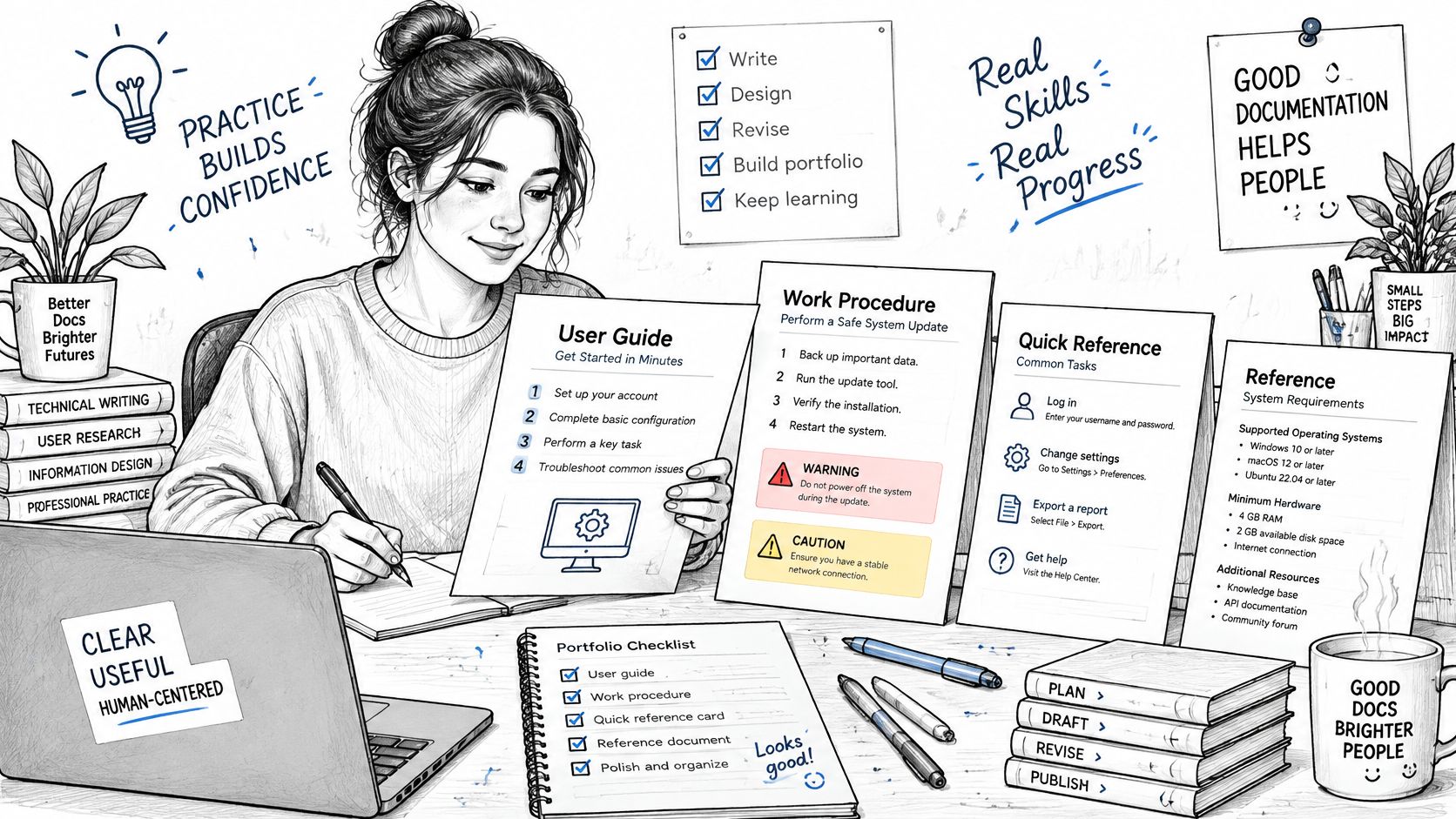
A useful portfolio contains documents that help readers complete tasks or find specific information. Strong technical writing courses should produce items such as:
- Task-based user guide: Instructions organized around reader goals.
- Work procedure: Steps with appropriate warnings, cautions, and verification points.
- Quick reference card: Essential information for a defined working context.
- Reference topic: Structured descriptions that readers can scan and compare.
- Review record: Comments, decisions, corrections, and unresolved questions.
- Project plan: Scope, responsibilities, milestones, and delivery requirements.
A polished page isn't enough. The supporting records should show how the learner verified content and responded to review.
Separate content quality from project execution
In Utah State University's assessment, information design was exceptional in 4 of 6 documents, while project management was marginal in 4 of 6.
This small sample doesn't establish how all learners perform. It shows why a course shouldn't combine every competency into an unexplained overall grade. A learner can organize information well while struggling to manage the work.
A practical assessment model uses the following categories:
| Rubric category | Observable evidence |
|---|---|
| Audience analysis | Defined readers, tasks, prior knowledge, and constraints |
| Information architecture | Logical topic structure and usable navigation |
| Technical accuracy | Verified claims, correct steps, and resolved technical questions |
| Accessibility | Usable structure, alternatives, and relevant access checks |
| Editing | Consistent terms, clear sentences, and corrected errors |
| Tool use | Appropriate source files, formatting, and output checks |
| Project execution | Managed milestones, review records, and complete delivery |
Each applicable category can receive an exceptional, acceptable, or marginal rating. The rubric must define those terms with observable conditions.
Learners should ask for the share of graded artifacts that reach at least acceptable in each category. The provider should explain the sample, assignment type, and assessment method. An average grade can conceal a recurring weakness.
Follow a complete project through revision
A working project sequence begins with a scope statement. The learner then conducts an audience interview and submits an outline for review.
The first draft goes to a subject-matter expert. A real reader then attempts the documented task during a usability check. Final delivery includes corrected content, source files, and review records.
The same document should receive at least two revision rounds as a course-selection requirement. This allows learners to practise correcting structure and then checking the revised result.
Worked Simplified Technical English examples can support sentence-level practice within that larger project. Learners should explain each change and confirm that it preserves the technical meaning.
Two warning signs deserve attention: prose-only assignments and projects without deadlines or review steps. Both leave important production skills untested.
Before enrolling, a learner should request a graded sample document and its rubric. The useful evidence is the connection between the original problem, reviewer feedback, and final revision.
Controlled Language and STE Coverage
Plain language aims to help an intended audience understand and use information. Controlled language adds defined restrictions on wording and sentence construction. A course shouldn't treat the terms as interchangeable.
The official ASD-STE100 Issue 9 document contains writing rules and a controlled dictionary. The rules address grammar and style, while the dictionary controls approved vocabulary and permitted meanings.
A course that teaches STE should cover both parts. Sentence length alone doesn't establish conformity. A short sentence can still contain an unsuitable word, an unclear reference, or an incorrect technical statement.
The dictionary isn't a general list of interchangeable words. Writers must check the permitted meaning and part of speech. They must also learn how the standard handles technical names and technical verbs.
An introduction to STE can establish the scope before detailed exercises. Learners should then practise sentence review and vocabulary review as separate tasks.
Check the issue and examine worked rewrites
According to the ASD Simplified Technical English website, Issue 9 was released on January 15, 2025, and established international-standard status.
A syllabus should state which issue it uses. Documentation teams should also identify the issue behind existing style guides before comparing requirements.
The following editorial examples demonstrate clearer construction. They aren't extracts from the official rules or proof of full STE conformity.
Before
Prior to removal, it is necessary that the panel be checked for damage.
After
Check the panel for damage. Then remove it.
The revision names the action directly and makes the sequence visible. Each sentence contains a separate instruction. However, a technical reviewer must confirm whether removal remains permitted when damage is found.
Before
The unit may be damaged if the cover is not fitted correctly.
After
Fit the cover correctly. If you do not, the unit can be damaged.
The revision separates the instruction from its consequence. It also uses a direct verb instead of making the reader infer the required action. A complete procedure must still define correct cover installation.
A clearer rewrite must preserve the engineering meaning. Shorter wording isn't a reason to remove a condition or safety requirement.
Questions that reveal useful STE teaching
- Vocabulary: Does the course teach approved vocabulary and permitted meanings?
- Dictionary checks: Must learners explain their word choices?
- Translation: Do assignments remove ambiguous references and unstable terminology?
- Technical review: Does an expert verify that rewrites preserve conditions and consequences?
- Authority: Does the instructor distinguish educational explanations from official requirements?
The writing-rule explanations, rewrite examples, and dictionary guidance support introductory study. Guidance on obtaining the official PDF directs learners to the authoritative document.
The free STE checker checks a learner's text for common STE problems. It's a heuristic tool, so it can miss problems or flag correct text.
STE Guide provides general education, not a replacement for the official ASD-STE100 specification. Exact requirements must come from the official document.
Credentials Versus Practical Skills
A credential records an award or completion decision. A portfolio shows the work a learner can produce. Both matter, but neither tells the whole story: an award may not demonstrate practical writing, and a polished sample may not show how the learner responded to feedback.
| Credential type | What it mainly shows | What to verify before enrolling |
|---|---|---|
| Bachelor's or master's degree | Broad training, theory and extended projects | Course list, project work and instructor background |
| University certificate | Focused study with graded coursework | Tuition and whether learners can retain and share work |
| Short online course or workshop | Specific tools or techniques | Assessment method, instructor experience and samples |
| Vendor or employer certificate | Competence in one product or method | Scope of the content and whether it is recognized in the learner's sector |
These categories describe intended purposes, not guaranteed outcomes. A product-focused certificate, for example, might assess tool operation without testing audience analysis or technical accuracy.
Calculate cost without confusing it with value
The University of Arizona lists 12 credits at $525 per credit, which produces $6,300 in tuition by multiplication. That figure covers stated tuition only. Confirm current tuition, fees, and other charges on the university website before budgeting.
Compare the cost with the work learners receive in return. A course with detailed document review offers a different learning experience from a lecture-only course. Price and institutional wording alone do not show what learners can do by the end.
Verify assessment and usable evidence
Before enrolling, ask to see two sample graded documents, including feedback and the criteria used to assess them. The samples can show whether evaluation focuses on clear writing, technical accuracy, or both.
Also check:
- Portfolio permission: Can learners retain and share their work?
- Instructor practice: Do instructors work as technical writers, and what kinds of documents do they produce?
- Award record: Does the course issue an official transcript or a letter?
- Assessment scope: Does the award represent attendance, knowledge testing, or demonstrated performance?
Confidential projects need special care. Check whether learners can create anonymized samples or alternative portfolio documents.
An STE-focused credential still needs evidence of vocabulary review, technical accuracy, and assessed revision. STE Guide is a free, independent educational website; it does not issue certificates.
Check Workload, Format and Your Own Text
The syllabus should state expected hours per week and any academic credit requirement. It should separate class time from reading, drafting, interviews, testing, and revision. Credits alone do not show how the workload fits across a typical week.
Check the busiest assignment period, not only the average. Overlapping drafts and review deadlines can leave too little time to use feedback.
Match the format to the work
| Format | Schedule check | Feedback check |
|---|---|---|
| Self-paced online course | Submission windows and access limits | Whether an instructor reviews drafts |
| Instructor-led course | Attendance requirements and deadlines | Whether feedback arrives before the next revision |
| University certificate | Term dates and overlapping assignments | Review cycles within each course |
The format matters less than the chance to revise. Feedback should arrive while there is still time to apply it before final submission. A review delivered after a project closes cannot guide that project's next draft.
Test an existing draft
Paste a non-confidential paragraph into the free STE Checker. Review each flagged sentence manually against the applicable writing explanations and worked examples. The checker is heuristic: it can miss problems or flag correct text.
Record the original wording, proposed revision, and reason for the change. Preserve the technical conditions. Treat uncertain flags as questions for an instructor, not as automatic edits.
Decision test: Choose a course that fits your role, provides relevant practice, and leaves enough time to complete and revise the work.
Allow time for technical checks, reader testing, and responses to feedback. These steps show whether the schedule supports careful work, not just course attendance.
STE Guide offers explanations, worked examples, and a structured learning path for studying ASD-STE100. Technical writers, engineers, translators, and students can use the STE Guide website to practise a rewrite and identify skills to develop through assessed study.