Short sentences don't fix every translation problem. A short sentence can still use the wrong term. It can still hide a condition or a cultural assumption. Writing for translation works as selective risk control. Writers fix ambiguity, terminology, and format errors before translation starts. Translators and in-country reviewers keep decisions about naturalness and local use. That boundary matters more than one universal checklist.
Table of Contents
- Translation-Readiness Checklist at a Glance
- How to Simplify Source Sentences Step by Step
- Terminology and Idioms That Break Translation
- Formats, Units and Placeholders
- Where Source Writing Ends and Translator Review Begins
- Setting Up Segments, Metadata and CAT Tool Workflow
- Confirm Your Source Rules Before the Next Translation Batch
Translation-Readiness Checklist at a Glance
A procedure can pass spelling and grammar checks and still multiply errors. If the source says "adjust the valve after it cools," every translator must decide whether "it" means the valve, the tool, or the machine. Fix that referent once in English, or pay for the same question in each target language.
The table gives eight checks for use before translation starts. Each row names the fault and the repair.
| Check | What to look for | Fix before translation |
|---|---|---|
| Sentence length | Long sentences with several clauses | Split into shorter sentences |
| Actions per sentence | More than one instruction in one sentence | Give each action its own sentence |
| Pronouns and references | Words such as it, this or they with an unclear referent | Repeat the noun |
| Terminology | Several words for one part or action | Choose one term and use it everywhere |
| Idioms | Phrases whose meaning is not literal | Replace with literal wording |
| Cultural references | Local holidays, sports or slang | Replace with neutral examples or flag for a localizer |
| Formats | Dates, units and decimal marks | Mark as variables or state the target format |
| Embedded text | Placeholders and strings split across segments | Keep complete sentences in one segment and mark variables |
Checks That Need Local Knowledge
Some checks do not end with the English text. A neutral example in one market can confuse readers in another. A numeric date can be valid in the source and still be read in the wrong order locally.
The writer's job is to remove ambiguity, then hand over a clear decision where local judgment is required. Fix the first five rows in the source whenever the meaning is knowable there. For formats, cultural references and embedded strings, attach a flag that names the choice: target date order, unit convention, decimal mark, example to substitute, or variable that must not be translated. A good flag gives the reviewer the options and the constraint. It never makes the reviewer infer the intent from a fragment.
How to Simplify Source Sentences Step by Step
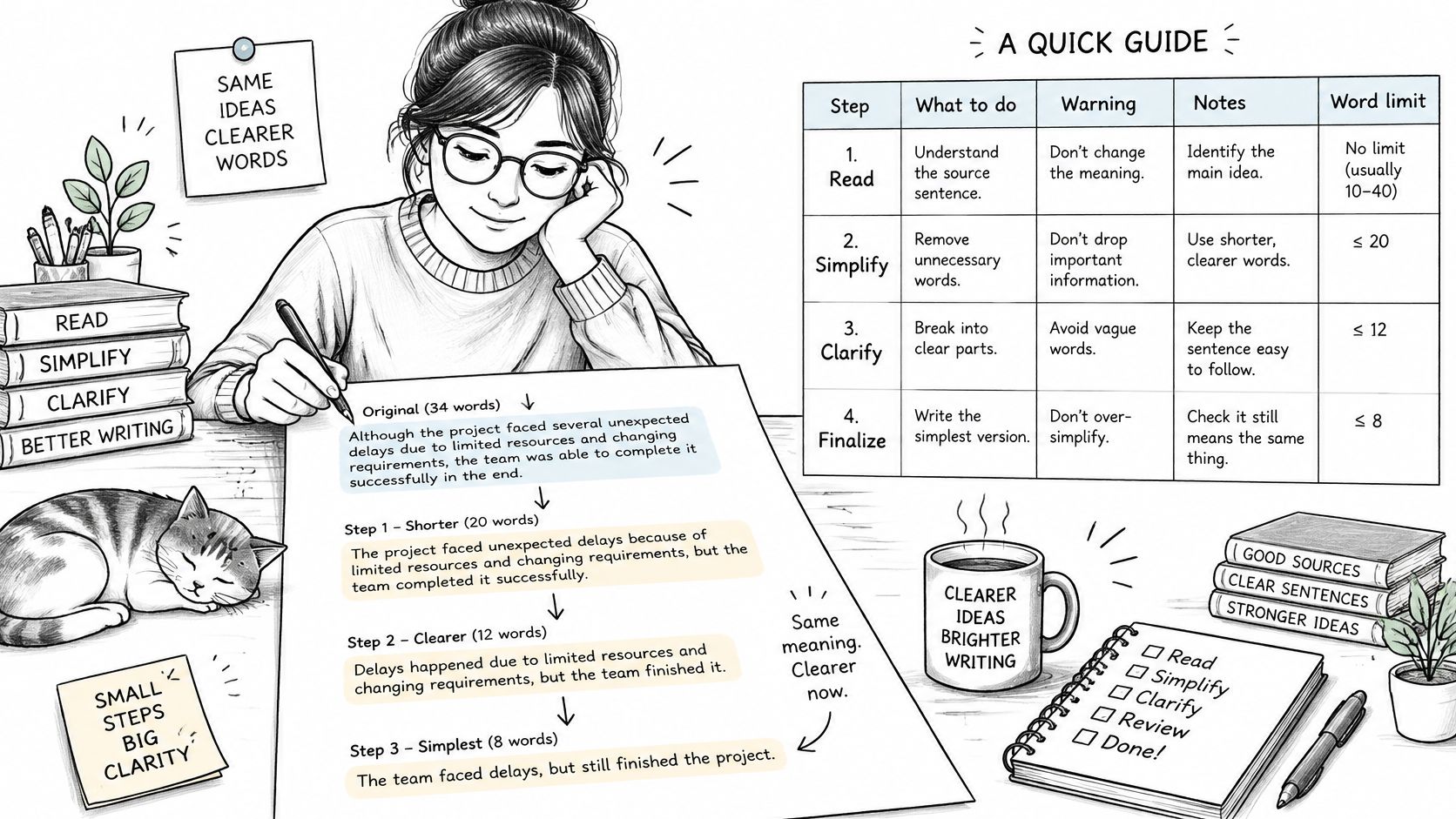
Every sentence handed to a translator carries a short list of risks: a second action hidden in one line, a pronoun with two possible referents, a condition the reader meets too late. Sentence work removes the risks that would otherwise become guesses in the target text.
The starting rule for a procedure stays simple: one sentence, one action. The translator then handles one action, one object, and one condition at a time.
Limits change with text type. The official ASD-STE100 Issue 9 specification sets a maximum of 20 words for procedures and for warnings, cautions, and other safety instructions. A note in a procedure can contain up to 25 words, and descriptive writing carries the same 25-word maximum. Text in parentheses counts as one word in the main sentence, and the words inside the parentheses form a separate sentence for counting purposes. Writers check the official specification for exact counting cases and exceptions.
| Text type | Maximum words | What the sentence does |
|---|---|---|
| Procedure step | 20 | Gives one instruction |
| Warning or caution | 20 | States a hazard or a required action |
| Note in a procedure | 25 | Gives information, not an instruction |
| Descriptive text | 25 | Explains a function, part or condition |
Six Steps for Each Sentence
These six checks sit on the writer's side of the handoff. Each one removes a decision the translator would otherwise have to make alone.
- Count the words: The writer compares the count with the limit for that text type. A sentence over the limit usually carries a second action or a second idea.
- Split multiple actions: Each action moves into a separate sentence. The translator doesn't have to decide where one step ends.
- Put the subject and verb first: Early placement shows who or what acts. It also reduces long introductory phrases that translators must reorder.
- Replace unclear pronouns: The writer repeats the noun instead of it or this. Repetition costs little and removes a common source of wrong references.
- Move conditions to the start: A condition at the start tells the reader when to act. The main action then stays short and direct.
- Read the sentence alone: A sentence that works alone has one clear meaning. A sentence that needs the previous sentence for its meaning needs a clearer noun or verb.
The sentence rules summary gives writers a quick reference during this pass.
Before and After Example
The source sentence packs three actions into one line: "Remove the panel and inspect the seal before you install the replacement." Split it: "Remove the panel. Inspect the seal. Install the replacement."
The word "before" disappears because sentence order now carries the condition. Each new line gives the translator one clear action and gives the technician one step to complete and check. A translation memory can also reuse each short step in other procedures, since "Inspect the seal" can appear wherever the same check applies.
A split can still go wrong. A writer who deletes a condition or a warning to meet a count hands the translator clean syntax and missing meaning. The rewrite keeps every required element: the hazard, the limit, the sequence. Once the second action moves into its own sentence, the count usually takes care of itself.
Terminology and Idioms That Break Translation
A word with several meanings forces a translator to guess. The translator selects one meaning for the target text. A translation memory then stores that guess for future reuse. One early guess can therefore spread through a full document set.
Controlled language reduces that risk at the source. The ASD-STE100 summary page explains that each approved word generally has one defined meaning and one permitted part of speech. The controlled dictionary contains approximately 900 approved general words. It also contains approximately 1,200 words that are not approved, with alternative suggestions. When several synonyms exist, the specification normally selects one preferred term. It selects "start" instead of alternatives such as "begin" or "commence."
| Before | After | Why it helps |
|---|---|---|
| Commence the operation | Start the operation | One preferred verb for one action |
| Keep an eye on the gauge | Check the gauge | Removes a figure of speech |
| Get the unit up and running | Start the unit | Removes an idiom and a phrasal verb |
| Make sure the cap is tight | Tighten the cap | Uses one action verb |
| Give the bolt a good whack | Hit the bolt with a hammer | Makes the action literal |
Why Idioms Fail
An idiom's meaning doesn't come from its individual words. "Keep an eye on" doesn't describe an eye. A translator must first recognize the figure of speech. A machine system can translate the words word for word and still produce fluent text. Literal wording removes that extra step. "Check the gauge" names the action and the object directly.
The same problem affects phrasal verbs and vague verbs. "Make sure" doesn't name a physical action. "Tighten" tells the technician exactly what to do. Writers should select the verb that names the actual task.
Project Terms Beyond the Dictionary
The general dictionary doesn't cover every product term. Technical names and technical verbs for a specific company or product remain possible. Writers control those terms through the writing rules and project terminology. A project glossary records the approved term, its definition, and terms writers must not use.
The controlled dictionary explanation helps writers separate general vocabulary from project terms. The official specification remains the authority for exact vocabulary decisions.
A term list works only when every writer and translator uses the same version.
A documentation manager therefore assigns one glossary owner. That owner approves additions and removes duplicates. Without that control, two writers create two terms for one part. Translators then create two target terms, and readers see inconsistent names for the same object.
Formats, Units and Placeholders
Format errors look small in the source. They cause large problems in target markets. A date, a decimal mark, or a placeholder can change meaning without changing any translated word.
Dates and Numbers
Numeric dates carry hidden ambiguity. The date 03/04/2026 can mean March 4 or April 3. Readers in different markets read the order differently. Writers avoid that risk in two ways. They write the month name in full, or they mark the date as a variable and state the target format.
Units need the same discipline. Each document uses one unit system. The unit follows the number, with a space between them. Mixed systems force translators to decide whether conversion is required. That decision belongs to an engineer or a documentation manager, not to a translator during translation.
Decimal marks also need an explicit decision. A writer states the decimal mark used in the source. A better option marks numbers as variables for locale formatting. The target system then applies the correct mark automatically. Translators don't retype numbers, and retyping errors disappear.
Placeholders and Sentence Fragments
One placeholder style should run through a full set. Writers use a form such as {count} everywhere. The placeholder sits inside a complete sentence.
- Before: The file contains %d entries.
- After: The file contains {count} entries.
The second version names the variable's content. A translator can place it correctly in the target word order. Tools can also protect it from accidental changes.
Writers mustn't build sentences from joined fragments. A fragment gives the translator no complete structure. Target languages often need a different word order or an extra word for agreement. A complete sentence allows that change. Fragments block it.
Each format decision needs a named owner in the style guide. The owner approves the date format, the unit system, and the placeholder style. That record stops each project from making a different choice.
Where Source Writing Ends and Translator Review Begins
Good source writing doesn't remove the need for review. It reduces ambiguity before translation. It cannot judge whether a sentence works for a reader in the target market.
The 2025 corporate localization survey reporting found that 74% of corporate respondents had stable or growing internal demand for translation despite flat budgets, and that 40% reviewed more than half of their AI-generated translations. That pattern describes a hybrid model: writers fix the source, and reviewers check selected output. Source writing reduces risk; review still judges fit. The result is selective review, where effort goes to the decisions that need human judgment.
Decisions Writers Resolve First
- Ambiguous references: Each pronoun has one clear noun as its referent.
- Overloaded terms: Each term carries one meaning in the document set.
- Unsafe instructions: Each hazard has its warning before the action step.
- Measurement formats: Each number has a stated unit and format owner.
- Cultural assumptions: Each local example gets a neutral replacement or a reviewer flag.
Decisions Translators and Reviewers Keep
- Naturalness: The target sentence follows target language patterns, not source patterns.
- Audience norms: The text matches how local technicians, patients, or users expect instructions.
- Functional usability: The translated step works in actual tasks, not only on the page.
A sentence can translate accurately and still fail its user. For safety content, target-audience norms take priority over literal copying of the source. A reviewer who spots that conflict should raise it, not preserve it.
Controlled rules also vary in value across engines and languages. Teams should test rules on representative samples for each language and each engine. A shorter source sentence can still produce weak output in one target language while a longer, explicit version translates cleanly. Test results, not habit, decide which rules a project enforces strictly. The style guide records this boundary so each reviewer knows who decides each issue.
Setting Up Segments, Metadata and CAT Tool Workflow
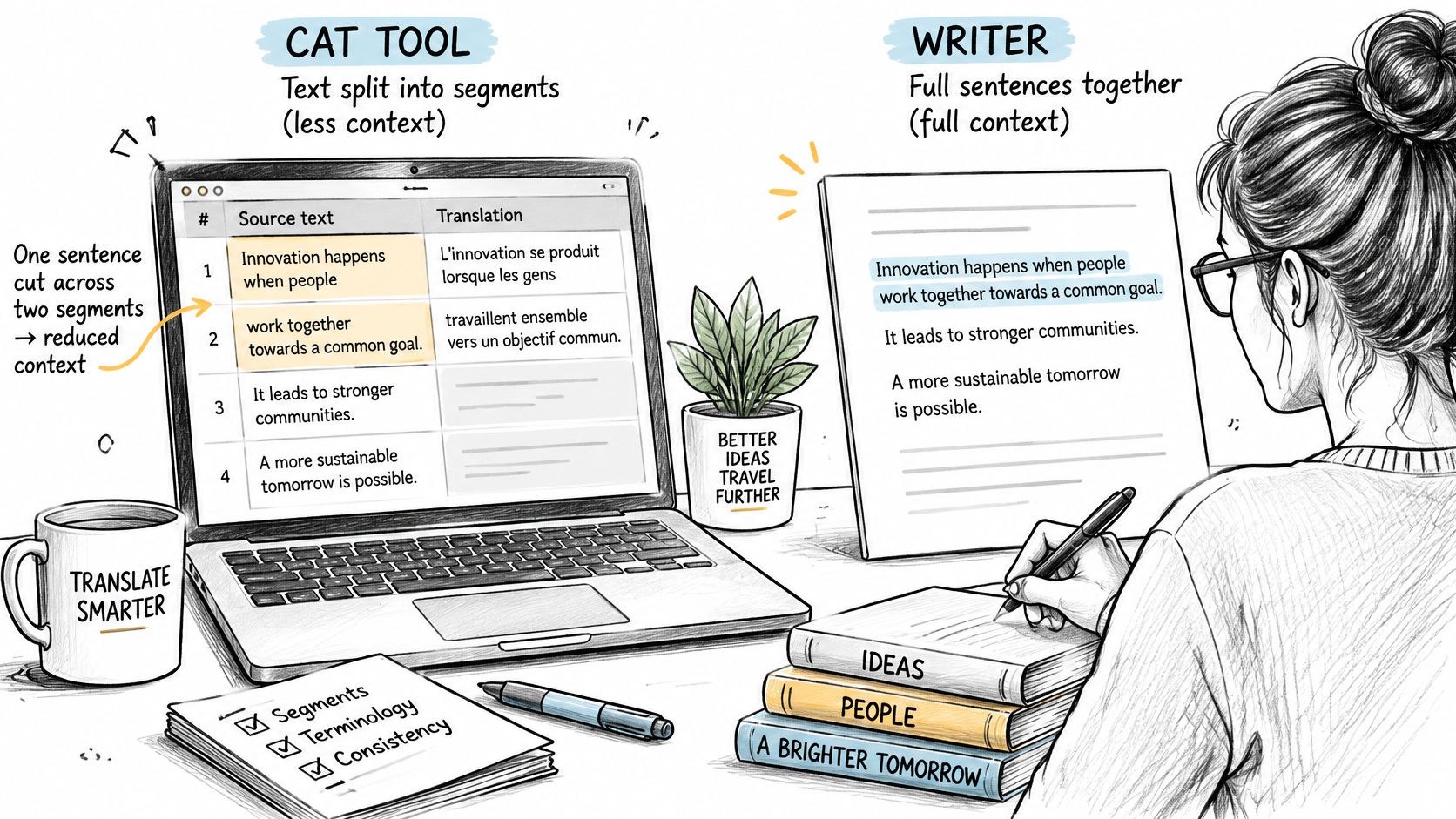
A CAT tool splits text into segments for translation. A sentence split across two segments gives the translator less context. The translator sees a fragment and must reconstruct the full meaning. Writers prevent that problem during source preparation.
Segments and Repeated Text
- One sentence per segment: Each full sentence stays in one segment, with its condition and object intact.
- Identical repeated text: Labels, button text, and warnings stay identical at each occurrence, so translation memory matches them exactly.
- Marked variables: Placeholders carry clear markup, so tools don't translate them and translators don't change them.
Small source variations break exact matches. An extra space or a changed word creates a new segment. Consistent source text therefore gives direct reuse benefits. The overview of technical writing tools helps managers place these checks in a wider tool setup.
Metadata and Version Control
Each file needs a complete version record. The record names the target languages and the product or document version. It also names the glossary version and the version of the writing rules in use.
Version identity matters for the standard itself. The official ASD-STE100 website identifies Issue 9 as the current issue, released on January 15, 2025. Each issue can revise writing rules and dictionary entries, and exact counts can change between issues, so check the official specification for current figures. A checklist based on an older issue can miss current wording.
Documentation managers identify the issue that writers and translators use. Version control covers the rules, approved vocabulary, project terminology, and review criteria. Every file in a set carries the same record.
Confirm Your Source Rules Before the Next Translation Batch
One representative document gives enough evidence for a first test. Choose a file that contains procedures, warnings, descriptions, and interface text, then run the eight readiness checks against it. Record each fault and sort it by owner. Breaches of the project rules and glossary go back to the writer. Judgment calls about target wording stay with translators and in-country reviewers.
The free STE checker gives a quick first pass for common problems. The checker is heuristic, so it can miss problems or flag correct text. It supports the test; it does not replace human review, and reviewers make the final decisions.
Supporting references serve different tasks during the test. The writing rules pages explain rule categories in plain language. The before and after examples show complete rewrites that writers can compare against draft text. The dictionary guidance explains controlled vocabulary, and the official specification guidance helps readers reach exact rules.
STE Guide is a free, independent educational resource, not an official ASD-STE100 source. Its examples are its own work. When its explanation and the official specification differ, the official specification is correct.
Start with the procedure file that carries the most warnings in the set. Lock its first glossary term, then run that file through the checks before the rest of the batch moves.
STE Guide offers free explanations, worked examples, and a heuristic checker that help writers prepare clear source text for translation. Readers who want to test a draft against common STE problems can start with those tools and examples. Visit STE Guide to run a first check and build a translation-ready writing process.