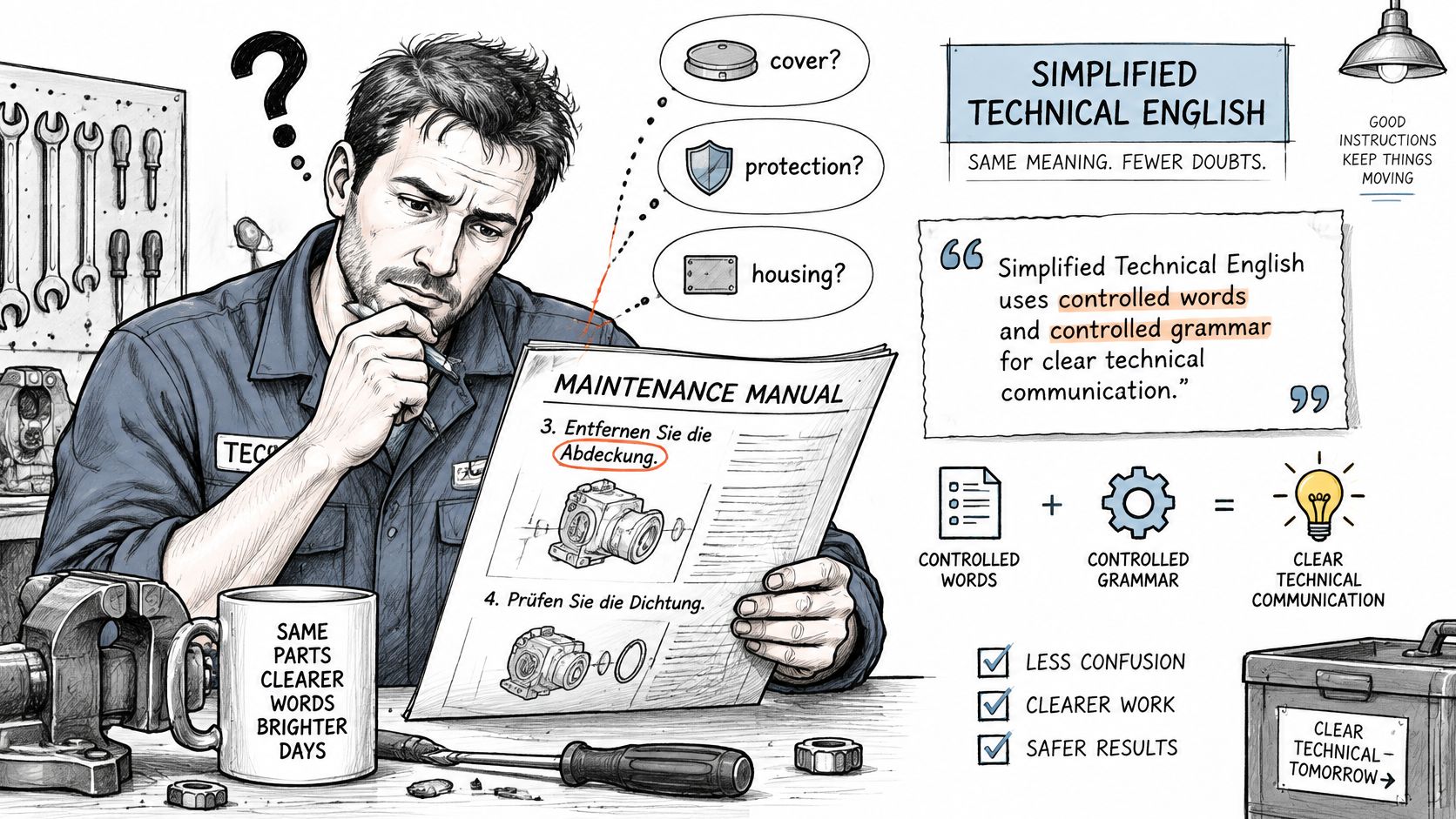
A technician reads a maintenance step in a second language and stops at a familiar word. That word has several meanings. The technician knows the equipment, but the sentence doesn't make the required action clear.
STE, Simplified Technical English, addresses this problem through controlled word choices and sentence patterns. Its value comes from a trade-off: writers accept less freedom so readers face fewer possible interpretations.
Table of Contents
- What Simplified Technical English Really Is
- How STE Started in Aircraft Maintenance
- Who Governs STE and What Issue 9 Changed
- The Two Controls Behind Every STE Sentence
- Rewriting Ordinary Text in STE
- STE Compared With Plain English
- Where STE Helps Translation and AI Workflows
- Get the Official Specification Before You Write
What Simplified Technical English Really Is
Simplified Technical English is a controlled form of English that limits vocabulary and sentence patterns so readers can interpret technical text consistently.
STE isn't a new language. Every STE sentence must also be correct English. The difference lies in the choices that writers can make within English.
A shared set of road signs provides a useful comparison. Drivers learn a defined meaning for each sign rather than interpreting a designer's personal choice. STE applies similar discipline to technical instructions.
Control means more than good style
A style guide usually helps writers choose a suitable tone and presentation. A controlled language sets more specific boundaries around vocabulary and grammar. Writers following those boundaries should produce more similar text.
This doesn't mean every document becomes identical. Engineers still need exact component names, operating conditions, and technical explanations. The control applies to how writers express that information.
STE targets several common sources of confusion:
- Words with several meanings. A reader shouldn't need to guess which sense the writer intended.
- Long sentences. Conditions, actions, and explanations become difficult to separate when writers combine them.
- Unclear references. Words such as it can leave readers uncertain about the component involved.
Consider an instruction that mentions a cover and a housing, then tells the technician to remove it. Shortening that sentence won't necessarily solve the problem. Naming the intended component will.
Clear language still needs technical knowledge
STE doesn't replace engineering judgment. A clear instruction can still describe an incorrect action. Technical reviewers must verify the equipment, sequence, conditions, and safety information.
The rules and dictionary appear in the official ASD-STE100 specification. The writing rules overview provides an introduction without reproducing the official requirements.
STE Guide provides general education, not a replacement for that specification. Its explanations use original wording rather than copying official rules or dictionary entries.
The practical learning path starts with understanding the controls. Writers then apply them to procedures, compare alternatives, and test their effect on translation and automated rewriting.
How STE Started in Aircraft Maintenance
Aircraft manufacturers and airlines needed to exchange maintenance information across national and language boundaries. A mechanic could understand the system yet struggle with a manufacturer's wording.
Consider a technician who moves between manuals for different aircraft. Each manual may describe similar actions with different verbs and sentence structures. The technician must separate genuine technical differences from differences in writing.
That distinction matters during maintenance. A writer's preference for varied language shouldn't make a familiar action appear unfamiliar.
From a shared problem to a maintained standard
The official ASD-STE100 history records the project milestones from 1979 to 2025 shown below.
STE milestones from 1979 to 2025
| Year | Milestone | What changed |
|---|---|---|
| 1979 | Project begins | The European Association of Airlines asks the European Association of Aerospace Industries, AECMA, to study common controlled English for maintenance information. |
| 1983 | Working group formed | The AECMA Simplified English Working Group is established on June 30 at the Fokker plant near Schiphol Airport in Amsterdam. |
| 1986 | First guide released | The AECMA Simplified English Guide, PSC-85-16598, introduces writing rules and a controlled dictionary on February 15. |
| 2004 | Group renamed | The ASD Simplified Technical English Maintenance Group, STEMG, became the responsible group after ASD was created. |
| 2005 | Modern name adopted | Issue 3 is released as ASD-STE100. |
| 2025 | International standard | Issue 9 is released on January 15, 2025, as an international standard. |
The initial investigation gave the industry a shared problem to solve. The working group gave that effort a formal structure. The first guide then gave writers something concrete to apply.
The later organizational change transferred responsibility for maintaining the guidance. The modern name gave writers a consistent specification reference. International-standard status marked a further change in its standing.
Why the maintenance origin still matters
STE began with work that readers had to perform, not prose that readers merely had to appreciate. That origin explains its emphasis on explicit actions and controlled wording.
A maintenance instruction must remain understandable when different organizations write, translate, revise, and use it. Training material must also prepare technicians to recognize the language used during actual tasks.
Practical lesson: A technical instruction should describe the required work, not demonstrate the writer's range of vocabulary.
This history doesn't mean every document needs STE. It explains where the discipline has particular value: globally distributed work with serious consequences for misunderstanding.
The same reasoning can guide documentation decisions outside aircraft maintenance. The relevant question concerns the task and its risks, not just the industry name.
Who Governs STE and What Issue 9 Changed
A specification issue works like an edition of a building code. The structure can look identical while the requirements inside it change. Issue 9 kept the existing rule count but revised substantial wording: the official ASD-STE100 overview reports that more than half of the 53 writing rules were refined for clarity.
Writers must check the current wording, because an unchanged rule count can hide revised text. Training notes and review comments written against an earlier issue can still read as correct while citing superseded language.
The revision aimed to improve clarity and align terminology with international standards, including ISO 1087-1:2019. Treat an issue change as a document-control matter that affects how your team writes and reviews, not as a cosmetic update.
Who maintains the specification
The ASD Simplified Technical English Maintenance Group, or STEMG, maintains the specification and manages its releases and revisions. Its work has produced a long series of releases, changes, and revisions, developed through working meetings held across multiple countries. The specification remains under active international maintenance rather than sitting as a finished document.
The dictionary also received attention. The ASD-STE100 FAQ describes 555 updated dictionary entries and terminology classifications aligned with ISO 1087-1:2019.
Terminology classification affects everyday decisions. A reviewer needs to distinguish an approved general word from a necessary technical term. Treating those categories as interchangeable produces incorrect review comments, and the distinction matters even more for translation: a narrowed, classified vocabulary only helps a translator when each word's status is clear.
What writers should change in their workflow
Issue 9 replaced earlier issues and revisions. A documentation team should therefore identify outdated reference material before using it for current work.
An internal checklist may still reflect an earlier interpretation. A checker configuration or an AI-assisted review prompt may also carry older vocabulary information. Neither should override the current specification.
A controlled update process should include:
- Issue confirmation. The document owner identifies the specification issue used for the project.
- Wording review. Writers read the applicable requirements in that issue before citing them during review.
- Document control. The team records the issue number in its controlled documentation records.
- Local guidance review. Editors update examples, terminology lists, and internal explanations that no longer match.
The team should first identify which requirements affect its content, then review the affected passages deliberately rather than rewriting everything at once. A remembered rule is useful for drafting. The current specification is the reference for settling a disagreement.
The Two Controls Behind Every STE Sentence
Compare two drafts of the same instruction:
Draft one: "The filter is removed by the operator and the housing is examined for damage." Every word is ordinary, and nothing looks wrong at a glance. The passive construction, though, hides who performs the action, and a translator or first-time reader has to dig for the instruction inside the sentence. The words would pass a vocabulary check. The sentence itself would not.
Draft two: "Remove the filter. Check the housing." Short, active, direct. Yet it can still fail if "housing" names two different components in the same document, or if a verb appears in a meaning the dictionary doesn't record. Grammar alone cannot catch that problem.
STE applies a separate control to each failure. The official Issue 9 specification contains 53 writing rules in nine sections, alongside its controlled dictionary. The rules govern how a sentence is built. The dictionary governs which words may fill it.
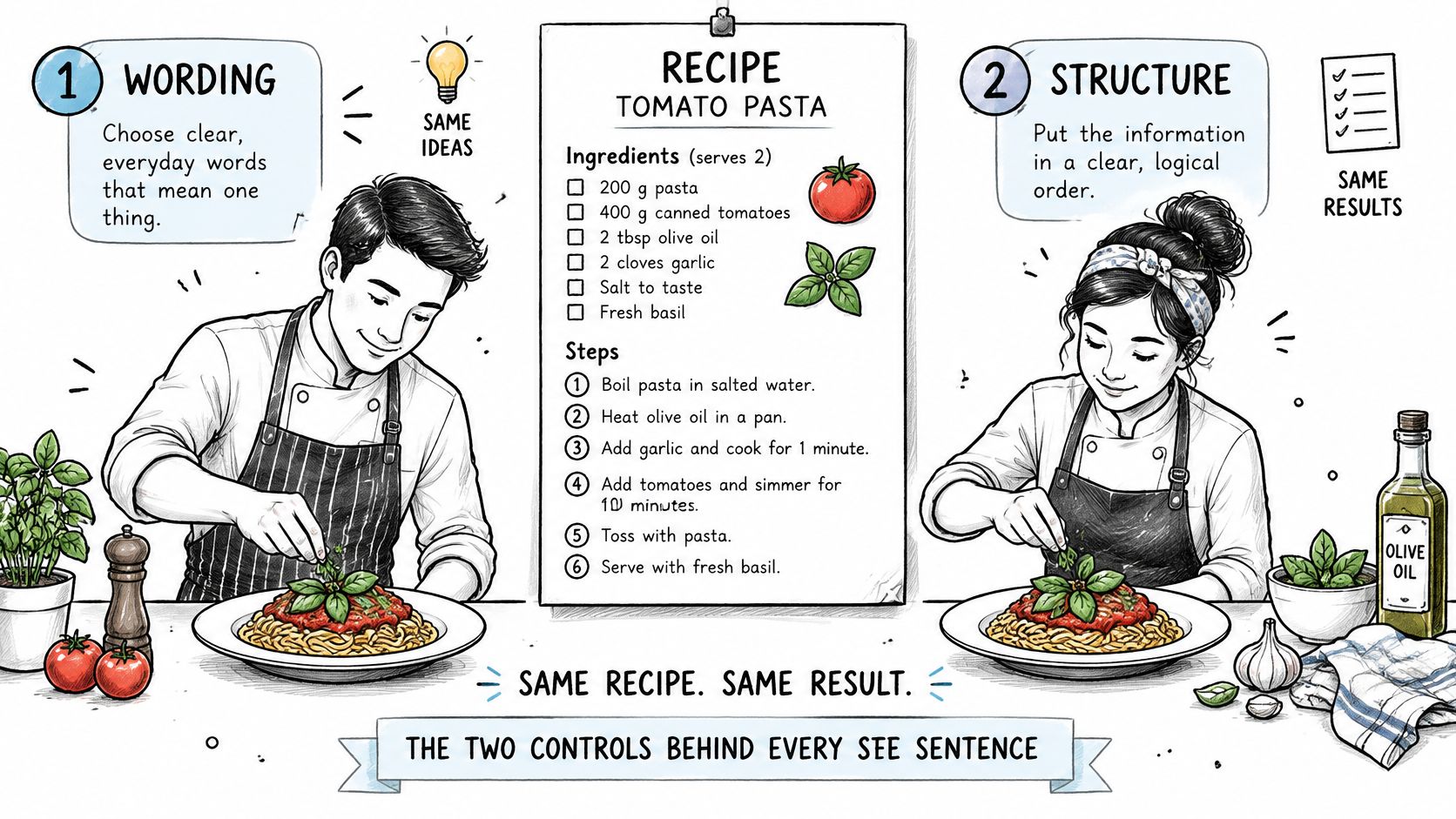
| Control | What it controls | Practical editing question |
|---|---|---|
| Writing rules | Grammar, sentence structure, and presentation | Does the sentence express the instruction clearly and follow the applicable requirements? |
| Controlled dictionary | General words, meanings, and parts of speech | Is this word permitted in this meaning and grammatical role? |
| Technical terminology | Necessary domain-specific nouns and verbs | Is this term technically necessary, correctly classified, and consistently used? |
Each control catches errors the other misses. A short sentence can still contain an ambiguous verb. An approved word can still sit inside a sentence whose reference is unclear. A writer can also use the same word as a noun in one passage and a verb in another; approval in one grammatical role doesn't automatically extend to the other.
Checking words against the dictionary
A vocabulary check runs in four passes. First, identify the function of each word: does it name something, describe something, or express an action? Second, compare the intended meaning with the permitted use, because a word can look acceptable while carrying a sense the specification doesn't allow. Third, classify technical nouns and technical verbs separately from general vocabulary, since component names and specialized processes need correct classification instead of deletion. Fourth, keep the chosen term for the same component or action throughout the document. The guide to working with the STE dictionary explains how to work through these checks without replacing the official entries.
The fourth pass is where synonym habits break down. Calling a component a "housing" in one step and a "casing" in the next suggests two different parts. Consistency has a limit in the other direction, too: two different components shouldn't share one name merely because the shorter term feels easier.
These boundaries are the point of the system. Approved words are restricted to recorded meanings and grammatical roles, and the writing rules restrict how sentences may carry them. Writers give up some freedom over vocabulary and phrasing; readers get instructions that resolve to a single meaning.
Rewriting Ordinary Text in STE
A maintenance note reaches the editor as ordinary English: a softened warning, three actions in one line, a noun phrase that hides the result. The first decision is practical. What must the technician do, in what order, under what condition, and with what evidence of completion?
The editor separates language faults from engineering gaps. A hedge such as "probably" can be removed once the responsible engineer confirms the action is mandatory; missing acceptance criteria need technical clarification, not a polished guess. STE helps by narrowing the choices, but that narrower vocabulary cannot supply a fact the source never gave.
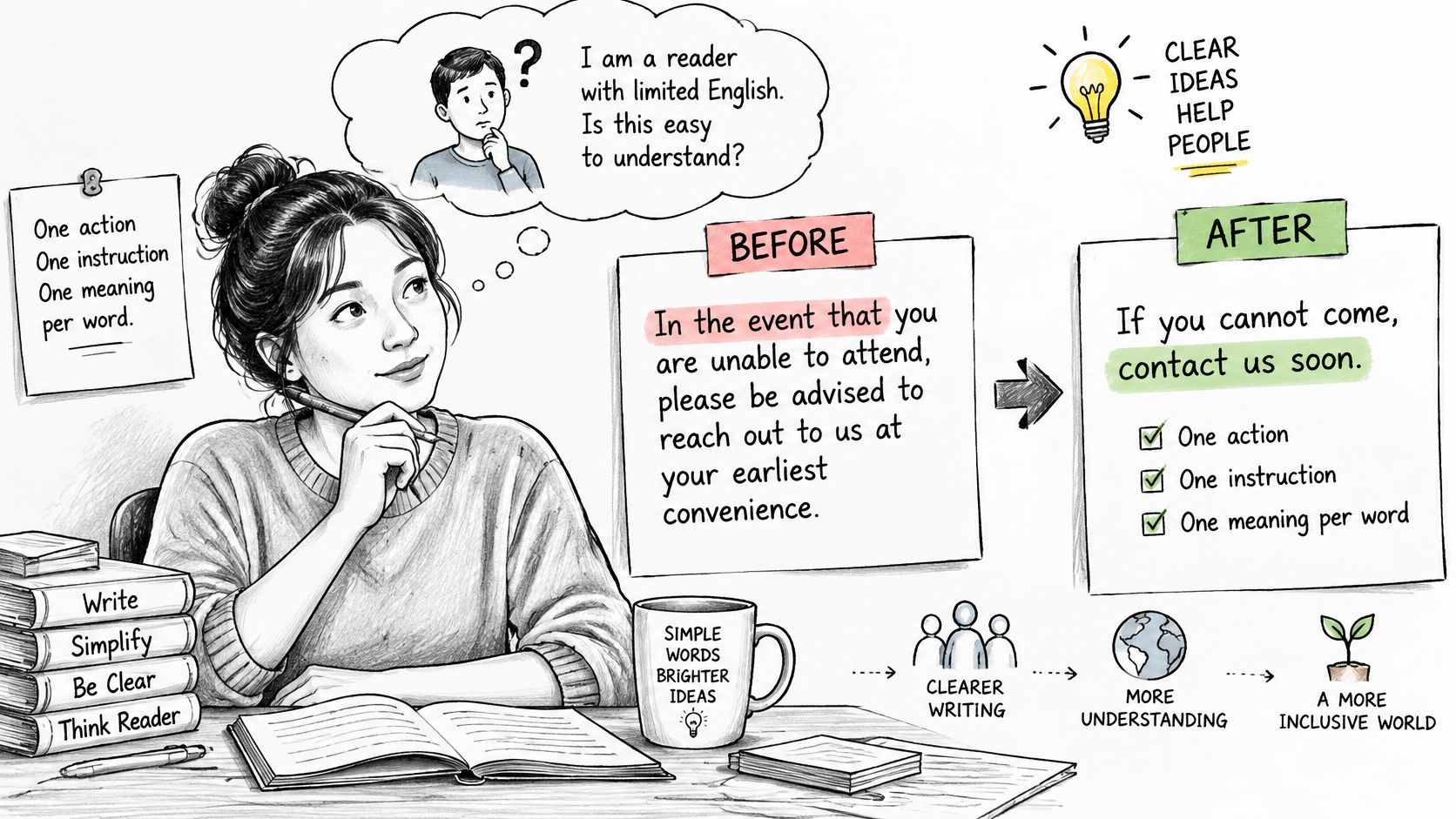
Before and after rewrites
These original examples illustrate editing principles. They are not official examples or complete conformity assessments.
Before and after rewrites, illustrative examples
| Original sentence | Rewrite | What changed |
|---|---|---|
| The cap should probably be tightened before the engine is started. | Tighten the cap before you start the engine. | The rewrite removes the hedge and replaces passive wording with an active instruction. |
| Clean the filter and check the seal and replace the gasket if needed. | Clean the filter. Check the seal. Replace the gasket if it is damaged. | The rewrite separates the actions and gives the replacement decision an explicit condition. |
| Wipe the surface with the cloth to clear the residue. | Wipe the surface with a clean cloth to remove the residue. | The rewrite replaces an ambiguous action word and specifies the cloth condition. |
| Ensure the unit is in a state of readiness for operation. | Make sure the unit is ready for use. | The rewrite replaces an abstract phrase with direct wording. |
Each row shows the same trade-off. The cap instruction becomes definite, so the engineer must confirm that tightening is mandatory and that the sequence is correct. The filter sentence becomes three findable actions, and the replacement step gains a condition a technician can test. The residue sentence chooses a more specific action verb, yet the editor still has to verify the permitted dictionary use and confirm that a clean cloth is technically appropriate. The readiness sentence removes abstraction, but "ready" may still need measurable acceptance conditions in the procedure.
A repeatable editing routine
A writer can apply this routine to a short procedure:
- Identify the action. Establish the required work, responsible person, applicable condition, and expected result.
- Put the instruction verb first. For an action step, express the task directly and separate unrelated actions.
- Check each word. Verify general vocabulary, technical terminology, references, and the intended meaning.
Verb-first drafting suits instructions. Descriptive passages need a structure that explains the equipment or condition accurately, because a stripped sentence can still name the wrong state. STE works like a marked toolkit: fewer tools, faster checks, less room for improvisation, and more reliance on the writer knowing which tool the task requires.
For more practice, compare the worked rewrite examples with the closer editing discussion in the simplified technical English examples article. A draft can receive an initial pass from the free STE checker; it is heuristic, free, and can miss problems or flag correct text, so it cannot replace expert review or the official specification.
A smoother sentence can still hide a changed obligation or an omitted condition. The reviewer must confirm that the rewrite keeps the original technical meaning and a complete instruction.
STE Compared With Plain English
A style-guide reviewer opens an STE procedure, sees short sentences and familiar words, and applies a Plain English checklist. The document passes. The review has still missed the point, because the part that makes it STE sits elsewhere: a fixed vocabulary and written rules that limit the writer's choices on purpose.
Plain English is a general goal of clear communication. STE is a specified controlled language with defined vocabulary and writing requirements.
Both approaches can produce readable text. They differ in who controls the language. Under Plain English the writer judges what a particular audience needs. Under STE the specification has already made those judgments, and the writer's job is to conform.
Plain English gives the writer a stocked kitchen and trusts the cook to choose the ingredients. STE hands the writer a labeled kit in which every part has one approved name and one approved use.
Two kinds of control
Plain English and STE compared
| Criterion | Plain English | ASD-STE100 STE |
|---|---|---|
| Rule source | General guidance and style choices | Written specification ASD-STE100 |
| Vocabulary | Common words selected for the audience | Controlled dictionary with approved words and meanings |
| Scope of control | Mainly clarity and tone | Vocabulary, grammar, and sentence structure |
| Main reader focus | General audience | Readers with different first languages and technical staff |
| Typical use | Articles, websites, and general business writing | Maintenance, service, and regulated technical documents |
| Verification | Editorial review using judgment | Rule and dictionary checks with expert review, not official certification |
That narrowing is the price of consistency. A public explanation gains from Plain English, where a familiar comparison or an approachable tone can carry the meaning. A maintenance team gains from STE, where the same action keeps the same wording across every related procedure, even when the repetition reads less elegantly.
Neither approach guarantees technical accuracy. A document can sound friendly and still give an incorrect instruction.
Choosing the level of control
Start with the content's purpose. Marketing pages and general business writing benefit from Plain English and vocabulary shaped to the audience. Maintenance procedures benefit from stricter controls, because a misread step can injure a technician or damage equipment.
For regulated documents, the decision comes from outside the text. The contract or documentation requirement attached to a project determines whether its documents follow STE, so the writer confirms that requirement with the customer or program office before selecting a language standard.
A short decision test helps a team choose:
- Consequences. Could a misread instruction cause injury, equipment damage, or incorrect maintenance?
- Shared authorship. Will different writers and translators maintain the same content?
- Repeated tasks. Would consistent wording help readers recognize recurring actions?
- Document purpose. Does the reader need to perform work rather than explore an argument or evaluate a proposal?
Keep the trade-off explicit. Plain English gives the writer range. STE gives the reader predictability. A team accepts the narrower vocabulary when a misunderstood step costs more than the lost flexibility, and when many contributors will share the documentation over time.
Where STE Helps Translation and AI Workflows
A translator opens an English maintenance procedure and hits a sentence that allows two readings. The author is unavailable, the deadline is fixed, and the wrong guess travels into every language the document ships in. Machine translation systems and generative AI tools face the same choice points, only faster and with nobody to flag the doubt.
Controlled wording limits the number of readings a translator must choose between. Each approved word has one job, and short active sentences name the actor, the action and the component without decoration. Whether this improves a given workflow remains a testable question, so the sensible move is to measure it on your own content rather than assume it works.
The same restrictions that remove ambiguity also shrink the vocabulary. A smaller vocabulary can erase distinctions a target language still needs.
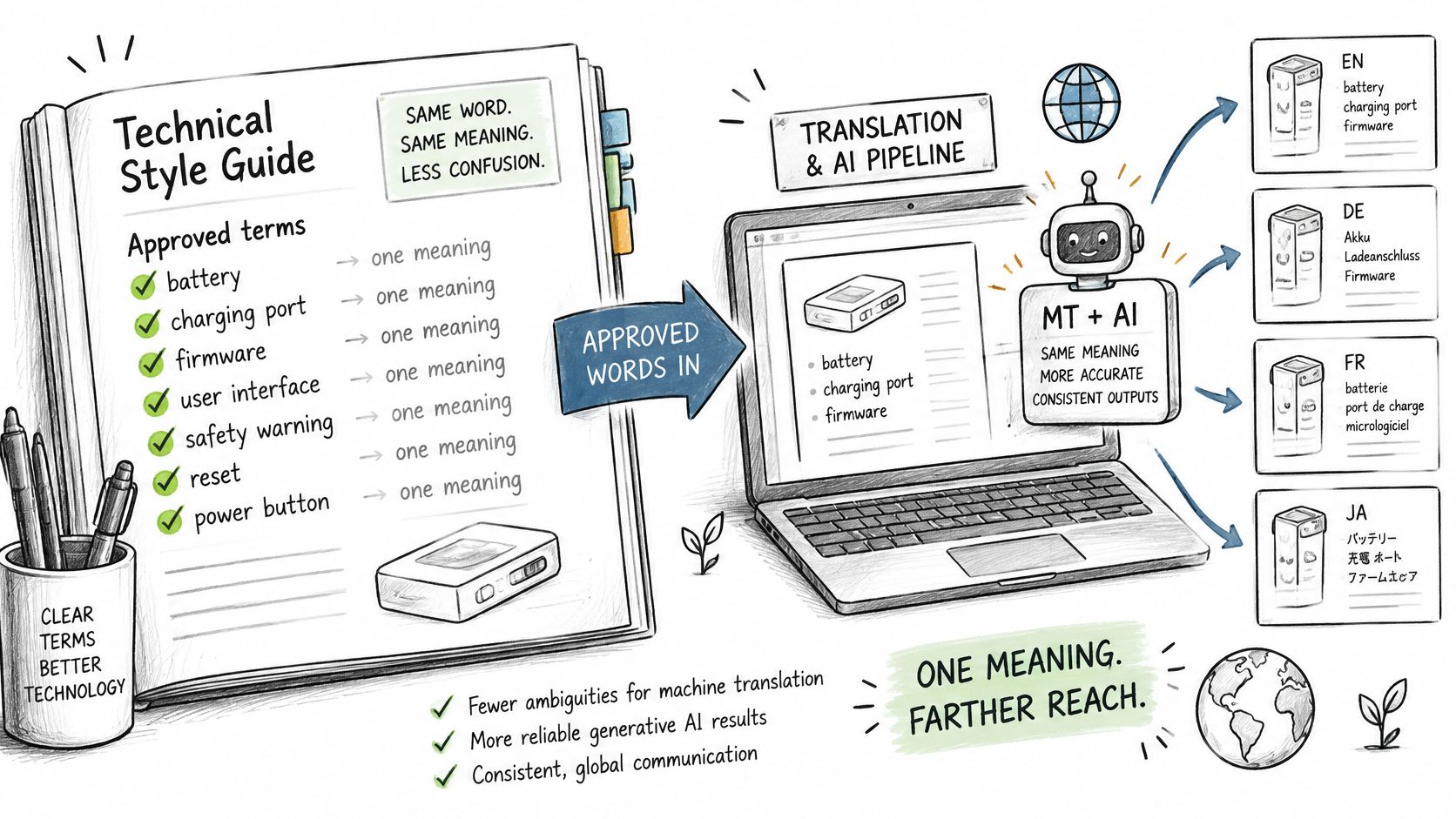
Simplification can remove necessary distinctions
An editor simplifying a text might combine two technical terms because they look similar in ordinary English. A translator often needs that exact distinction to pick the right target-language term, and an AI rewrite can drop a condition while making a sentence shorter.
Readability scores will not catch either failure. Reviewers need measures that expose lost information and incorrect meaning.
Metrics for comparing STE workflows
| Metric | What it measures | Why it matters for STE |
|---|---|---|
| Terminology accuracy | Whether approved terms retain the correct meaning | Tests whether controlled terminology survives translation or rewriting |
| Omission rate | Source content missing from the output | Identifies information lost during simplification |
| Post-editing effort | Time and edits needed to correct automated output | Tests whether the workflow reduces rework across language pairs |
| Safety-critical error rate | Errors in warnings, cautions, and procedural steps | Identifies failures with serious consequences |
Test equivalent content under controlled conditions
Pick representative procedures: warnings, conditional steps, specialized terminology. Have reviewers fix the correct technical meaning first, then compare human-written drafts, machine-translated versions and AI-assisted rewrites against the same acceptance criteria.
For translation tests, qualified reviewers must assess the target language. An English readability score can't verify a translated warning.
Four safeguards keep the test honest:
- Protected terminology. Prompts should preserve approved component names and distinguish terms that must not merge.
- Complete conditions. Automated rewrites should retain prerequisites, exceptions, quantities, and sequence.
- Recorded corrections. Reviewers should classify errors rather than record only an overall preference.
- Human decisions. Checker warnings require review because false positives and missed problems remain possible.
Teams that publish to structured technical standards can pair this testing with the S1000D specification overview, since publication structure and language quality need separate checks.
Automation earns its place in drafting and review. The final call on technical equivalence and safe task execution stays with people.
Get the Official Specification Before You Write
A documentation team needs a controlled reference before it standardizes its language. Summaries help with orientation, but they cannot resolve every vocabulary or grammar question. Only the specification itself settles a disputed word or sentence form.
The following action plan connects learning with a manageable drafting task.
A practical starting sequence
Obtain the official specification. The specification file guide explains how to reach the official ASD source. Link to that file rather than circulating copies, so every reviewer works from the same document.
Confirm the issue. The document owner checks the issue number before distributing reference material. Writers then read the writing rules and dictionary in that issue. Local notes should identify their reference issue clearly.
Prepare the domain terminology. STE narrows the working vocabulary on purpose, and that narrowing is where a team can accidentally lose meaning. Engineers and writers should list the technical nouns and technical verbs the procedure needs, distinguishing component names, actions, and terms that look similar but describe different things. A necessary term stays even when a shorter word exists.
Rewrite a short procedure. The writer identifies the action, drafts a direct instruction, and checks the vocabulary. A technical reviewer then verifies conditions, sequence, and acceptance criteria. Starting with a bounded task makes disagreements easier to resolve.
Run an initial language check. The draft can pass through the free STE checker before detailed review. It works as a heuristic triage aid rather than an official conformity check, so its markings show reviewers where to look next.
Use educational summaries for orientation. The writing rules overview and dictionary guide can help writers understand unfamiliar concepts. Exact requirements must come from the official specification. Reviewers should record unresolved questions rather than improvise a rule.
Route each finding to the right specialist
A language finding and an engineering finding look identical in a marked-up draft, but they belong to different owners. Vocabulary questions go back to the dictionary in the confirmed issue. Questions about sequence, conditions, or quantities go to the engineer responsible for the task. Recording both categories in the review log keeps the correct specialist on each problem instead of letting a writer guess at engineering intent.
When a secondary explanation and the official specification differ, the official specification is correct. Guides and summaries describe the standard. They do not issue it.
STE Guide offers explanations, original rewrite examples, and a structured learning path for applying controlled technical language. Technical writers, engineers, and translators can visit STE Guide to select a practice procedure and prepare it for review against the official specification.