A technical writer finds three names for the same valve in a maintenance manual. An engineer approves one name, but a translator receives another. The reviewer can't tell whether the names describe different parts or inconsistent wording.
A controlled vocabulary prevents this uncertainty. Its value depends on more than an approved word list. Someone must also manage definitions, approve changes, and update affected documents.
Table of Contents
- What Controlled Vocabulary Means and Where It Came From
- Controlled Vocabulary Versus Controlled Language
- Clarity and Localization Benefits in Practice
- How STE Applies a Controlled Vocabulary
- How to Build and Start a Term Base Aligned With STE
- Maintaining Your Term Base as Terms Change
- Common Mistakes and How to Fix Them
What Controlled Vocabulary Means and Where It Came From
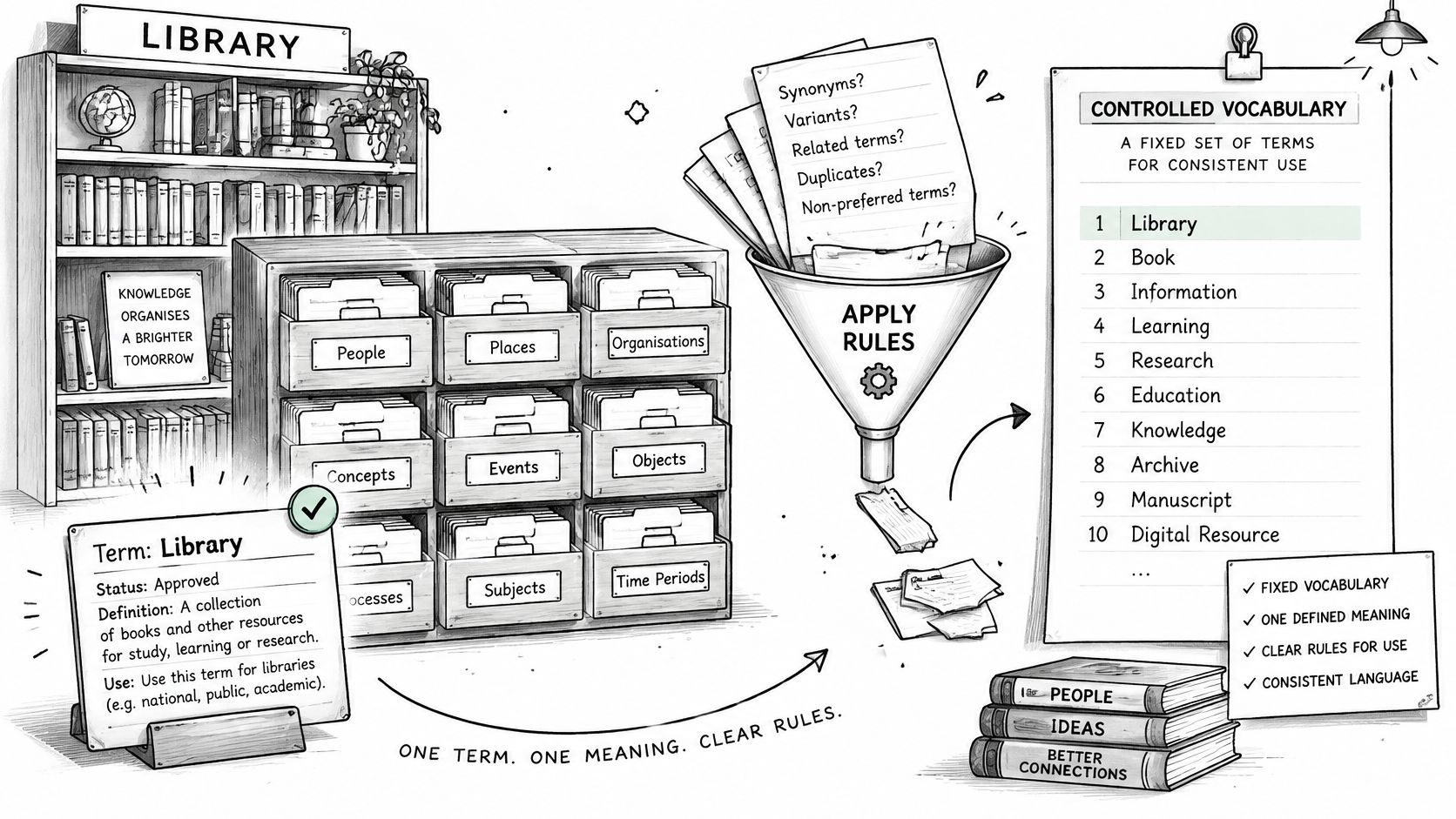
A controlled vocabulary is a defined list of approved terms with clear meanings and rules for use. The list stays stable during an approved release, and its owner revises it through a controlled process as products, standards, and usage change. A term base is a working tool, so an owner has to keep it current.
A library catalogue works the same way. A catalogue assigns a preferred subject heading to each topic. Alternative search words point readers toward that heading, so related records stay together instead of splitting across unrelated labels. When a new subject appears, a cataloguer records the decision and updates the affected records.
Technical documentation needs the same kind of control. Writers might use shutoff valve, stop valve, and cut-off valve for the same component. Without a recorded decision, readers can't know whether those differences matter. Once a team approves one term and logs it, every new manual follows that choice.
Core terms in a controlled vocabulary
| Term type | Meaning | Example |
|---|---|---|
| Preferred term | The one approved name for a concept | shutoff valve |
| Synonym | Another word for the same concept, not approved for use | stop valve |
| Homonym | One word with two or more unrelated meanings | seal, a gasket or to close |
| Scope note | A short statement that defines the intended use of a term | Use for the valve that stops fluid flow in a line |
| Non-preferred term | A variant that writers must replace with the preferred term | cut-off valve |
These examples describe a local terminology decision, not a universal engineering classification. A team must confirm that alternative names identify the same concept before treating them as synonyms.
The seal example also shows a practical ambiguity between a component name and an action. Recording the meaning and grammatical use prevents a reviewer from approving the word without checking its function.
From catalogues to technical information
Modern institutional practice developed from information-retrieval thesauri during the 1960s, according to NISO's history of vocabulary standards. ISO 2788 appeared in 1974, followed by multilingual ISO 5964 in 1985, and ISO 25964 Part 1 replaced both in 2011, as described in NISO's account of international thesaurus standards.
That sequence matters for documentation teams. Standards bodies keep revising vocabulary specifications, and a term base needs the same treatment. Product names change, parts get renamed, and each change has to move through the same controlled process.
A controlled vocabulary governs how writers name things. Engineers still decide what those things do, and precise product names remain necessary even when they don't resemble everyday words.
The aim is consistent meaning across readers and systems. Writers, translators, and search administrators should recognize the same concept, regardless of the alternative wording they first encounter.
Controlled Vocabulary Versus Controlled Language
A controlled vocabulary controls words. A controlled language controls words and sentence construction.
This distinction matters when a team chooses how to improve documentation. A terminology database can correct inconsistent component names. It can't, by itself, separate several actions hidden inside a complex sentence.
| Aspect | Controlled vocabulary | Controlled language |
|---|---|---|
| Scope | Word list and term meanings | Words, grammar, sentence structure and style |
| Typical output | Consistent names for concepts | Consistent names plus consistent sentence form |
| Compliance check | Term lookup against the approved list | Term checks plus rule-based sentence review |
| Works alone | Yes, for term consistency | Requires a vocabulary as one of its parts |
| Example | A company term base for product names | ASD-STE100, with writing rules and a dictionary |
Why terminology checks aren't enough
Consider this illustrative draft:
Before: Following removal of the cover, inspection of the filter and replacement if necessary should be performed.
Every component name could match an approved term base. The sentence still hides the actions inside nouns and leaves the replacement condition unclear.
A sentence-level revision could read:
After: Remove the cover. Inspect the filter. Replace the filter if it is damaged.
The example assumes that damage is the correct replacement condition. An engineer must confirm that condition before release. Language revision must never introduce an unsupported technical requirement.
A vocabulary check examines the names and permitted word uses. A controlled-language review also examines how the writer expresses actions, conditions, and relationships.
Choosing the appropriate level of control
A style guide may recommend clear wording or consistent tone. A controlled language sets defined restrictions that reviewers can apply systematically. The distinction concerns the precision of the controls, not whether a style guide can contain mandatory requirements.
A company can maintain product terminology without adopting a complete controlled language. For example, a software team might govern interface labels, feature names, and error names while allowing varied sentence structures.
A controlled language needs vocabulary controls because grammar alone can't resolve uncertain meanings. A short sentence can still contain an ambiguous verb or an incorrect component name.
The controlled language overview explains this broader approach to writing constraints.
Use vocabulary control for inconsistent terminology. Add controlled-language rules when complex sentences also prevent reliable understanding, especially across language boundaries. Teams should select controls against identifiable documentation problems, rather than introduce restrictions without a clear purpose.
Clarity and Localization Benefits in Practice
A maintenance instruction names several items, but the drawing shows a single pump. The reader must decide whether the instruction lists separate components or alternative names.
Before: Inspect the hydraulic pump, the pressure unit and the pump assembly.
After: Inspect the hydraulic pump.
This revision works only if engineering confirms that all the names refer to the same inspection target. If they identify separate assemblies, deleting them would remove technical content.
One preferred name removes doubt about identity. The action becomes easier to locate because the reader doesn't need to resolve the terminology first.
Precision matters in warnings
A warning can use ordinary words and still fail to identify the hazard.
Before: Do not touch the unit when it is hot.
After: Do not touch the brake disc when it is hot.
The revised warning identifies the component that the reader must avoid. It doesn't replace a precise name with a shorter but less useful label.
The wording still requires technical review. The writer must verify that the brake disc is the intended hazard and that the warning belongs at that location.
ASD's official STE website explains that ASD-STE100 originated in aircraft maintenance documentation, with controlled general words and stable meanings.
What translators need from the term base
Translators need more than a source term and an unexplained target equivalent. They also need the definition, product context, and any restriction on use.
Consistent source terminology gives translation memories a better basis for matching repeated text. It also helps reviewers distinguish an intentional terminology change from an accidental variation.
A useful localization workflow includes these controls:
- Confirm the concept: Link each translated term to the same component or action definition.
- Record approved equivalents: Keep accepted target-language terms with the source entry.
- Explain restrictions: Identify product variants or contexts where an equivalent must not appear.
- Report uncertainty: Route terminology questions to a named technical owner.
The guidance on writing for translation supports this work before documents reach the translator. A free STE checker can flag possible variant terms during draft review.
STE Guide creates its own examples. The site doesn't copy the official specification's rules or dictionary.
For documentation managers, consistent application can reduce clarifying questions and translation queries. The benefit comes from resolving terminology decisions before each reader must resolve them independently.
How STE Applies a Controlled Vocabulary
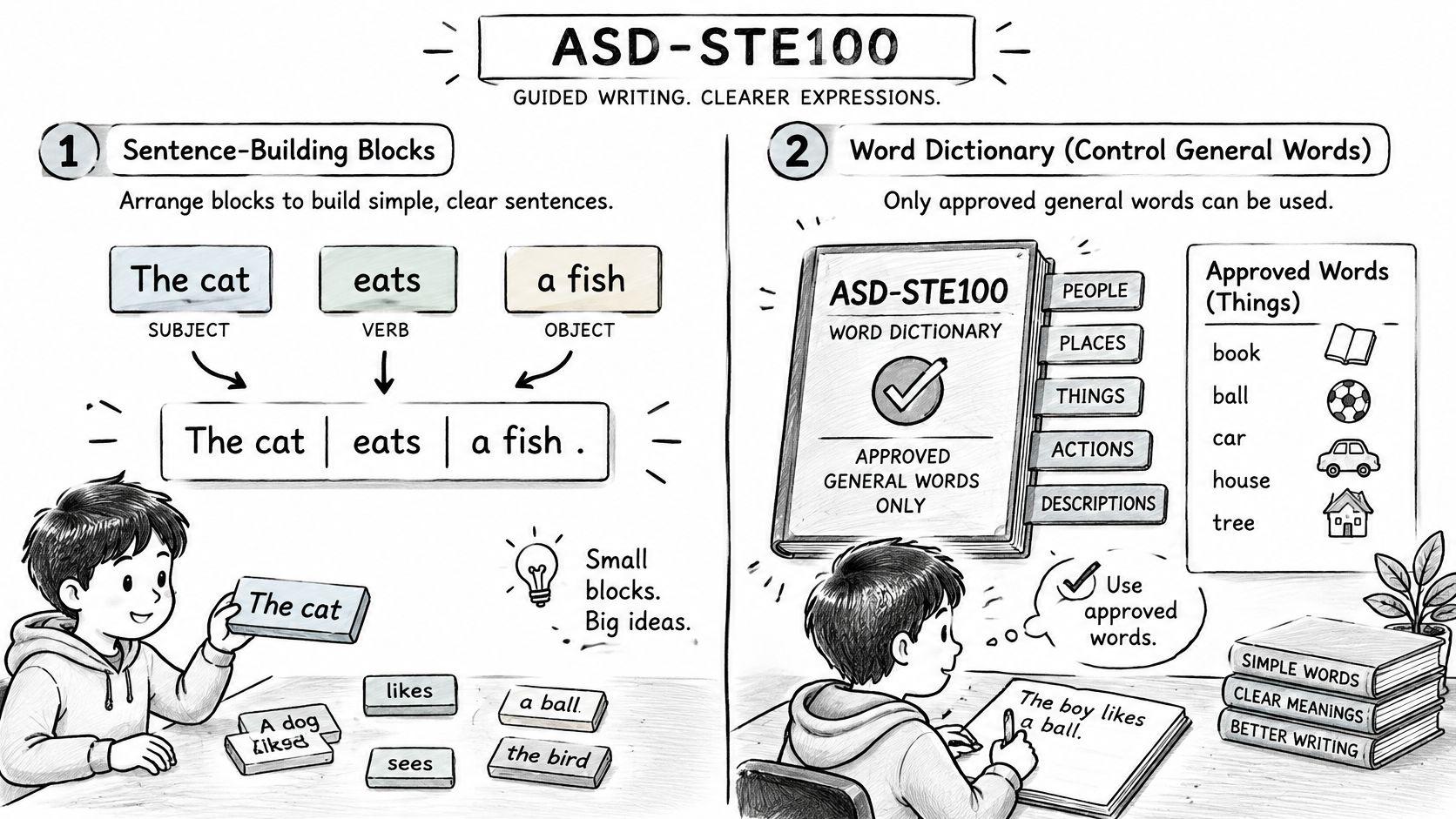
ASD-STE100 combines writing controls with vocabulary controls. Its dictionary isn't a complete inventory of the technical terms that an organization may need.
The official Issue 9 specification contains writing rules in Part 1 and a dictionary in Part 2, with approximately 900 approved general words. It also provides controls for technical nouns and technical verbs.
A shared toolbox provides a useful analogy. General tools have labelled storage spaces with defined purposes. Product-specific tools remain available, but someone must identify and manage them separately.
Meaning and grammatical use
An approved general word normally has one defined meaning and one permitted part of speech. Approval therefore concerns a particular use, not every possible use of that spelling.
A writer can't assume that an approved noun is also acceptable as a verb. Likewise, a familiar everyday meaning doesn't automatically qualify as an approved technical meaning.
This requires a more careful review than a simple spelling search. Reviewers must inspect the word in its sentence and compare its actual function with the permitted use.
The writing rules explanation provides context for sentence construction. The dictionary overview explains how vocabulary restrictions guide word selection.
Where product terminology belongs
Organizations may use technical nouns and technical verbs for their products or industries, subject to the standard's controls. They shouldn't replace precise engineering terminology with vague words merely because those words seem simpler.
A practical implementation separates these resources:
- General controlled vocabulary: The approved general words and their permitted uses.
- Product terminology database: Component names, specialist actions, definitions, and approval decisions.
- Authoring configuration: Checks that apply the relevant vocabulary to the correct document set.
Review principle: Approval of a spelling isn't approval of every meaning that spelling can express.
A local product entry should identify its technical basis. A component name might match a drawing, while an action term might require an engineering definition.
Keeping these resources separate also clarifies ownership. A local terminology owner can manage product names but cannot redefine the official general dictionary.
The official specification contains the exact rules. This independent educational site explains their application and does not replace the specification or provide official certification.
How to Build and Start a Term Base Aligned With STE
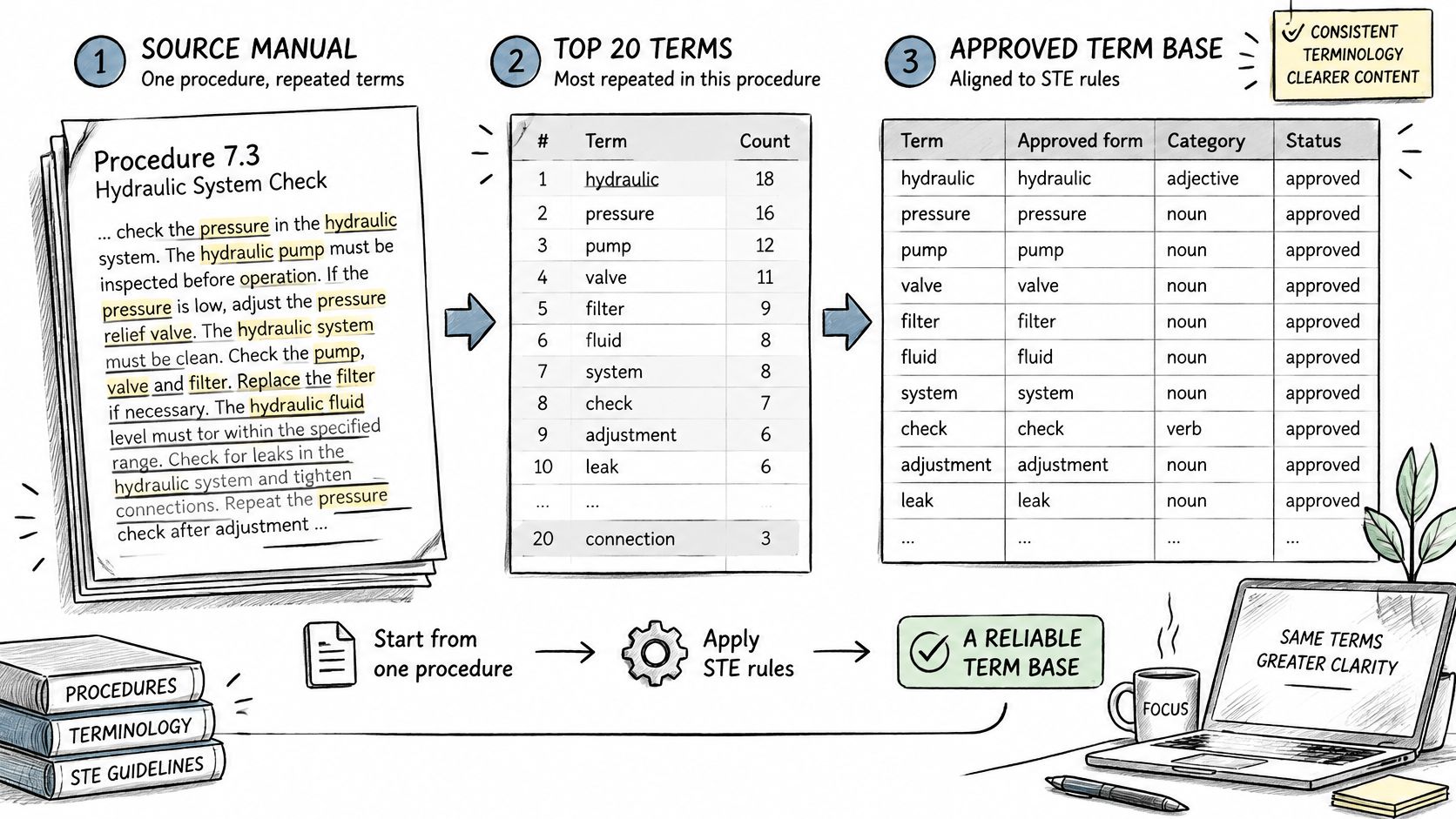
A pilot should begin with a real document, not an empty database design. A maintenance procedure gives reviewers concrete sentences, component names, and decisions to examine.
The first term base can use a spreadsheet or a terminology database. The essential controls are clear fields, named reviewers, and an approval process.
A practical pilot sequence
Choose a bounded sample. Select one manual or procedure and list its twenty most repeated technical terms. Include component names, actions, and warning words. Repeated terms affect many instructions, so early decisions have broad application.
Separate general words from product or domain terms. Their approval routes differ. A product specialist can confirm a component name but cannot approve a new general dictionary meaning.
Define each entry. Record one intended meaning and one part of speech. A definition should distinguish the concept from nearby concepts, not merely repeat the term.
Assign an explicit status: approved, non-preferred, or prohibited. Give each non-preferred variant a preferred replacement. Explain why a prohibited term creates an unacceptable interpretation.
Check the current dictionary. Compare every general word with the current Issue 9 dictionary, rather than an inherited local list. The STE dictionary guide explains the lookup approach.
Load approved terminology into the authoring tool. Where configuration permits, block unreviewed synonyms or flag them for review. Keep proposed terms separate from released entries.
Test a small rewrite. Run three rewritten sentences from the pilot through the free STE checker. Treat each result as a heuristic flag, not a conformity result. A reviewer must still confirm terminology, meaning, and technical accuracy.
A completed local term record
| Field | Approved entry | Variant entry |
|---|---|---|
| Term | shutoff valve | cut-off valve |
| Definition | Device that stops fluid flow in a line | Same concept as the approved entry |
| Part of speech | Noun | Noun |
| Status | Approved | Non-preferred |
| Replacement | No replacement required | shutoff valve |
These are illustrative local records, not official dictionary entries. Engineering must confirm their suitability for the product.
The official PDF access guide directs readers to the specification containing the exact rules. Original before-and-after examples provide additional practice material.
STE Guide is a free, independent educational website for technical writers, engineers, translators, and students. Its ASD STE 100 skill page offers a learning path, exercises, and an AI prompt template.
After the pilot, reviewers should examine disputed entries and rejected suggestions. The first batch reveals which terms need stronger definitions or tighter controls.
The documentation manager should select the pilot manual, assign its terminology owner, and schedule the post-pilot review before wider use.
Maintaining Your Term Base as Terms Change
Standard revisions can affect vocabulary decisions even when the overall framework remains familiar. Local lists therefore need traceable references, not an unsupported label stating that they follow STE.
The ASD Issue 9 announcement reports revised wording for 31 of 53 existing writing rules and 555 updated dictionary entries. Those changes make a release comparison necessary when a team updates its authoring baseline.
A documentation team should record the standard issue used during both authoring and review. An older local entry may require reassessment of its meaning, example, or classification.
Term record fields for maintenance
| Field | Purpose | Example |
|---|---|---|
| Preferred term | The approved name used in all new text | shutoff valve |
| Definition | Fixes one meaning for the term | Device that stops fluid flow in a line |
| Part of speech | Records the permitted grammatical use | Noun |
| Status | Shows approved, deprecated or prohibited | Deprecated |
| Issue reference | Shows which standard issue the entry was checked against | Issue 9 |
| Replacement | Names the term that replaces a deprecated one | shutoff valve |
| Owner and review date | Shows who maintains the entry and when it was last checked | Documentation lead; actual approval date recorded at review |
The table shows field examples, not a single internally consistent entry. In a deprecated variant record, the preferred-term and replacement fields can both identify shutoff valve.
Who approves a change
A writer, engineer, or translator should be able to propose a terminology change. The proposal should include a definition, product context, supporting technical reference, and affected documents.
A technical owner confirms the concept. A terminology owner checks naming consistency, grammatical classification, and conflicts with existing entries. Translation reviewers assess approved equivalents when the change affects localized content.
Acceptance criteria should answer concrete questions:
- Distinct meaning: Does the proposal identify a different component, action, or condition?
- Technical authority: Does its name agree with approved product information?
- Existing coverage: Can an established term express the concept accurately?
- Migration impact: Which documents, search labels, and translation records need changes?
Retiring terms without losing context
A new concept needs a new entry when its meaning differs from an existing concept. Reusing an established term would make older documents misleading.
A renamed concept needs a different treatment. Retain the old label as deprecated, record its replacement, and explain which releases require migration.
A deprecated label should remain traceable until affected documents and dependent systems no longer require it.
A controlled replacement must include contextual review. Automatic replacement can alter historical product names or change instructions for earlier configurations.
Stable core terms usually need less frequent local attention than changing product terminology. Review domain terms at product changes and documentation releases, with additional checks after relevant standard or regulatory changes.
Strict control without maintenance invites workarounds. When writers can't obtain necessary terms through the approved process, they may create unofficial vocabulary outside it.
Common Mistakes and How to Fix Them
An outdated list can be more damaging than an incomplete list that clearly identifies unresolved entries. Writers may trust obsolete approvals without checking their technical context.
Errors that weaken terminology control
Treating the list as permanent. Before: an entry still names a retired assembly. After: the entry identifies the applicable product version and replacement. Fix: Review terminology when approved product information changes.
Letting local lists drift. Before: a draft relies on an entry with no issue reference. After: the reviewer records the checked issue and review outcome. Fix: Require a traceable baseline before releasing a terminology update.
Replacing precision with ordinary wording. Before: Remove the brake disc. Poor simplification: Remove the part. After: Remove the brake disc. Fix: Retain the exact component name when it identifies the required target.
Accepting copied synonyms. Before: Close the cut-off valve. After: Close the shutoff valve. Fix: Review pasted text and new authors' drafts against the approved project terminology.
Approving undefined words. Before: unit, approved, with no definition. After: hydraulic pump, approved, with a product-specific definition. Fix: Require a meaning that distinguishes the entry from related components.
Consistent words don't guarantee reliable retrieval
Vocabulary control alone doesn't make documentation machine-ready. A document can contain approved terms while using inconsistent headings, missing identifiers, or unclear revision metadata.
The machine-readable documentation guidance published by CableLabs treats consistent terminology, predictable naming, and metadata placement as connected requirements.
Teams should therefore test whether retrieval returns the correct procedure and product revision. An AI-generated answer may preserve a preferred term while combining instructions from incompatible contexts.
Term control supports retrieval and automation, not only human reading. Reliable use also requires stable identifiers, clear document boundaries, consistent metadata, and human review of technically significant answers.
STE Guide offers independent explanations, original rewrite examples, and a free heuristic checker for terminology review. Technical teams can visit STE Guide to select a practice example and begin a term-base pilot with a current procedure.