Career pages often give the same advice. Get a technical writing certification, then expect better jobs. That advice skips the questions that decide value. What does the program assess? Is the program still offered? Does a reviewer judge real writing, or does the record only show that a course ended?
A long program name does not prove job readiness. Years of history do not prove that exams still run. Technical writers, engineers, documentation managers and translators should judge each credential by its evidence.
The comparison below uses that test. It covers assessed professional levels, ASD-STE100 training routes and university certificates. This site is an independent guide to Simplified Technical English. It isn't ASD, and it doesn't award official certificates.
Table of Contents
- Technical Writing Certification Options at a Glance
- Whether Certification Matters for Technical Writers
- How Certification Programs Differ in Scope and Assessment
- ASD-STE100 Training Certificates and What They Prove
- Choosing a Certification by Career Goal
- How to Verify a Credential Before You Enroll
- Choose Your Next Certification Step
Technical Writing Certification Options at a Glance
Five pathways can be set side by side. Each row names the issuer, the assessment and the reader who fits it best.
One familiar option is absent on purpose. Freelance Atlas reports that the Society for Technical Communication announced in January 2025 that it was dissolving and ending certification courses and exams. Some career guides still present those credentials as open choices. A dissolved exam isn't a current pathway, so it isn't in this table.
| Pathway | Issuer | What Is Assessed | Best Fit |
|---|---|---|---|
| tekom Professional Level | tekom | Foundational competence in law and standards, professional writing and information creation | Writers who are building core skills |
| tekom Expert Level | tekom | An information product, a reflection on how it was created, technical questions and an oral discussion | Experienced writers who want a higher-level credential |
| ASD-STE100 writer, reviewer and proofreader training | STEMG members and approved partners | A certified training course for people who write, review or proofread in STE. Public pages don't state one shared exam format. | Writers, reviewers and proofreaders who use STE |
| ASD-STE100 trainer certification | UNINETTUNO University | Authorization to certify other STE trainers. Only this university certifies trainers on behalf of ASD. | Prospective STE trainers |
| University technical writing certificate | Universities such as Oregon State and the University of Arkansas | Course outcomes such as manuals, procedures, technical editing and visual aids. No named controlled language is tested. | Learners who need documentation foundations |
How to read the rows
Match each row to the current role. Ignore how impressive the certificate title sounds.
Check the work sample. Ask whether the assessment uses the candidate's own document.
Check the language standard. A university certificate can cover manuals, procedures, technical editing and visual aids. It doesn't test a named controlled language such as ASD-STE100.
Check the role on the record. Training for writers isn't the same result as authorization to certify trainers.
Practical rule: If the certificate doesn't name the assessed work, treat it as course completion until the issuer shows a reviewed sample.
After the role match, the next question is whether any credential is required for the job at all.
Whether Certification Matters for Technical Writers
A credential can strengthen an application, but it cannot replace writing ability, subject knowledge or a portfolio. Certification is generally optional for technical writers. The U.S. Bureau of Labor Statistics says professional associations offer certifications, but employers do not generally require them. It also describes certification as evidence of competence and professionalism that may support advancement.
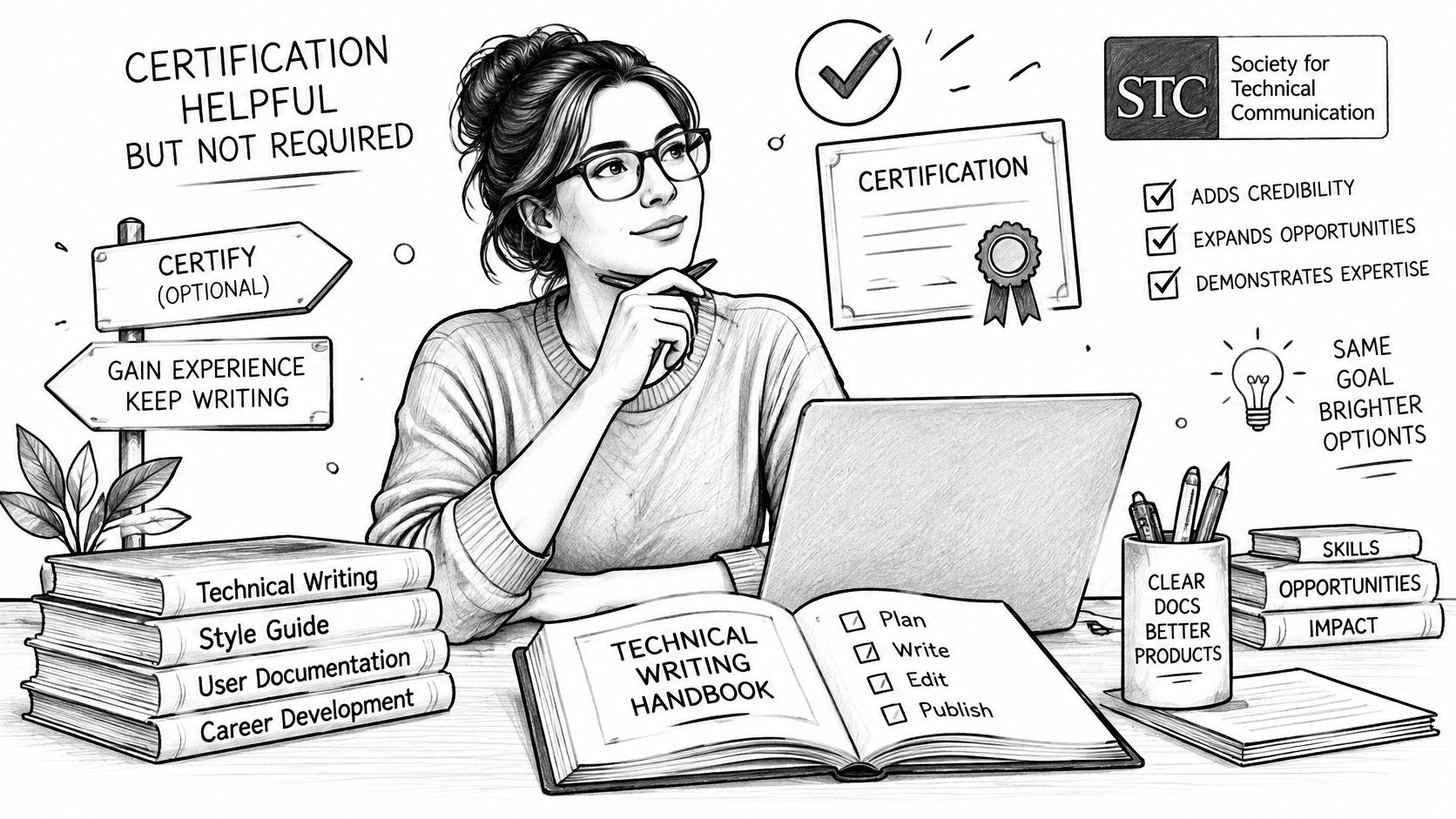
The BLS projects approximately 3,200 technical-writer openings per year, on average, from 2025 through 2035, and about 1% employment growth over that period, according to its occupational profile. Most openings are projected to come from workers leaving the occupation or changing jobs rather than rapid employment growth. A credential may help employers compare candidates with different backgrounds, but it does not create demand for a role.
Where the signal carries weight
Consider an engineer applying to a regulated aerospace documentation team with a mechanical degree and one writing sample. In regulated, safety-critical, multilingual or complex product documentation, a recognized credential can support credibility. The sample still needs to demonstrate the candidate's work.
Before paying for a program, examine three practical signals: whether target employers name the credential in current job postings, whether similar roles in the industry mention it, and whether the program assesses writing rather than attendance. If employers do not ask for the credential and the program does not assess written work, reviewed procedures may provide stronger evidence of the candidate's ability.
How Certification Programs Differ in Scope and Assessment
A credential's title reveals little about what it assesses. Compare the work candidates submit, the criteria applied and the decisions they must explain.
The tekom certification model distinguishes two levels of assessment. Professional Level evaluates foundational competence, including knowledge of law and standards, professional writing and the information-creation process. Expert Level adds a submitted information product, a reflection on how it was created, technical questions and an oral defence of the work.
The experience requirements are entry conditions, separate from the assessment itself. According to tekom's certification requirements, Expert Level candidates generally need a qualification consultation and at least two years of professional experience, or an accredited preparation route. Candidates progressing from Professional Level may qualify with one year of experience after certification and consultation. These thresholds indicate when someone may apply; they do not show how well that person writes.
Scope varies by program
University certificates can cover broad areas of technical communication, with different emphases. Oregon State's certificate covers manuals and instructions, usability and UX design, and technical editing of SOPs and flowcharts. The University of Arkansas lists outcomes including research, audience identification, organization, collaborative writing, ethics, revision, web writing, instructions, procedures, reports and visual aids.
These outcomes show breadth, not a single standardized assessment. A general certificate may build writing foundations without demonstrating conformity with ASD-STE100 or competence in a particular company's review process.
Five dimensions to compare
Use the same evidence-based questions across programs. A syllabus can describe coverage, but assessed work shows what candidates must do.
| Dimension | What to Check | Evidence to Request |
|---|---|---|
| Controlled language and terminology | Use of an approved vocabulary and one meaning per term | A reviewed sample showing terminology choices |
| Procedural accuracy and risk communication | Clear steps, correct order and visible warnings | An assessed procedure or safety notice |
| Editing and quality assurance | The review method and revision process | A marked-up draft with revision notes |
| Usability and accessibility validation | Reader testing and accessibility checks | A test report or accessibility rationale |
| Tool and workflow competence | Authoring, version control and publishing practice | A working file or workflow description |
A program that requires candidates to produce and explain a document provides evidence of applied performance. Without that assessment, its certificate supports a narrower conclusion: the candidate completed instruction in the listed subject areas.
ASD-STE100 Training Certificates and What They Prove
ASD-STE100 training certificates cover different roles, so assess each by the work it prepares someone to do and the performance it evaluates. The official ASD training page describes two routes.
Writer, reviewer and proofreader training is available through STEMG members and approved partners. It prepares people to apply the standard when writing or reviewing documents, making it relevant to maintenance writers and STE reviewers.
Trainer certification is a separate route. UNINETTUNO University can provide certified training for prospective trainers and is the only organization authorized to certify trainers on behalf of ASD. A certificate for applying STE therefore does not establish qualification to train or certify other trainers.
A course record is more informative when it identifies the role covered and shows whether the participant's work was assessed. Attendance records course completion; reviewed writing provides evidence of applied performance. Candidates can use these distinctions to judge what a certificate demonstrates without repeating a provider-by-provider verification process.
For a plain-language introduction, see the guide to Simplified Technical English and its purpose. The official specification remains the reference for STE rules.
Choosing a Certification by Career Goal
The fitting pathway follows the documents a person must produce. A general ranking of certificates doesn't make that match.
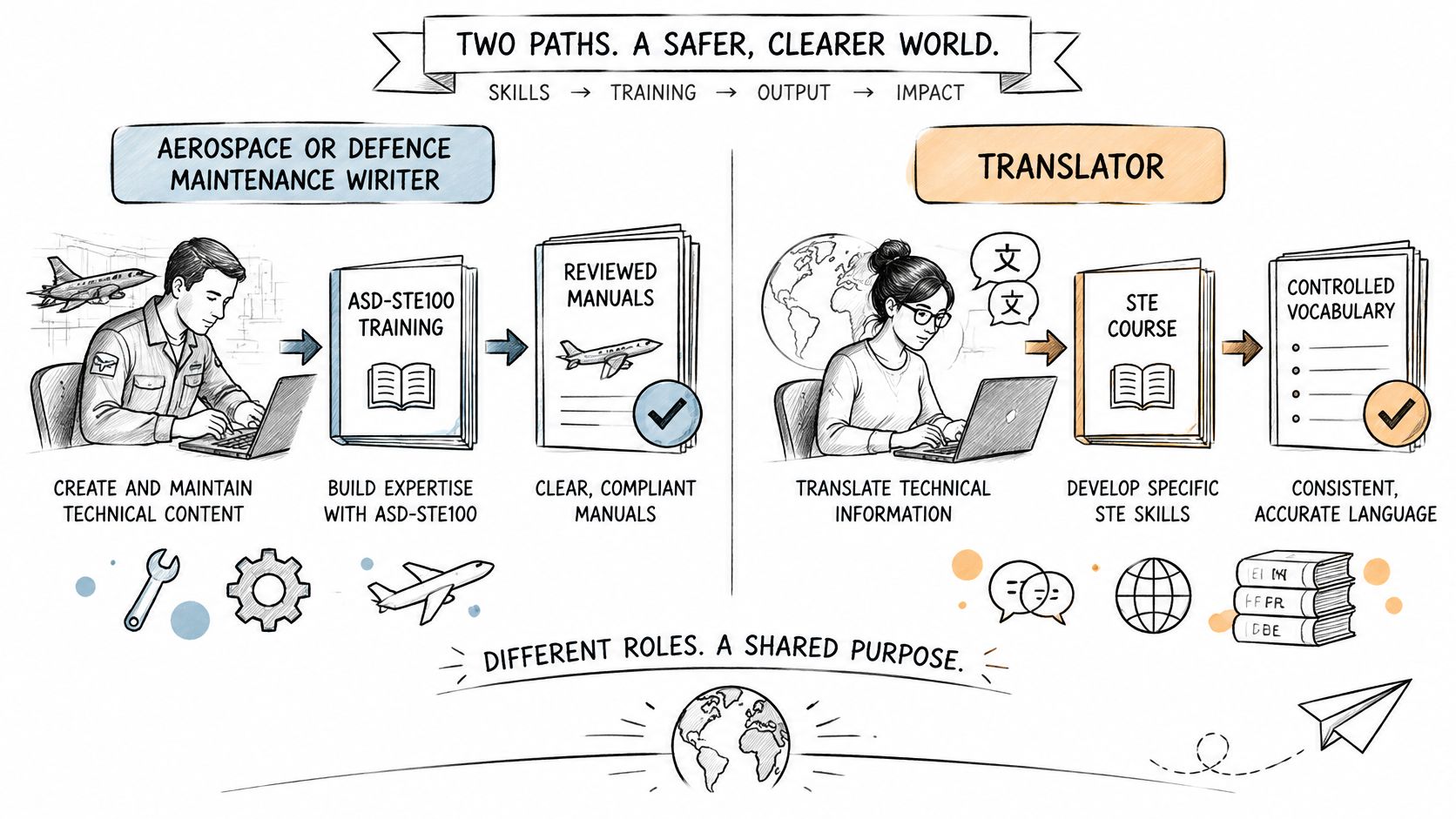
Aerospace or defence maintenance writers should pair ASD-STE100 training with reviewed manuals. The manuals are the evidence. They show that steps, warnings and terms survive a real review, not only a classroom exercise.
Translators usually gain more from an STE course than from a broad writing certificate. A controlled vocabulary cuts ambiguous terms before translation starts. Technical writing courses serve a different aim when the target is controlled language rather than open prose. The translator still needs the source text to obey one meaning per word.
Documentation managers need an assessed professional credential that covers planning, review and quality. The trainer route fits only when the job includes teaching other writers. A manager who only approves manuals doesn't need authority to certify trainers.
Engineers who write procedures can start with a short STE course and a small set of procedures from their own equipment. The portfolio carries the proof. A long course list without those pages doesn't.
Early-career writers can use a university certificate for foundations in manuals, editing and visuals. An assessed credential can wait until they have a document they can defend. Course completion is a start, not a senior signal.
What an STE course should change
The ASD-STE100 Issue 9 document combines a controlled vocabulary of approved words with a set of writing rules. Check the official text for the exact counts. The vocabulary controls word choice. The rules control sentence construction and how information is presented. "Simple English" is too vague for that scale. Readable English can still fail the standard. The text may use an unapproved technical sense, give one word several meanings, or join several actions in one sentence.
Before:
Check the panel and replace the damaged seal before continuing.
After:
Check the panel. Replace the damaged seal before you continue.
The first sentence contains two actions. The second version gives each action its own sentence. That is the kind of change an STE course should teach and then review in the writer's own procedure. Exact rule wording and dictionary entries must be checked in the official specification. A paraphrase can't establish formal compliance.
If the employer requires STE, prioritize STE training. If the work is general documentation, prioritize an assessed professional credential.
How to Verify a Credential Before You Enroll
Credential names can stay the same while their content changes. Verify the current edition, assessment and status before deciding whether a program fits the work you want to do.
Check the edition, not only the name
The official ASD-STE100 FAQ states that Issue 9 was released on January 15, 2025. It changed the status from a specification to an international standard and harmonized terminology with ISO standards. The ASD Simplified Technical English Maintenance Group, STEMG, maintains the standard. The official format is PDF, and the standard is free of charge. For the typical interval between issues, consult the ASD-STE100 FAQ.
Training material should identify the edition it uses. An unspecified “STE certification” label does not establish which issue, course category or certification route the program covers. Use the official Issue 9 document for exact requirements, and consult the Issue 9 overview for a short introduction.
Verify the credential before paying
Check these records together. Each answers a different question about whether the credential is current and relevant:
| Check | Evidence to look for |
|---|---|
| Issuer and status | The issuing body still exists, and the program is active. |
| Assessment | The format is stated, and exams or reviews are currently offered. |
| Renewal | The terms explain whether the credential expires and how it remains valid. |
| Badge validation | The issuer explains how a third party can verify a digital badge. |
| Recognition and refunds | Geographic recognition and refund terms are available in writing. |
| Current relevance | Recent job postings for the target role mention the credential. |
Refund terms matter because some providers treat a started module as a completed sale. A current syllabus should also reflect the tasks required by the role, such as version control, accessibility, localization or AI-assisted drafting. Use the syllabus and recent postings to judge relevance, rather than relying on an older guide's praise.
Choose Your Next Certification Step
A certificate matters only to the extent that its assessment matches the work you want to do. Choose one pathway based on the target role, then test whether it builds a skill that role requires.
Before enrolling, use the verification questions in the preceding section to assess the credential. Then compare a short procedure you wrote before training with one you write afterward. Keep both drafts to see what changed.
STE Guide is a free, independent educational website about ASD-STE100, with free tools and examples for technical writers, engineers, translators and students. The STE Checker checks your own text for common STE problems. It is heuristic, not an official conformity check, and can miss problems or flag correct text.
STE Guide also provides explanations, worked examples and a learning path. Its official Issue 9 PDF page directs readers to the specification, which takes precedence if an explanation differs.
Use the checker to spot possible issues in a draft, not to judge whether a credential is worthwhile. The stronger test is what the program assesses and whether that assessment reflects the writing tasks you need to perform.