A mechanic reads an instruction to check the connector after removing the panel and bracket. Must both parts come off before inspection? The writer intended a sequence, but the mechanic must infer it. A controlled style of documentation makes that sequence explicit.
Table of Contents
- Documentation Styles and What They Control
- Voice Length and One Action per Sentence
- How to Set a Documentation Style Guide
- Before and After Style Rewrites
- A Review Checklist for Documentation Style
- Limits of a Documentation Style
- Check One Draft Against the Official Rules
Documentation Styles and What They Control
Documentation styles compared
| Style | What it controls | How strict | Typical use |
|---|---|---|---|
| House style guide | Tone, terms, and layout | Advice that writers can interpret | Company manuals and help |
| Plain English | Short words and clear sentences | Guidance without one fixed vocabulary | Public and general technical text |
| ASD-STE100 | Writing rules and a controlled dictionary | Defined words, meanings, and grammar | Safety-critical and translated procedures |
| Procedure style | Task order, step boundaries, and warnings | Strong on sequence, weak if words stay free | Maintenance and operating steps |
| Reference style | Names, values, limits, and versions | Strong on data, weak if prose stays loose | Specifications and software references |
A documentation style consists of repeated choices that help different writers produce similar text. Those choices include vocabulary, grammar, sentence structure, and layout. They also include how writers separate actions from descriptions.
These styles aren't mutually exclusive. A maintenance manual can use company layout, controlled language, and a defined procedure format. Each controls a different source of inconsistency.
A house guide might prefer direct language without defining what direct means. Plain English encourages understandable sentences without assigning a fixed meaning to every word. A controlled language restricts the choices themselves.
Choose controls by document risk
The document manager should select controls according to the consequences of misunderstanding. A general introduction can allow more expression than an instruction involving stored energy. Reference material still needs exact names, values, and applicable versions.
Procedure formatting alone isn't enough. A numbered list can preserve the wrong sequence or contain ambiguous verbs. Controlled vocabulary alone also isn't enough if the writer omits a necessary condition.
The distinction between language and document requirements matters when selecting technical documentation standards. A team should identify what each standard controls before treating it as a complete quality system.
Practical rule: Select the controls that prevent the document's likely failures, not merely the controls that improve its appearance.
Why aviation required a shared system
Aircraft maintenance information had to support consistent understanding across countries and language backgrounds. Individual writing preferences couldn't provide that consistency.
The ASD-STE100 historical FAQ traces investigation to 1979 and the working group's establishment to 30 June 1983. It records the first formal publication in 1986. The approach later extended into defense, rail, automotive, energy, medical devices, and software.
That history explains why documentation style became an engineered communication system. Writers could control vocabulary and sentence construction instead of relying on a general request for clarity.
Translators benefit when an approved word retains a defined meaning. They don't have to decide whether a writer intended a new meaning or merely preferred another expression.
This page provides an independent explanation, not an ASD publication. Its examples teach sentence choices without replacing the authoritative specification.
Voice Length and One Action per Sentence
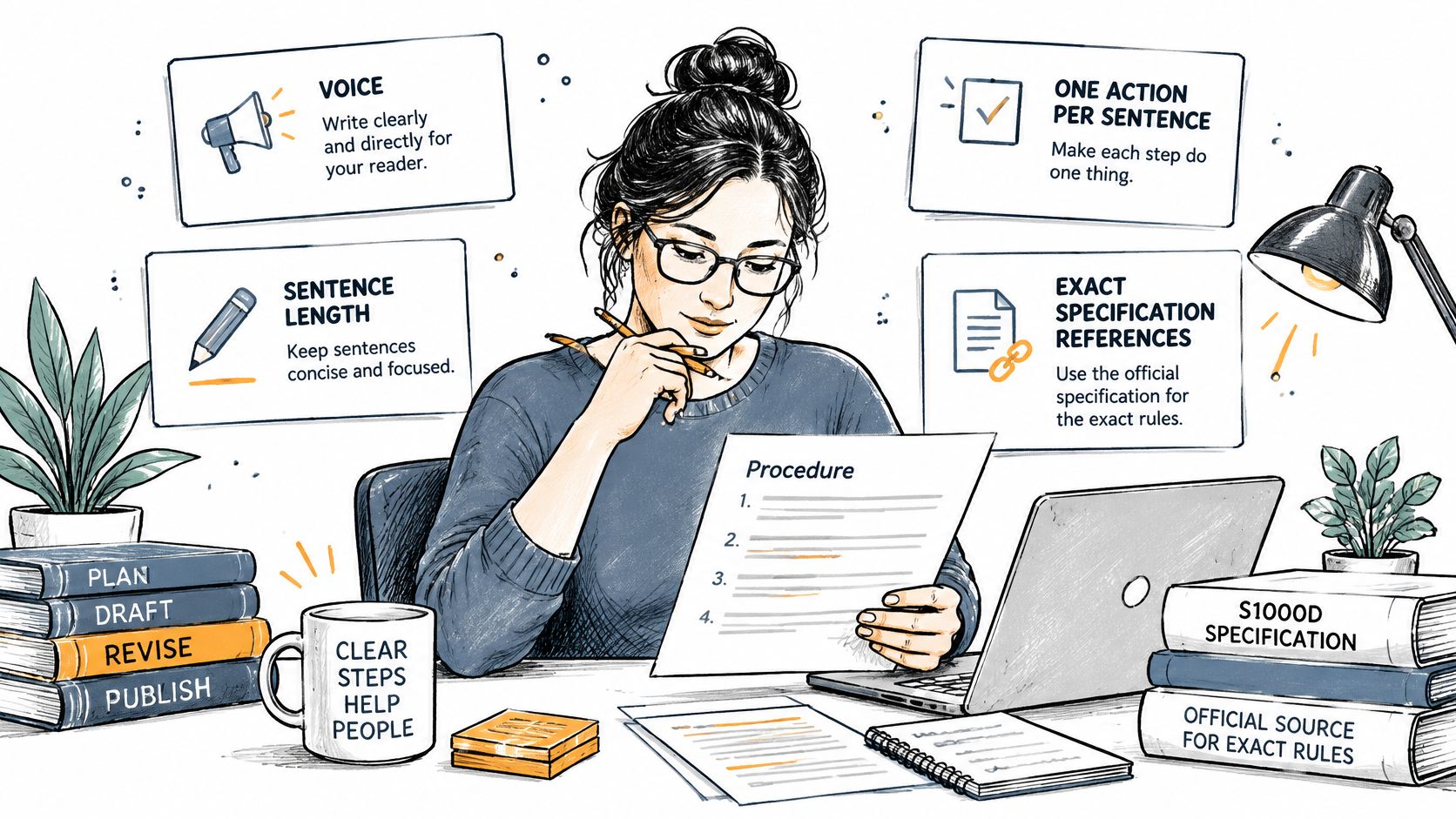
The first sentence control concerns who acts. Active voice identifies the technician, system, or tool that performs an action. Passive wording can leave that responsibility unclear.
An instruction can use the imperative because the procedure identifies its intended reader. A description should name the system or component when that actor matters. The writer shouldn't invent an actor merely to avoid a passive construction.
Next, the writer selects a simple verb form. Unnecessary auxiliary verbs make an action harder to locate. Each sentence should express a clear instruction or fact.
Separate instructions from descriptions
ASD-STE100 Issue 9, dated January 2025, limits instructional sentences to 20 words and descriptive sentences to 25 words. These are specific controlled-language limits, not general Plain English recommendations.
Sentence choices by text type
| Text type | Maximum length | Voice | Job of one sentence |
|---|---|---|---|
| Instruction | 20 words | Active | One action the reader performs |
| Description | 25 words | Active where the actor is known | One fact about a part, state, or result |
| Warning or caution | Apply the official Issue 9 safety-instruction rules | Active | One hazard and the required action |
| Procedure | Sequence of short instructions | Active | Ordered steps, not one long paragraph |
The writer must retain all necessary sentence parts. Removing articles or other required words isn't a valid way to shorten text. Contractions also shouldn't serve as a way around the limit.
The educational writing rules summary explains these controls in plain language. If that summary and the official text differ, the official text takes precedence.
A writer can check sentence structure while reviewing the actual procedure.
Preserve the sequence and its conditions
A long sentence can contain several actions even when its meaning seems familiar to an experienced engineer. The reader must separate those actions mentally.
Before
After removing the panel, inspect the connector and, if damage is found, report it before continuing.
After
- Access: Remove the panel.
- Inspection: Inspect the connector.
- Condition: If you find damage, report it.
The rewrite makes the action sequence visible. However, the original also controls when work may continue. The writer must retain that restriction wherever the procedure defines continuation.
A shorter sentence isn't an improvement if the writer removes a necessary condition.
One instruction per sentence also requires attention to step boundaries. A procedure should present actions in their required order. Conditions should appear before the actions they control, while warnings need distinct treatment.
A description explains a component, state, or result. It shouldn't contain a command that the reader might overlook as background information. The writer should classify the text before counting its words.
How to Set a Documentation Style Guide
A documentation manager can begin with the documents already under review. A useful guide resolves actual writing decisions instead of collecting broad advice. Its scope should remain small enough for writers to apply consistently.
Define the working decisions
Name the document types. Identify procedures, warnings, descriptions, and software references. Specify which parts of each document the guide covers.
Identify the readers. Include technicians, engineers, and translators. Record whether readers use English as an additional language and what technical knowledge the procedure assumes.
Select the base approach. Choose house style, Plain English, or ASD-STE100 according to the document's requirements. Safety-critical text requires more than a preference for short sentences.
Record sentence decisions. Describe voice, sentence length, and instruction boundaries in the team's own words. The guide can direct writers to the educational writing rules overview.
Build a project lexicon. Separate project-specific technical names from general vocabulary. The official STE overview describes approximately 900 approved general words and approximately 1,200 non-approved words with alternatives. Each approved general word has a defined meaning and permitted part of speech. A word can therefore be acceptable as a noun but not as a verb. The educational dictionary explanation is a study aid, not the final authority. Writers need the official dictionary for final decisions; a spell checker can't verify these distinctions.
Assign a consistent name to each part. Match the terminology to the product and its approved identifiers. Writers shouldn't introduce synonyms to avoid repetition.
Assign terminology approval. Name the person who approves additions and changes. Store the term list in a shared location with a version date.
Assign release review. Identify the language reviewer and technical reviewer. Add a version note that records which guide and terminology list governed the release.
Make terminology entries usable
A term entry should help the writer choose the correct name without searching through meeting notes.
| Field | Example project entry |
|---|---|
| Term | access door |
| Use | The hinged panel on the unit |
| Do not use | hatch, cover, or door for this part unless the team approves that name |
| Owner | Documentation manager |
| Review | At each release |
This is a project terminology example, not an official dictionary entry. Product-specific approval remains necessary.
The team should pilot the guide on a procedure of about a page. Review disagreements should become clearer guide entries before the team expands its use. A pilot also exposes missing ownership decisions before they affect a larger document set.
Before and After Style Rewrites
A writer reviewing a maintenance draft can examine voice, action boundaries, terminology, and warning placement separately. These are original teaching examples, not official ASD text. The counts below apply only to the rewritten sentences.
The examples show sentence-level changes, not validated maintenance procedures.
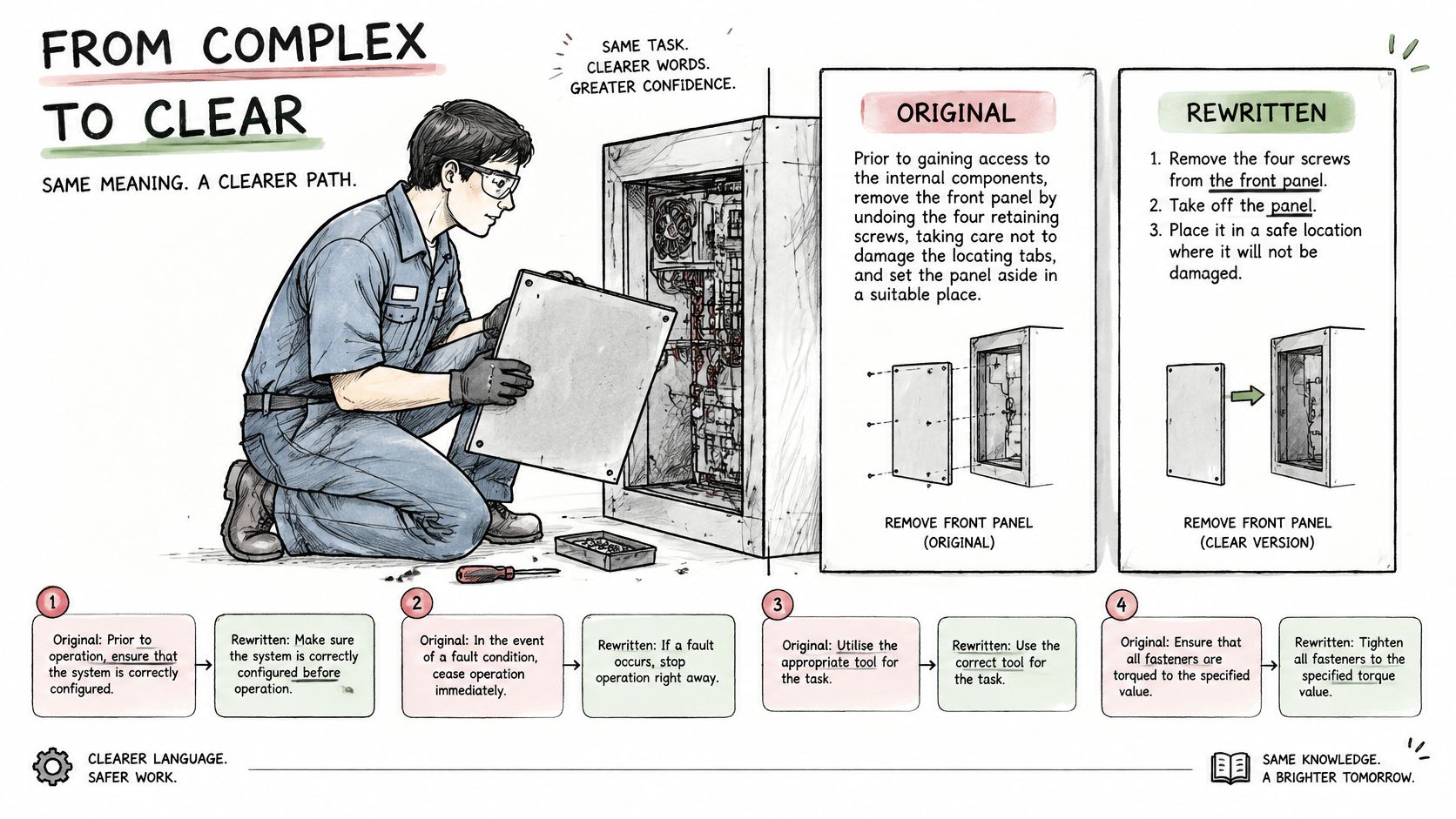
Make the action direct
Before
The connector is to be inspected by the technician after the panel has been removed.
After
| Rewritten sentence | Word count |
|---|---|
| Remove the panel. | 3 |
| Inspect the connector. | 3 |
The rewrite retains the panel, connector, and required order. It removes the indirect construction around inspection. The procedure's scope must still identify the technician responsible for these actions.
Keep the condition with its action
Before
Check the level, tighten the fitting if it leaks, and then record the result.
After
| Rewritten sentence | Word count |
|---|---|
| Check the level. | 3 |
| If the fitting leaks, tighten it. | 6 |
| Record the result. | 3 |
The condition still controls tightening. The rewrite doesn't direct the technician to tighten a fitting that doesn't leak. It also preserves the requirement to record the result.
Technical review must resolve what result the technician records. If the intended record is unclear, the writer needs more information rather than another stylistic change.
Keep the same part name
Before
Open the access door, then close the hatch.
After
| Rewritten sentence | Word count |
|---|---|
| Open the access door. | 4 |
| Close the access door. | 4 |
This correction applies only when access door and hatch identify the same part. If they identify different parts, the writer must preserve that distinction.
The rewrite retains the opening and closing actions. It doesn't explain the work between them. A complete procedure must include any intervening task.
Separate the hazard from the step
Before
Carefully remove the cover, making sure you avoid the hot surface.
After
| Rewritten sentence | Word count |
|---|---|
| Warning: The surface is hot. | 5, including the label |
| Do not touch the surface. | 5 |
| Remove the cover. | 3 |
The description identifies the hazard. The instructions state the prohibited contact and the required action. Every rewritten instruction remains within the instructional ceiling, and the description remains within the descriptive ceiling.
The example doesn't establish that cover removal is safe. A technical reviewer must confirm whether cooling, isolation, or protective equipment is necessary.
Further worked rewrite examples and Simplified Technical English examples provide additional practice. For the current manual, the writer should select a real paragraph and apply these same checks. Every retained condition, part name, and intended result should remain traceable to the original technical meaning.
A Review Checklist for Documentation Style
Documentation style review checks
| Check | Fail sign | Fix |
|---|---|---|
| One action | Two verbs tell the reader to act | Split the sentence into steps |
| Actor | The sentence hides who acts | Use active voice and name the actor |
| Length | An instruction exceeds 20 words or a description exceeds 25 | Divide the text and keep every needed word |
| One name | The same part has two names | Use the approved technical name |
| Warning | A hazard sits inside an action sentence | Put the hazard and the action in separate sentences |
| Sequence | The step order differs from the physical task | Reorder steps to match the work |
| Result | The reader cannot see when the step is done | Add the observable result |
The reviewer should record pass, fail, or not applicable for each relevant check. A failed check needs a marked sentence and a specific explanation. A general comment such as unclear doesn't identify the required correction.
The action check requires judgment. A conditional sentence can contain a verb describing a condition without directing another action. The reviewer should identify what the technician must do, rather than count verbs.
Check validity and physical workflow
Language review can't establish whether the procedure matches the equipment. Each step needs the conditions that make it valid. Each step also needs an observable completion point where the task requires one.
For example, an instruction to move a control needs an identifiable destination. A test instruction needs a defined expected result. The writer shouldn't invent either detail to complete the sentence.
The FAA maintenance human-factors guidance connects usable procedures with accurate content, unambiguous language, and task-matched organization. It identifies STE as a proven method for reducing comprehension errors. It also reports that a 2012 government-industry workshop ranked technical instructions as the leading maintenance human-factors challenge.
Those requirements explain why a grammatically correct procedure can still fail. A technician may need access that an earlier step removed. A warning may appear after exposure to the hazard.
Validation check: The technician should perform the intended task without inventing missing instructions.
Observe a representative user
The reviewer should observe a representative user performing the task under safe, appropriate conditions. Desk review alone can miss confusion caused by equipment layout or document placement.
- Record pauses: Note where the user stops to interpret an instruction.
- Record backtracking: Identify steps that require returning to earlier information.
- Capture questions: Preserve the exact clarification the user needs.
- Compare actions: Mark any action that differs from the intended procedure.
The writer then revises the affected text, and the reviewer repeats the relevant validation. An unsafe ambiguity requires resolution before further task execution.
Every failed check should return to the writer with the exact sentence marked. Technical questions should go to the responsible engineer rather than receive an unsupported language correction.
Limits of a Documentation Style
A style guide can recommend consistent wording without defining a controlled language. Writers may still use several expressions for the same action. A controlled language needs defined vocabulary and grammar requirements; a team's local guide alone does not establish conformity.
Readability doesn't establish correctness
Misconception: readers need STE training to understand STE text. STE uses English, so readers do not need specialist STE training to read it. They still need the technical knowledge and task competence the document assumes.
Writers need to understand the applicable rules and vocabulary to produce controlled text consistently. Clear English alone may not settle every word choice.
A short sentence can still be wrong or incomplete. It may omit a condition, identify the wrong part, or require an unsafe action. Sentence length is one review criterion. It does not confirm that a task is safe.
Authority and ownership remain separate
A style guide needs an owner. Product changes and terminology decisions can make earlier guidance outdated, so the guide should identify who maintains it and when it was reviewed.
The official ASD-STE100 website traces the standard to AECMA Simplified English for aerospace maintenance. ASD later assumed responsibility. STE became an international specification in 2005 and an international standard in 2025.
The current release is Issue 9, dated January 2025. The Simplified Technical English Maintenance Group, known as STEMG, develops, publishes, and maintains the standard.
STE Guide is an independent educational website about ASD-STE100. Its explanations support general education and do not replace the official specification. The official specification is the authority for exact rule interpretations and word decisions.
Check One Draft Against the Official Rules
A documentation team can begin with a procedure of about a page. The writer should identify instructions, descriptions, and safety text before making changes. The technical reviewer should preserve the procedure's required conditions and results.
Complete a focused review
Revise the draft. Use active constructions and separate instructions. Apply the instructional and descriptive sentence limits without deleting necessary information.
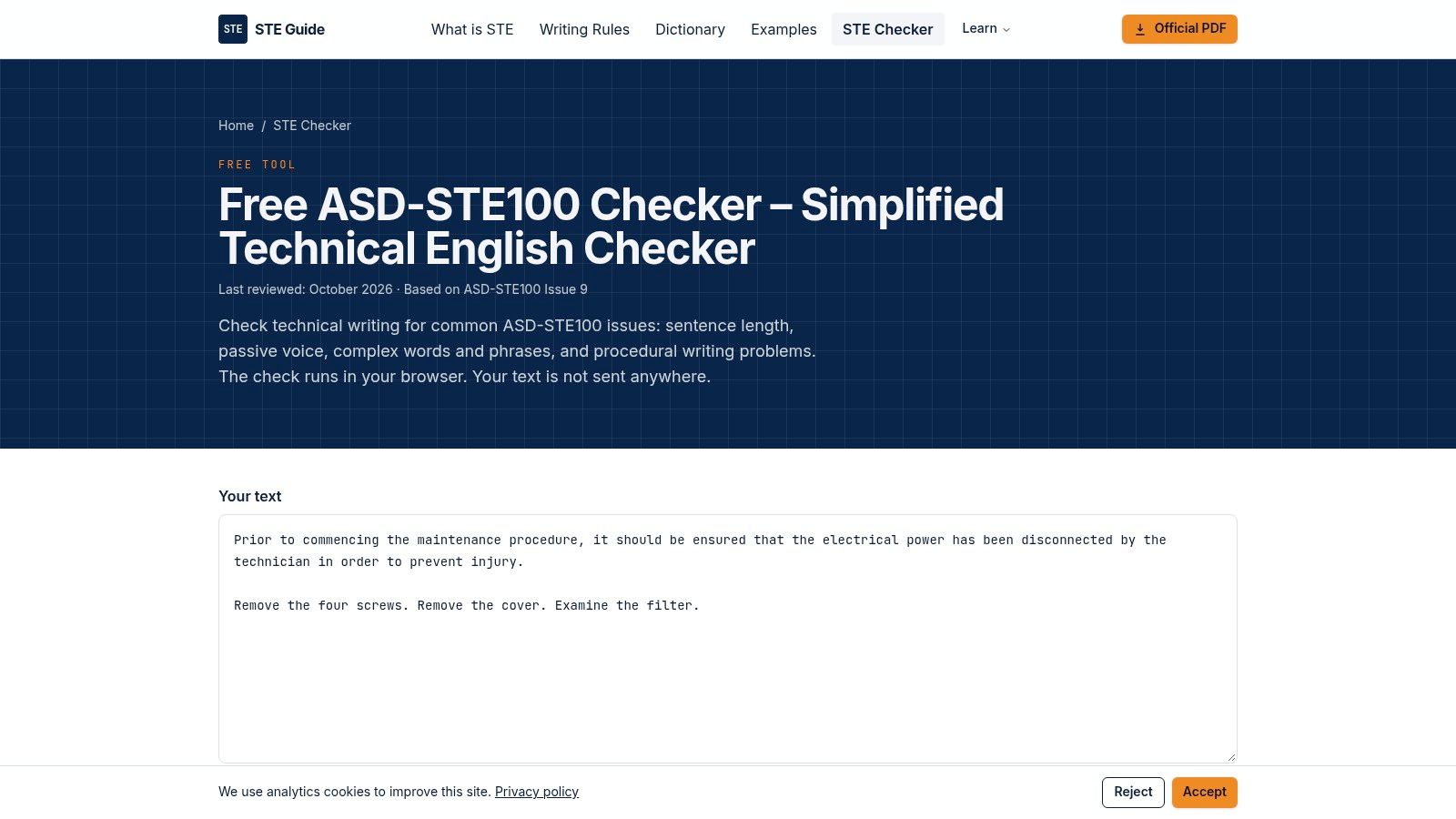
Run an initial check. Submit the draft to the free STE Checker. This simplified heuristic can miss problems and flag correct text. It isn't an official ASD-STE100 conformity check and doesn't certify a writer or document.
Verify uncertain decisions. Check terminology and difficult constructions against the official specification. Educational rule summaries and worked examples remain study aids only.
Resolve and approve. Return unresolved sentences to the writer. Approve the page only after every applicable check passes against the official rules and technical review confirms the procedure.
The screenshot shows the checking interface, not evidence of conformity.
The guide to obtaining the ASD-STE100 PDF directs readers to the official file. STE Guide doesn't host the specification. Reviewers should confirm the text against the official source.
The final decision should be explicit: approve the page or return marked sentences for correction. A tool result can't replace that accountable decision.
STE Guide offers free, independent educational tools and examples for technical writers, engineers, translators, and students. Documentation teams can visit STE Guide to practice a controlled style of documentation, then verify their decisions against the official specification.