What does a high score from a checker prove about a controlled-language draft that tells a technician to remove the guard before locking the panel? It proves only that a tool found few likely breaches of the rules it can test. The score cannot show that the steps are in the right order, that no step is missing, or that an approved term is clear at that point in the procedure. Controlled language fails without warning when writers and tools treat the number as approval. Use the score as a first pass, then have a person review sequence, completeness and meaning.
Table of Contents
- What Controlled Language Means and How It Differs
- Consistency, Translatability and Safety Goals
- How Controlled Language Developed in Aerospace
- How ASD-STE100 and Controlled Vocabulary Fit Together
- Before and After Rewrites Under Controlled Rules
- Where Controlled Language Is Used Beyond Aerospace
- Which Checks to Automate and Which Need Human Review
- Start Applying Controlled Language to Your Next Document
What Controlled Language Means and How It Differs
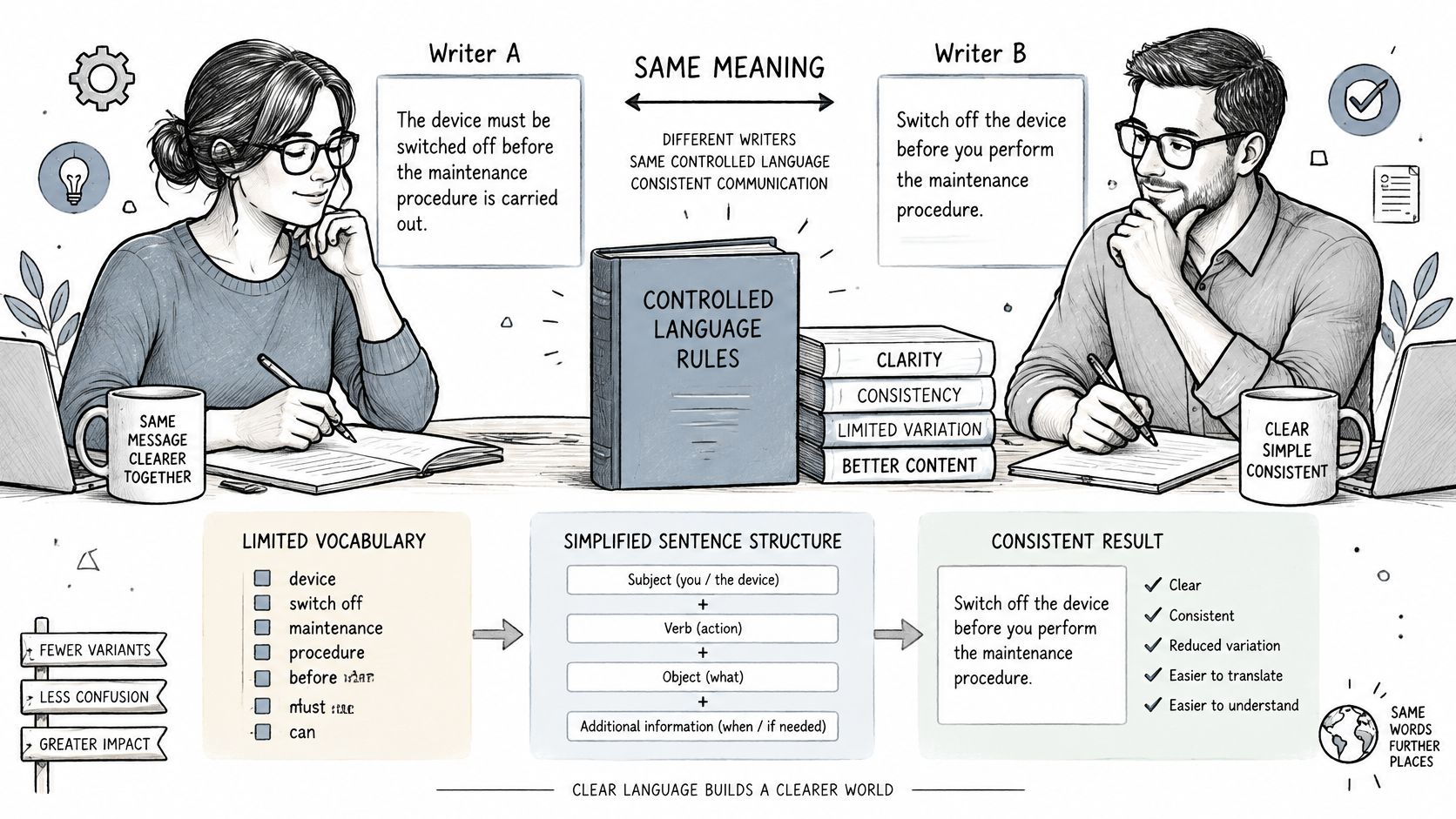
A controlled language is a defined subset of a natural language. It limits the words, meanings and sentence patterns a writer may use. Two writers who follow the same set therefore produce very similar text.
Free writing is like cooking by feel. A style guide is a recipe with suggestions. A controlled language is a recipe with fixed measures that every cook follows.
Ordinary English With Defined Limits
Controlled text is still ordinary English. A reader who hasn't seen it before can read it without training. The control sits with the writer, not with the reader.
A style guide gives advice. A writer can accept that advice or set it aside for a good reason. A controlled language gives defined rules that can be checked, so a reviewer can test a draft against the same criteria each time.
| Criterion | Free Writing | Style Guide | Controlled Language |
|---|---|---|---|
| Vocabulary | Any word the writer chooses | Preferred terms listed | Limited approved words with one meaning each |
| Sentence rules | Writer's judgement | Advice on length and tone | Defined rules for length, voice and structure |
| Enforcement | None | Editorial review | Checked against defined rules, often with tools |
| Translation effort | High and variable | Moderate | Lower and more predictable |
| Best fit | Fiction, marketing and personal writing | Brand consistency across teams | Safety-critical and translated technical text |
How a Reader Decides
The table shows a trade in flexibility. Free writing gives the writer the most choice. Controlled writing gives the reader the most predictability.
Practical rule: Fixed rules suit text where a misreading carries a high cost. Flexible guidance suits text where tone and variety matter more.
A documentation manager can decide from two questions. Who reads the text, and what's the cost if that reader acts on a wrong meaning? High cost points to defined rules. Low cost usually points to a style guide.
Consistency, Translatability and Safety Goals
Consistency
One term always names one part. A reader doesn't need to wonder whether valve and valve assembly are different items. Writers choose the approved name once, and every procedure uses that name.
Consistency also helps search. A technician finds every step for a part with one search term. A reviewer finds every use of a term during an update.
Translatability
Short sentences with simple structure translate more reliably. Approved words with one meaning each give a translator fewer choices to guess. Machine translation also handles predictable input with fewer errors. Readers who want the wider idea behind this goal can read about clarity in writing.
Say a source sentence contains three actions and one condition. A translator must first separate those ideas, then translate them. Controlled source text does that separation before translation starts.
Safety
In maintenance and operation, an unclear instruction can cause a wrong action. Safe text shows the actor, the action, the object and any condition that applies. The reader shouldn't need to infer who acts or when.
Consider this example. Before: Clean the filter when it is dirty and make sure the engine is cool. After: Make sure the engine is cool. Clean the filter. The condition now comes first, and each sentence holds one task.
Controlled text can feel repetitive. That repetition is the point, since variety in wording often creates variety in meaning.
The trade-off is real. Controlled text takes longer to write at first. A team must also maintain a glossary of approved terms and review new terms as products change.
Three questions test any document:
- Same meaning: Could two readers understand this sentence the same way?
- No guessing: Would a translator need to guess the meaning?
- Safe action: Could a wrong action follow from this sentence?
How Controlled Language Developed in Aerospace
In the late 1970s, European airlines asked the European Association of Aerospace Industries (AECMA) for clearer aircraft maintenance documents. Many mechanics read English only at a basic level. The ASD-STE100 history page records that AECMA created a dedicated Simplified English project group in 1983, and the first formal guide was released in 1986 as AECMA Document PSC-85-16598.
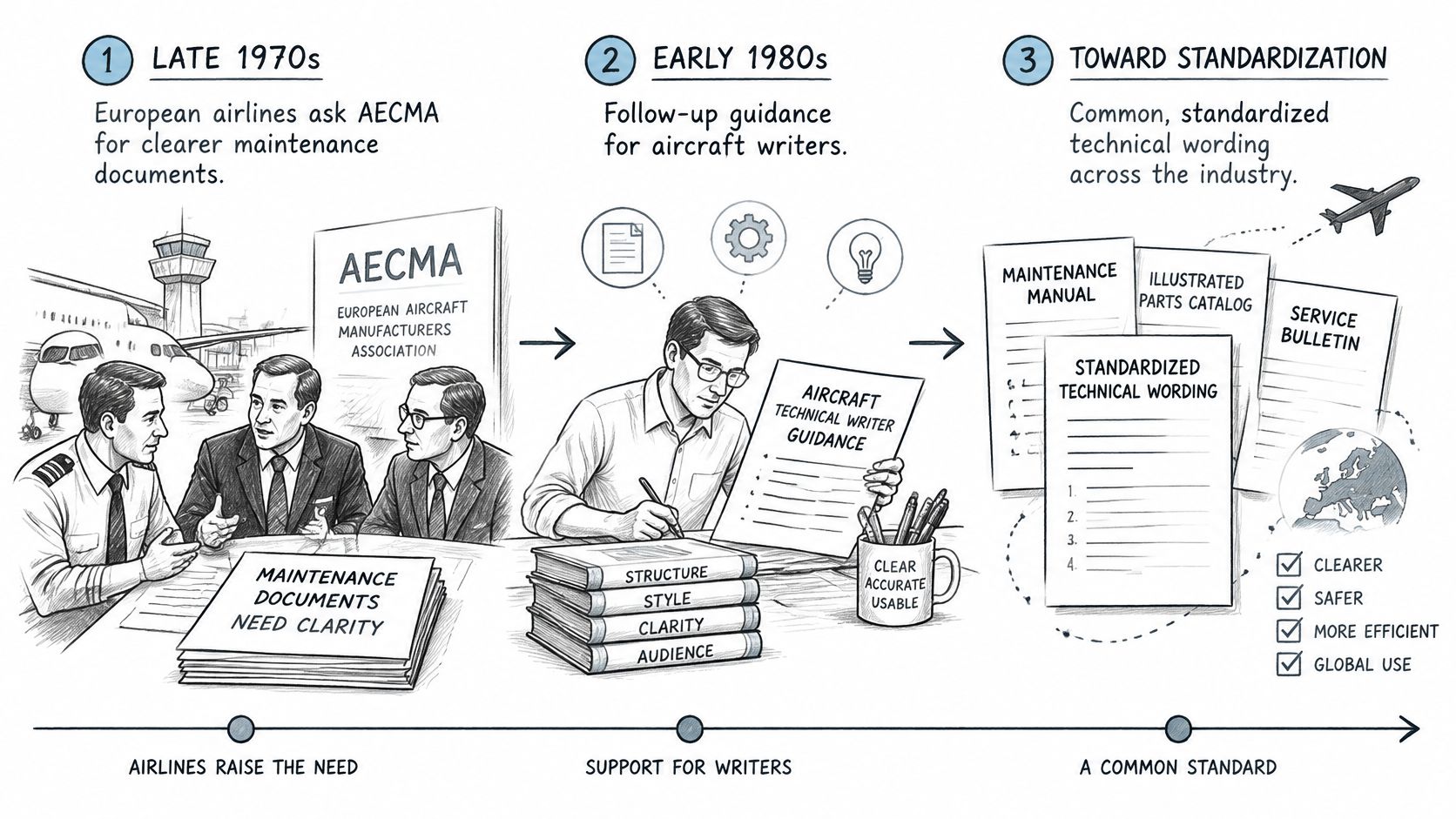
In 2005, the document became the ASD-STE100 Simplified Technical English specification. This change followed the formation of ASD through the merger of European aerospace associations. Issue 9, released on January 15, 2025, moved the document from a specification to an international standard for technical documentation.
The Simplified Technical English Maintenance Group, or STEMG, develops, publishes and maintains the standard. It reports to the ASD Services Commission.
The original safety goal still shapes the rules. It explains the focus on unambiguous wording, consistent terminology and predictable sentence structure. Controlled language in aerospace is a maintained engineering practice with formal revision cycles. It isn't a passing style preference.
How ASD-STE100 and Controlled Vocabulary Fit Together
The confusion usually starts with three labels that sound interchangeable. Controlled language is the general category. ASD-STE100 is one controlled language, built for technical documentation and maintenance text. A controlled vocabulary is one part of a controlled language.
That vocabulary is a limited list of approved words. Each word has one meaning and a stated part of speech. A word that's approved as a verb isn't automatically approved as a noun. Controlled language works like a workshop with rules for how to use tools. The controlled vocabulary is the labeled drawer of permitted words.
The Two Core Parts
ASD-STE100 has two core parts. Writing rules govern how a writer builds sentences. A dictionary governs which words a writer may choose. The table places those parts beside two related items: a checker and the official specification.
| Component | What It Controls | Example |
|---|---|---|
| Writing rules | Sentence length, voice and structure | One instruction per sentence |
| Controlled vocabulary | Which words are approved and what each one means | One approved word for one meaning |
| Dictionary | Approved words with their part of speech and status | An entry marks a word as approved or not approved |
| Authoring checker | Likely rule and vocabulary breaches in a draft | Flags a word that is not in the approved list |
| Official specification | Exact rules and the complete word list | ASD-STE100 Issue 9 is the reference for exact rules |
The dictionary is much smaller than a general dictionary. Many words that aren't approved have an approved alternative, so a writer changes the word, not the technical content. The writing rules page gives an overview of the rule categories, and the before/after examples show how those rules change a sentence.
A checker can flag a word that is not on the approved list. It cannot decide whether the writer chose the right approved word for the task. The checker is also heuristic: it can miss problems and flag correct text. A high score can look like proof of clarity. It only shows that the draft avoided some known patterns. The exact rules and complete word list sit in the official specification. Where a summary differs, the specification is correct.
Adopt a Standard or Build a Set
A company can also build an in-house controlled language. It defines its own rules and approved terms, with ASD-STE100 as one option among several. An in-house set needs an owner, a glossary and a review process. Without those three items, the set decays into a style guide. The choice is plain: adopt a published standard, or build a company set that matches the product line and the translation needs.
Before and After Rewrites Under Controlled Rules
The ASD-STE100 Issue 9 document sets a maximum of 20 words per sentence for instructions and permits explanatory sentences of up to 25 words. Instruction text also expresses one instruction per sentence, except where actions occur simultaneously.
| Issue | Free Writing | Controlled Rewrite |
|---|---|---|
| Compound command | Remove the cover, disconnect the cable and put the cover aside. | Remove the cover. Disconnect the cable. Put the cover aside. |
| Delayed condition | Once the fluid has cooled, drain the tank. | If the fluid is cool, drain the tank. |
| Vague word | Check the unit regularly. | Check the unit at the interval in the maintenance plan. |
| Unclear actor | The seal is replaced. | Replace the seal. |
| Long sentence | The pump, which was installed during the last overhaul, may leak if the seal is worn. | Check the pump seal. If the seal is worn, the pump can leak. |
What Changed in Each Row
Each row removes one source of doubt. These rewrites are illustrations written for this site, not official text. All examples on the site are the site's own, and the site doesn't copy the rules or dictionary of the official specification.
- Compound command: Three actions become three sentences, so the reader tracks one completed step at a time.
- Delayed condition: The condition moves to the front, so the reader checks it before starting the action.
- Vague word: The word regularly becomes a named interval, so two readers schedule the same check.
- Unclear actor: The passive form becomes an imperative, so the responsible reader knows the task is theirs.
- Long sentence: Background detail leaves the instruction, and the check stands on its own.
Conditions that affect execution belong before the command. Active voice is preferred because it exposes the actor responsible for the action. The reader holds fewer ideas at once, and the sequence stays explicit.
A Five Step Review Workflow
- Classify each sentence as instruction, explanation, note or safety text, because the limits differ by type.
- Count words using the standard's counting conventions, since a simple whitespace count is only an approximation.
- Split compound commands so each instruction carries one action the reader can complete and confirm.
- Move execution-critical conditions in front of the command, so the reader tests them before acting.
- Check the imperative names the required action, so the reader doesn't infer the task from context.
Shorter prose isn't the goal by itself. The goal is a structure that reduces ambiguity during execution and gives translators predictable source text.
A useful first exercise is small. The reader applies the five steps to one procedure from a current manual. Five rewritten sentences usually show which rules the team finds hard, and where the approved term list has gaps.
Where Controlled Language Is Used Beyond Aerospace
At the end of 2024, 64% of ASD-STE100 users were from outside the aerospace and defence industries, according to the ASD-STE100 distribution log recorded on the Simplified Technical English overview. The method now serves many sectors.
| Sector | Typical Documents | Main Reader Risk Reduced |
|---|---|---|
| Aerospace and defence | Maintenance manuals and job cards | Wrong action during maintenance |
| Automotive | Service procedures and workshop guides | Unclear steps or inconsistent component names |
| Energy | Operating and inspection procedures | Misread safety conditions |
| Medical devices | Instructions for use and service manuals | Ambiguous device operation |
| Software documentation | Installation guides and administrator manuals | Inconsistent terms across releases |
| Translation and localization | Source texts for many target languages | Meaning shifts after translation |
What Changes Between Sectors
The discipline stays the same. The approved vocabulary differs. A software team needs approved terms for interface elements and releases, while an automotive team needs one name for each component and tool.
A translation team needs a different gain. Stable source text keeps its meaning across target languages. Readers who manage several rule sets can compare this approach with other technical documentation standards.
The limits matter too. Controlled language suits instructions and procedures better than marketing copy, concept explanations or creative writing. Those texts need range and tone that fixed measures remove.
A practical test uses the reader's own documents:
- List costly misreadings: Name the three most costly misreadings in current documents.
- Match a control: Decide whether a controlled rule or term list would prevent each one.
- Keep flexible style: Retain it for any text where the answer is no.
Which Checks to Automate and Which Need Human Review
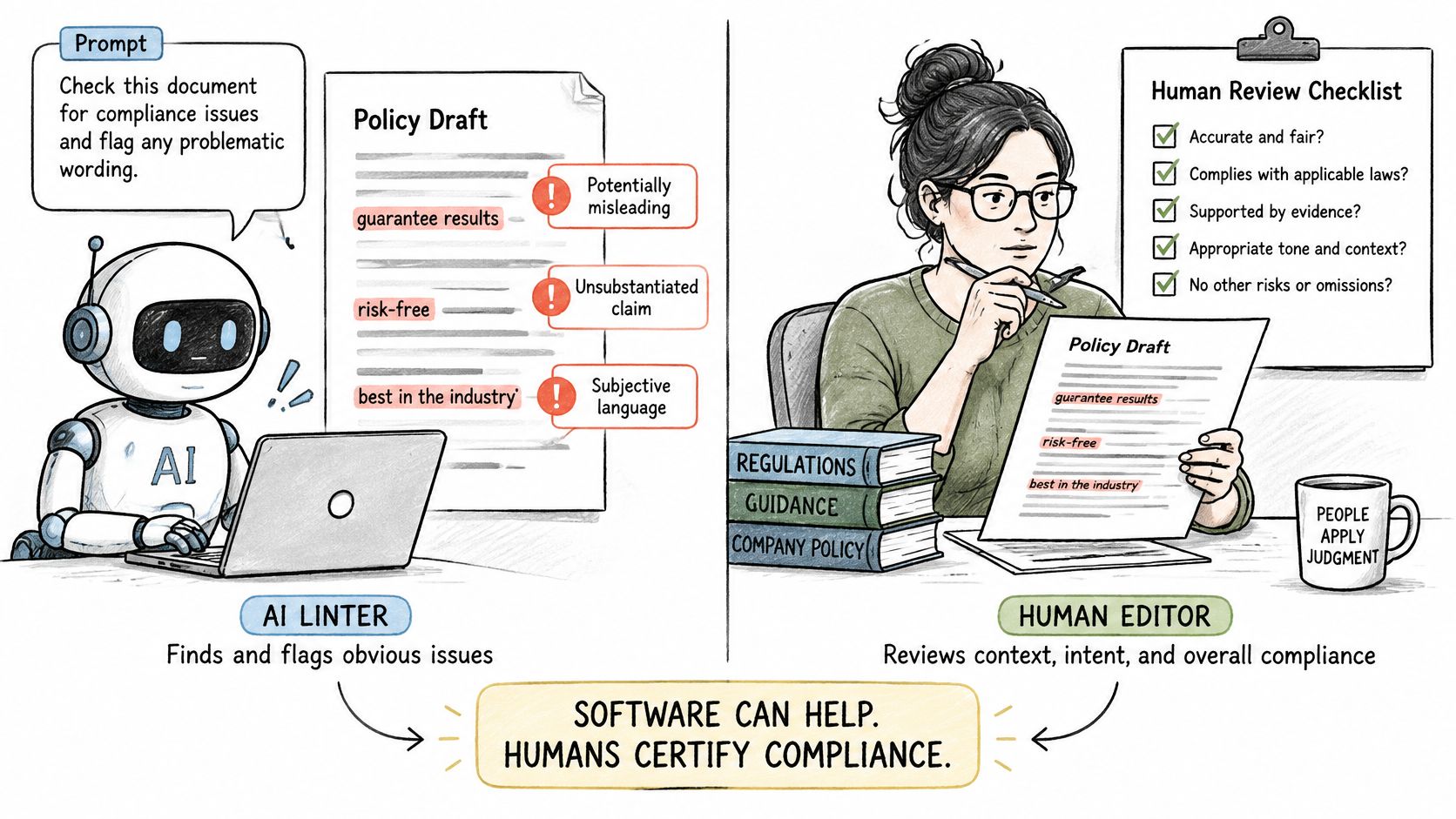
A linter or an AI prompt can't certify that a text is compliant. The ASD Europe FAQ on Simplified Technical English states that authoring tools and AI tools are being developed to check STE rules, while human expertise remains necessary.
What Tools Do Well and What They Miss
Tools flag likely vocabulary and grammar breaches. They validate terms against an approved list. They also support pre-editing for machine translation and can suggest rewrites.
They don't reliably assess technical accuracy, omitted conditions, unsafe sequencing or incorrect units. They also can't confirm that an approved word carries the right meaning in context. A sentence can pass every check and still instruct the reader to do the wrong task, in the wrong order, with the wrong value.
- Rule linting: Automate it, and keep the rule set version with the draft for traceability.
- Terminology validation: Automate it against the approved list, and let a terminologist approve new terms.
- Machine translation pre-editing: Automate the flags, and confirm that edits don't change the source meaning.
- LLM rewriting: Treat each output as a draft, and check every sentence against the source text.
The free STE checker is a heuristic tool that can miss problems or flag correct text. A high score therefore doesn't prove conformity or usability. When the site's explanation and the official specification differ, the official specification is correct.
Automate repeatable checks. Keep meaning and safety decisions with a qualified human reviewer.
Start Applying Controlled Language to Your Next Document
Which document in your set would hurt the most if a reader misunderstood one step? Start there. One procedure is enough to test the method.
- Pick one procedure from a current document where a misreading would be costly.
- Rewrite its highest-risk sentences using the before and after patterns in the rewrite table, and keep the original beside the draft.
- Run the draft through the checker and read each flag as a question about your text, then answer it yourself.
- Check every approved word against the dictionary explanation, because a permitted word still has to carry the right meaning in that sentence.
- Compare the rewrites with the worked pairs on the ASD-STE100 examples page.
- Obtain the official specification from the official source, using the guidance on the ASD-STE100 PDF page, and confirm the exact wording of the rules there.
A draft can score well and still fail. The score shows that your text matches the checker's patterns. It says nothing about whether the steps are in the right order, whether a value or unit is correct, or whether the warning comes before the action it protects. That gap is where controlled language fails: the page looks compliant, someone signs it off, and the reader follows a clean sentence into the wrong task. The person who knows the procedure is the one who closes it.
The decision is narrow. Adopt controlled rules first for safety-critical and translated documents. Keep flexible style for marketing and other low-risk text. The first document to change is the one where a misreading costs the most.
STE Guide offers plain explanations of ASD-STE100, worked rewrite examples and a free checker for a first review of controlled drafts. Technical writers, engineers and translators can use those resources to test controlled language on one real procedure before they commit a full manual set. Visit STE Guide to start with the examples and check a draft today.