
Advice to adopt S1000D often starts with choosing an XML editor or buying a database. That starts too late in the decision process. A project first needs agreement on its information structure, business rules, and approval responsibilities.
The S1000D specification provides a common framework. It doesn't supply every decision needed to produce usable technical information.
Table of Contents
- What the S1000D Specification Defines and Leaves Open
- Project Business Rules and How BREX Records Them
- Where the Common Source Database Fits
- Confirm the Issue and Rule Sources First
- How to Write S1000D Content in STE Step by Step
- Replacing Semicolons With Simpler STE Constructions
- Checking S1000D Drafts Before Release
What the S1000D Specification Defines and Leaves Open
The S1000D specification is a common framework for creating, structuring, and publishing technical information as data modules. A data module contains an identifiable unit of information, such as a description or maintenance procedure.
Organizations use this approach in aerospace, defence, transport, energy, and medical-device programs. Their equipment differs, but their documentation teams face similar problems with reuse, configuration, and controlled updates.
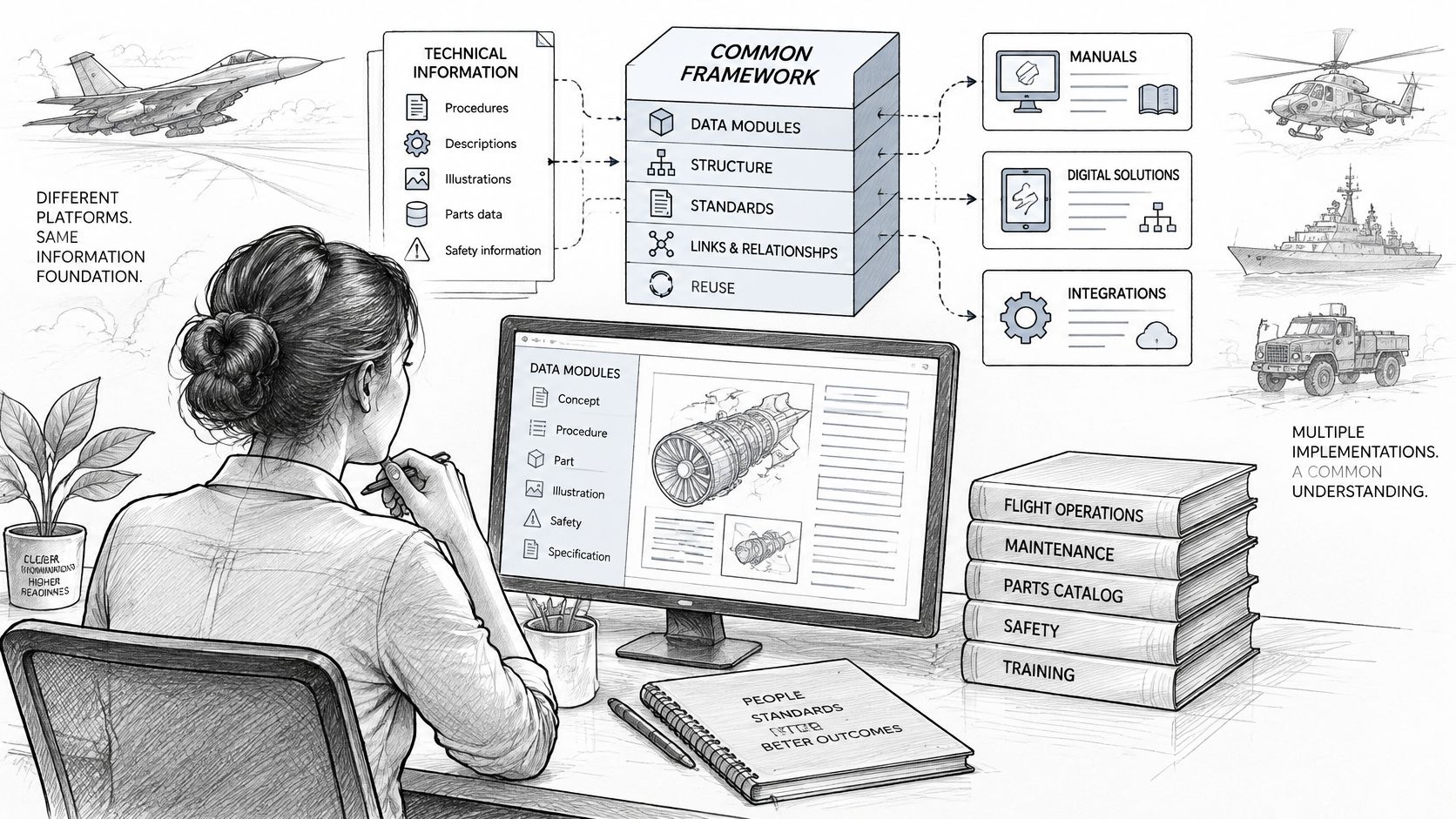
Spec Layers and What Each One Decides
| Layer | What it defines | Who sets the details |
|---|---|---|
| S1000D specification | Common framework for data modules, structure, and publication | Standards body and the issue in use |
| Project business rules (BREX) | Allowed module types, metadata, naming, and validation rules | Project participants, agreed jointly |
| Common Source Database | Storage and management of data modules and related objects | Not defined by the specification; set by the organization or vendor |
| ASD-STE100 writing rules | Sentence and vocabulary control for text inside modules | ASD STEMG, using the current Issue 9 |
These layers solve different problems. A structurally valid module can contain unclear instructions. A clearly written procedure can still use incorrect metadata.
S1000D governs the data structure. ASD-STE100 governs controlled language inside modules when the project requires STE. Neither replaces technical review.
The S1000D Data Dictionary lists Issue 6 with a publication date of 19 June 2024. Before project setup, the team should check the official S1000D site for the current issue and confirm the contractual baseline.
Boundary to preserve: S1000D does not define the functions of the Common Source Database.
STE Guide bases its explanations on the current official ASD-STE100 specification published by ASD. Its educational explanations don't replace that specification.
Authors work daily with module structure, metadata, and wording. Before drafting begins, project participants must agree on the business rules that connect these layers.
Project Business Rules and How BREX Records Them
A project must convert the common framework into specific decisions. Otherwise, suppliers can deliver structurally valid content that the receiving organization can't use consistently.
The S1000D implementation guide describes approximately 550 guidelines and the need for participants to define project rules before implementation.
Those decisions include allowed data-module types, metadata requirements, applicability encoding, and naming conventions. They also include workflow states, publication structures, and validation rules.
From Conflicting Requirements to an Agreed Rule
Consider a project where the customer requires applicability information on fault-report modules. The supplier's local rule makes that information optional.
The team must resolve the conflict before validation. Authors shouldn't choose whichever interpretation permits a module to pass.
The Business Rules Exchange (BREX) mechanism records permitted customizations in machine-readable form. The CSDB stores and manages the resulting modules and related objects.
In this scenario, the participants agree that applicability information is mandatory for the relevant modules. The rule owner records the constraint in BREX where supported. The team updates its authoring guidance and tests both acceptable and unacceptable examples.
A Responsibility Matrix for Project Decisions
| Decision | Owner | Approval point |
|---|---|---|
| Required applicability information | Customer's technical authority | Business-rule baseline approval |
| Machine-checkable expression | BREX maintainer | Validation test acceptance |
| Supplier implementation | Supplier documentation lead | Authoring environment release |
| Exceptions and unresolved conflicts | Joint governance group | Recorded disposition before delivery |
Not every decision translates directly into an automated check. Reviewers still need documented checks for requirements that depend on meaning or engineering judgment.
A change-control checklist should include:
- Propose the change. State the problem and affected rule.
- Assess validation effects. Identify affected modules, checks, and supplier exchanges.
- Record the version. Preserve the relationship between the rule and its implementation.
- Approve the change. Obtain the designated authority's decision.
- Publish the baseline. Distribute the rule and its effective application.
Standardization alone doesn't produce interoperability. Different local rules can recreate separate information systems under a shared specification name.
Where the Common Source Database Fits
The Common Source Database (CSDB) stores controlled information objects. These include data modules, graphics, multimedia, publication modules, and administrative objects.
The official S1000D overview distinguishes the information framework from the implementation of the repository. The specification doesn't prescribe CSDB software functionality.
A project therefore needs an operating model, not just a product category. Repository location alone doesn't establish ownership or approval authority.
Repository Operating Models Compared
| Model | How data is held | Main trade-off |
|---|---|---|
| Centralized | One system holds all data modules and related objects | Simple control, but one system is a single point of dependency |
| Federated | Each supplier holds its own modules and exchanges them with others | Flexible sourcing, but synchronization and status control are harder |
| Hybrid | A central repository holds shared objects, and local stores hold supplier work | Balanced, but needs clear rules on which copy is authoritative |
For a centralized model, the team must plan access and recovery. For a federated model, participants must agree on exchange acceptance and synchronization.
A hybrid model requires explicit authority for each object. An approved central copy and an unfinished supplier copy must remain distinguishable.
Decisions Before Procurement
Procurement teams should resolve these questions:
- System boundary. Must a single system hold all data?
- Supplier exchange. How will participants exchange and synchronize modules?
- Legacy content. What remains in the existing repository?
- Configuration control. How will versions and status values connect to equipment configuration?
- Required capability. Which functions support project obligations, and which are optional vendor features?
Rule maintenance also needs ownership. The ASD announcement on Issue 9 identifies STEMG as responsible for developing, publishing, maintaining, and managing ASD-STE100. A repository administrator shouldn't replace that external language authority with local software settings.
Repository acceptance should include an exchange test, not only a software demonstration.
Before migration, the team should map each object type to a repository capability. Participants should exchange a representative module and confirm identifiers, references, and status values.
They must also identify who owns each rule source. Interoperability depends on governance, identifiers, status control, and exchanged rules, not the database label.
Confirm the Issue and Rule Sources First
Authors need a controlled set of references before they create content. A folder containing several unidentified rule files isn't a usable baseline.
Establish the Authoring Baseline
Obtain the agreed S1000D issue and project BREX. The project manager should name the owner of each source. A newer publication doesn't automatically replace a contracted issue.
Obtain the official ASD-STE100 Issue 9 PDF from ASD. STE Guide doesn't host the file and links to the official copy instead. Its Issue 9 overview provides independent orientation.
Review the language constraints. The writing-rule explanations provide a plain-language refresher, not an alternative rule set.
Select relevant worked examples. The STE rewrite examples can help authors examine procedures or descriptive text similar to their module.
Assign conflict resolution. A named technical authority must decide how the team handles apparent conflicts between project requirements and STE requirements.
Keep Educational Guidance Separate
The dictionary guidance explains vocabulary selection without replacing the official dictionary. The PDF guidance explains how to obtain and use the controlling document.
STE Guide provides general education. It isn't ASD, doesn't represent ASD, and doesn't provide official certification.
When educational guidance differs from the official text, the official text controls. Local software settings and inherited checklists also require review against that baseline.
How to Write S1000D Content in STE Step by Step
STE editing requires more than replacing difficult words. Authors must preserve the task's conditions, sequence, and technical meaning.
The official ASD-STE100 Issue 9 PDF is the controlling reference for the writing rules and the dictionary. A checklist inherited from an earlier issue should not be the sole reference.
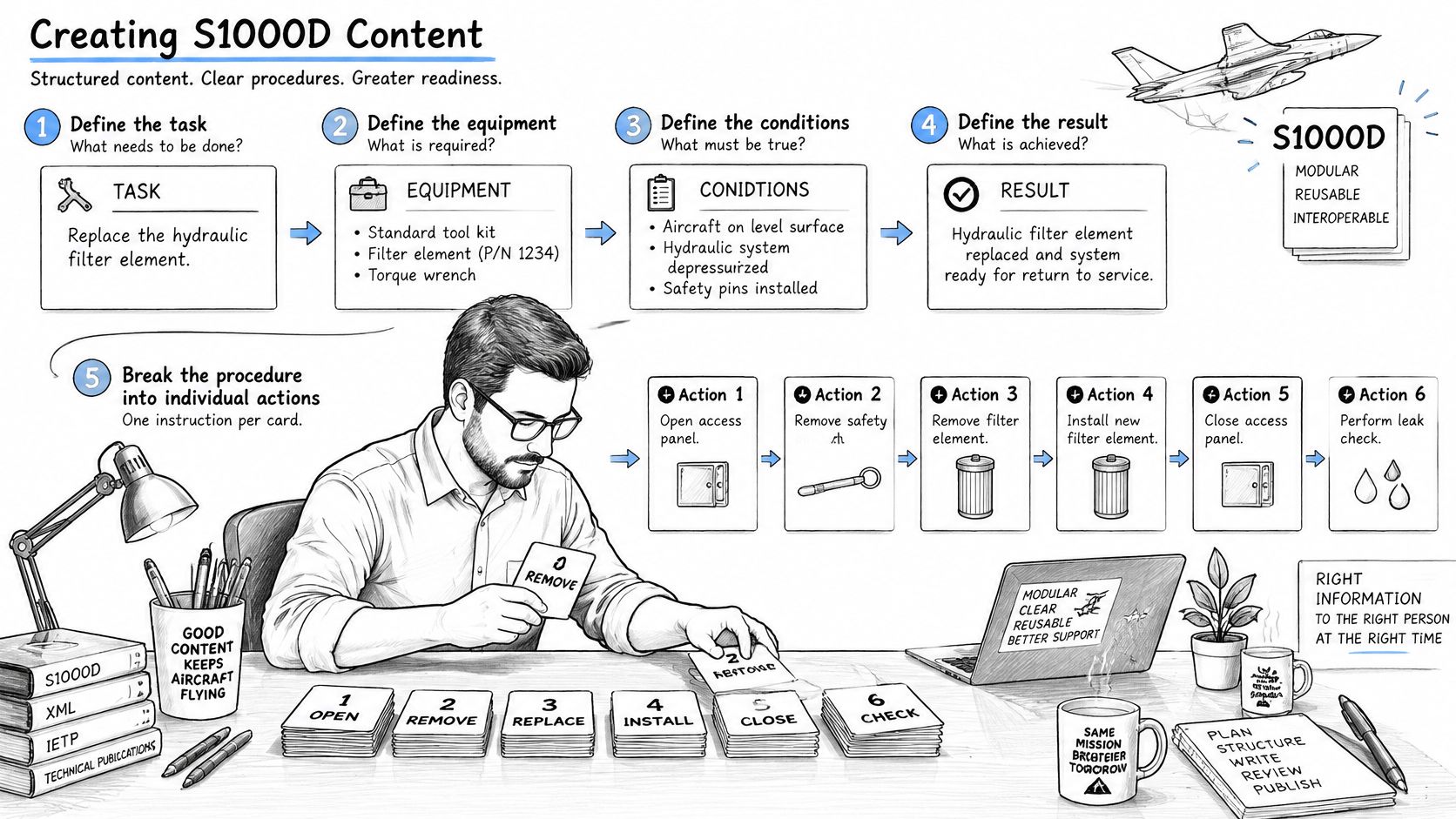
Establish Purpose and Sequence
Define the task before drafting. Record the equipment, starting conditions, and required result. This gives each instruction a clear purpose.
Separate the actions. Place each instruction in its own sentence. This makes the sequence easier to follow and review.
Before
Remove the cover, disconnect the lead and check the unit, then reinstall it, and make sure the seal is intact.
The sentence hides several actions and an unclear reference. The word it could refer to the cover or the unit.
After
Assume engineering has confirmed that the cover is the item to reinstall. The following example illustrates sentence separation, not an approved maintenance procedure.
- Remove the cover.
- Disconnect the lead.
- Check the unit.
- Install the cover.
- Examine the seal for damage.
The original doesn't explain how to check the unit or whether the lead needs reconnection. An engineer must resolve those omissions before release.
Control Terms and Verify Meaning
Select approved vocabulary. Give each recurring term a consistent meaning and grammatical role. Record project technical terms so authors and translators use them consistently.
Replace indirect wording with explicit actions. For example, change a check of the seal to check the seal. The author must still specify what condition requires inspection.
Verify the complete procedure. Review grammar, warnings, sequence, and consistency against Part 1 and Part 2 of the official standard. Sentence-level improvements must not introduce task-level errors.
Examples illustrate an editing approach. They don't establish conformity, and the author remains responsible for checking the wording against the official text.
The resulting draft should identify who acts, what changes, and which conditions apply. It should be ready for separate structure, terminology, syntax, and safety-critical reviews.
Replacing Semicolons With Simpler STE Constructions
| Pattern in draft | Why it slows the reader | Simpler construction |
|---|---|---|
| Two actions joined by a semicolon | Reader must hold two instructions in one sentence | Two or more sentences, one instruction each |
| Warning joined to an action by a semicolon | The warning can be missed inside the action | A separate warning sentence placed before the action |
| Condition joined to a result by a semicolon | Condition and result blur together | A sentence that starts with the condition, then a separate result sentence |
| Long list of items inside one sentence | Many items in one sentence are hard to scan | A bulleted list with one item per line |
| Explanation attached after a semicolon | Extra meaning is hidden in the sentence | A separate sentence with one idea |
A semicolon connects related thoughts within a sentence. In a procedure, that connection can combine instructions that deserve separate attention.
Authors should treat the mark as a sentence-splitting signal. They must identify the relationship before selecting the replacement.
Actions and Safety Information
Before
Open the valve; wait ten seconds; record the reading.
After
Open the valve. Wait ten seconds. Record the reading.
The waiting period belongs only to this hypothetical example. Actual procedures need an engineering-approved duration and a defined measurement point.
Before
Do not touch the connector when power is on; the pins can be damaged.
After
Touching the connector with power on can damage the pins. Do not touch the connector when power is on.
The rewrite separates the consequence from the prohibition and uses active wording. The project must still apply the correct safety classification and required warning structure.
A warning belongs before the action that exposes the reader to the hazard. Splitting sentences doesn't replace safety analysis.
Observations and Conditions
Before
The filter is clean; the sensor reads zero.
After
The filter is clean. The sensor reads zero.
These are separate observations. The semicolon doesn't establish that the clean filter causes the reading.
If the intended meaning is conditional, the author needs technical confirmation. A sentence beginning with if must state a real condition, not an assumed relationship.
Replacing a semicolon with a comma doesn't resolve an overloaded sentence.
That replacement can create a comma splice while leaving the same reading problem. Authors should instead separate actions, expose conditions, or use a list.
A draft search for semicolons provides a useful review queue. Each occurrence needs a decision about sequence, explanation, condition, or list structure.
The punctuation guidance offers educational explanations. The official ASD-STE100 writing rules provide the exact punctuation limits, which aren't reproduced here.
When the site's explanation differs from the specification, the specification is correct.
Checking S1000D Drafts Before Release
A checker score doesn't prove conformity or safe task execution. Software can identify a suspect word while missing an omitted condition or incorrect instruction.
There is no established universal comprehension percentage for STE documents. Organizations need controlled tests of their own content and users.
The aviation maintenance corpus study found generally aligned rhetorical structure alongside lexical, phrasal, and sentence-level deviations. Such conflicts require technical judgment, not automatic rewriting.
Measure Task Performance
A controlled comparison starts with representative procedures. Reviewers record baseline findings and task-completion errors, then prepare STE rewrites.
Representative users execute both versions under equivalent conditions. Test planners should control learning effects so prior exposure doesn't distort the comparison.
Useful measures include:
- First-pass comprehension. Can users explain the instruction correctly without clarification?
- Critical-error rate. Which mistakes affect safety or the required result?
- Clarification requests. Where do users need additional explanation?
- Task time. How long does correct completion take?
- Terminology-consistency defects. Where do labels or meanings change unexpectedly?
Results need separation by user language background and task complexity. A favorable average can conceal failures at safety-critical steps.
Separate the Review Passes
| Review pass | Main question |
|---|---|
| Structure | Are module boundaries, prerequisites, references, and sequence correct? |
| Terminology | Does each term retain its intended meaning? |
| Syntax | Are sentence construction and grammatical relationships clear? |
| Safety-critical meaning | Could an omission or interpretation cause an unsafe action? |
The free STE checker can support first-pass review. It's a simplified heuristic tool, not an official ASD-STE100 conformity check or release authority.
Reviewers should escalate forced or technically misleading rewrites to subject-matter experts. They should document justified deviations, including the affected requirement and approval.
Release evidence should combine validation results, editorial review, technical approval, and user-test findings. The official PDF remains the controlling language reference.
STE Guide offers independent explanations, worked rewrites, and learning resources for authors applying STE within S1000D modules. Documentation teams can visit STE Guide to practice clearer procedural writing and find guidance to the official specification.