
A shorter instruction can still be unsafe. ETSI's guidance on information quality treats correctness, consistency, and comprehensibility as separate concerns. Clear wording alone doesn't establish technical accuracy.
Most unclear technical text fails for repeatable reasons: long compound sentences, hidden actors, vague qualifiers, and words with several meanings. Writers can correct these patterns without removing necessary technical detail. However, every rewrite must preserve conditions, responsibilities, limits, and exceptions.
Each example of technical language below becomes a Simplified Technical English style rewrite, with reasoning, trade-offs, and a repeatable editing tactic. These examples illustrate language choices, not complete maintenance procedures or verified conformity with the standard.
Exact requirements belong to the official ASD-STE100 Issue 9 specification. The explanations use original wording and don't reproduce its rules or dictionary. Technical reviewers must still confirm each instruction against approved engineering information before release.
Table of Contents
- 1. Long Instructions and Conditional Sentences Rewritten as Clear Steps
- 2. Nominalized Verb Phrases Rewritten as Direct Verbs
- 3. Vague Qualifiers Replaced With Measurable Criteria
- 4. Passive Voice That Hides the Actor Rewritten in Active Voice
- 5. Multi-Meaning Words Replaced With One Clear Term
- 6. Warnings and Cautions Buried in Prose Moved to Clear Notices
- 7. Idioms and Figurative Expressions Replaced With Literal Instructions
- Seven rewrite patterns compared
- Key Takeaways and How to Practice These Rewrites
1. Long Instructions and Conditional Sentences Rewritten as Clear Steps
A sentence can contain familiar words and still present too many actions. Technicians must identify both the sequence and the decision points.
Before
Remove the access panel, disconnect the harness, and lift the unit clear of the mounting bracket before inspecting the seals.
After
- Remove the access panel.
- Disconnect the harness.
- Lift the unit off the mounting bracket.
- Inspect the seals.
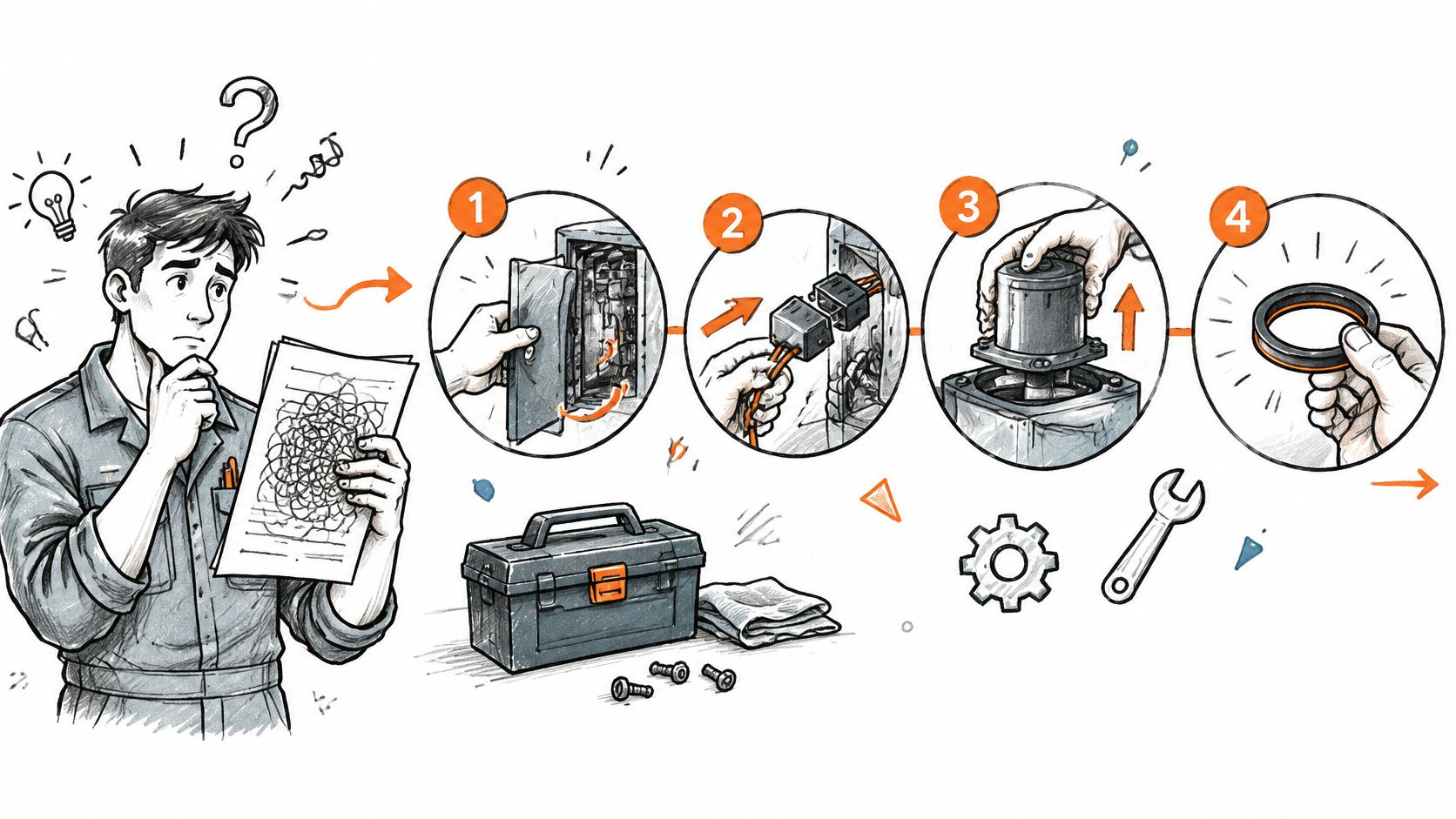
The numbered sequence makes each action visible. However, splitting sentences must not separate a condition from its required action.
Before: If appropriate, perform the test.
After: If the indicator is red, perform the test.
The revised condition works only when approved technical information establishes that trigger. Writers must never invent a condition to improve readability.
Keep conditions attached to actions
ASD-STE100 Issue 9 limits procedural sentences to 20 words and normally requires one instruction per sentence. ASD and the Simplified Technical English Maintenance Group maintain the authoritative document.
- Find action verbs: Mark each commanded action, then separate actions that require distinct steps.
- Resolve exceptions: Confirm whether an inspection waiver also changes replacement or recording requirements.
- Test the sequence: Ask a technician to follow the revised procedure against approved task information.
The technical instruction examples explain how to organize actions without losing dependencies. Complex branches may need a decision table or flowchart rather than additional sentences.
2. Nominalized Verb Phrases Rewritten as Direct Verbs
Action nouns hide the verb. Replace them with direct verbs so the reader can see the required action.
Before: Performance of a leak check is required before the installation of the cover.
After: Do a leak check. Then install the cover.
The rewrite makes both actions easier to identify. Use this sequence only if the approved procedure supports it. If the cover can be installed only after a satisfactory leak-check result, state that acceptance condition.

Before: Adjustment of the tension is to be made by the technician.
After: The technician adjusts the tension.
Naming the actor can clarify responsibility. In a procedure already addressed to the technician, the shorter instruction Adjust the tension may be enough.
Editing tactic: Search for nouns ending in -tion, -ment, and -ance. Treat these endings as search targets, then test each match for a direct verb.
Keep a noun when it names a specific item, such as installation drawing or a named test. Replacing a recognized technical term with a general verb can reduce precision. Ask who acts and what action the text requires, then remove abstract phrases such as make an adjustment when a direct verb preserves the intended meaning.
3. Vague Qualifiers Replaced With Measurable Criteria
Words such as proper, adequate, and sufficient can conceal missing acceptance criteria. Different technicians may reasonably interpret them differently.
Before: Tighten the bolts to a proper torque.
After: Tighten the bolts to the torque value in the approved installation table.
The reference must identify a table that exists and applies to the relevant assembly. An editor shouldn't add a plausible torque value.

Replace judgement with an observable condition
Before: Replace the seal if necessary.
After: Replace the seal if the seal shows cracks or cuts.
This rewrite gives the technician a visible decision criterion. It's suitable only if approved inspection information identifies those defects as replacement conditions.
- Identify the decision: Establish what the technician must observe, measure, or compare.
- Locate the authority: Find the applicable drawing, test specification, inspection criteria, or approved procedure.
- Confirm applicability: Check the component variant, operating condition, and document revision.
A missing value is an engineering question, not a wording problem. The draft should remain unresolved until the responsible reviewer supplies the criterion.
Direct values reduce navigation, but repeated values create maintenance work when specifications change. References reduce duplication, but vague references make information harder to locate.
Writers should choose the format that preserves accuracy and supports the task.
4. Passive Voice That Hides the Actor Rewritten in Active Voice
A maintenance instruction must distinguish an action from an existing condition. Passive wording can leave that distinction unclear.
Before: The fuel line is drained before the filter is removed.
After: Drain the fuel line. Then remove the filter.
The rewrite identifies required actions and their order. In an assigned procedure, imperative verbs direct the responsible technician without repeating the role.

Before: The bolt is torqued to the specified value.
After: Tighten the bolt to the specified torque.
The revision clarifies the action, but specified torque still needs an identifiable source. Active voice doesn't repair a missing technical reference.
An imperative identifies the procedural reader as the actor. A task performed by another role needs an explicit role name.
For example, a release procedure may assign inspection to a technician and approval to a supervisor. Removing those role names could change responsibility.
The passive-to-active editing guide provides additional transformation examples. A practical review starts by searching for is, are, was, and been.
Those words aren't automatic errors. A sentence such as The indicator is red describes a condition, not a hidden action.
Passive voice may remain useful when the actor is unknown or irrelevant. Instructions need closer scrutiny because readers must know who acts next.
5. Multi-Meaning Words Replaced With One Clear Term
The verb check can conceal several different tasks. A technician might inspect a surface, measure pressure, compare readings, or test operation.
Before: Check the valve. Then run the pump and check the pressure.
After: Inspect the valve. Operate the pump. Measure the pressure.
The rewrite separates activities and chooses more specific verbs. However, it still needs inspection criteria, operating conditions, and an approved pressure-measurement method.
Keep terminology tied to the task
Before: Set the timer. Then set the unit to standby.
After: Adjust the timer. Then put the unit in standby.
Here, the writer replaces repeated wording with terms that distinguish different actions. The correct choice depends on the equipment and its defined operating states.
- Record the meaning: Define what each project term means in its technical context.
- Record the action: Distinguish visual inspection, measurement, comparison, and functional testing.
- Review revisions: Check terminology whenever engineers change component names or operating modes.
Consistency matters more than stylistic variety. Alternating between unit, module, and assembly can suggest different objects when the writer means the same component.
The trade-off is that repeated terms can sound mechanical. Technical procedures benefit from that repetition when it prevents mistaken identity.
A project glossary should support the standard, not replace it. Writers must verify approved vocabulary, grammatical use, and permitted technical terminology against the authoritative specification.
6. Warnings and Cautions Buried in Prose Moved to Clear Notices
Safety information belongs where readers need it before acting. A warning placed after cover removal arrives too late to guide that action.
Before
It is recommended that the system be isolated because high voltage may be present in some areas if the cover is removed.
After
WARNING: High voltage can cause electric shock. Isolate the system before removing the cover.
This illustrative rewrite makes the hazard and required action visible. The approved safety procedure must establish isolation methods and verification requirements.
Safety boundary: Shorter wording must never remove a hazard, prerequisite, protective measure, or required verification.
Before: Be careful not to damage the connector when disconnecting it.
After: CAUTION: Pulling the wires can damage the connector. Hold the connector body during disconnection.
The revised caution replaces general care with a specific handling action. A technical reviewer must confirm that the instruction matches the connector design.
- Place the notice: Put it before the affected action, following the organization's required format.
- Name the consequence: Explain the relevant harm or damage without unsupported severity claims.
- Verify the control: Confirm that the stated action addresses the identified hazard.
The warning-versus-caution explanation helps writers distinguish notice purposes. The organization's safety standards determine the required classification and format.
A notice can become longer when necessary controls remain explicit. That's preferable to a concise notice that omits a critical safeguard.
7. Idioms and Figurative Expressions Replaced With Literal Instructions
A figure of speech can hide the action.
Before: Bleed the hydraulic system to get rid of the air.
After: Remove the air from the hydraulic system. Use the bleed valve.
The rewrite states the intended result directly while retaining bleed valve as a possible component name. Keep defined component names when they identify equipment more precisely than an everyday substitute.
The example does not provide a complete hydraulic procedure. Preserve the specified valve sequence, operating conditions, hazards, and completion checks.
Distinguish idioms from technical terms
A familiar expression can require interpretation, especially for translators and readers outside the field. A recognized technical term can also have a precise meaning, so replacing it with an everyday phrase may reduce accuracy.
Before: Provide a ballpark figure for the fuel load.
After: Provide an estimated fuel load in kilograms.
The rewrite replaces a figurative phrase with a specific request. Use the unit required by the approved reporting convention.
- State the intended meaning: Name the requested action, result, or estimate.
- Retain defined terms: Keep recognized field terms when they identify a component or concept accurately.
- Check for interpretation: Ask a translator or non-native reader which expressions require explanation.
Use this test: can the intended reader identify the same action consistently? Reading aloud can reveal awkward phrasing. A glossary can clarify retained field terms without introducing competing names for the same component.
Seven rewrite patterns compared
The same-day tactic determines whether a rewrite stays accurate. Use the table to choose a quick editing move, then check that the revised instruction preserves the required technical meaning.
| Rewrite pattern | Main benefit | Main cost | Best suited for | Same-day editing tactic |
|---|---|---|---|---|
| Long instructions and conditional sentences rewritten as clear steps | Makes sequences and decision points easier to follow | Procedures may become longer, especially with branches | Ordered procedures with multiple actions or conditions | Mark each action and condition in the original, then give each a place in the sequence. |
| Nominalized verb phrases rewritten as direct verbs | Makes actions clearer and sentences shorter | Standard noun terms need review; large revisions take time | Instructions that use abstract action nouns | Circle action nouns, identify who performs each action, and test a direct verb in their place. |
| Vague qualifiers replaced with measurable criteria | Supports consistent, objective decisions | Requires verified engineering data | Tasks that need clear pass-or-fail criteria | Underline vague qualifiers and replace each only with an approved value, reference, or observable condition. |
| Passive voice that hides the actor rewritten in active voice | Clarifies responsibility and makes instructions more direct | Some passive sentences describe results or states appropriately | Instructions where the responsible actor should be clear | Ask who performs the action; name that role if responsibility matters. |
| Multi-meaning words replaced with one clear term | Improves clarity and translation consistency | Creating and maintaining a term list takes time | Documents with repeated actions or shared terminology | Search for repeated terms, select one approved term for each meaning, and check for inconsistent alternatives. |
| Warnings and cautions buried in prose moved to clear notices | Makes hazards and required actions easier to identify | Notice formats vary, and too many notices can be overlooked | Safety-critical steps with specific hazards | Find each hazard and place its notice before the action that exposes the reader to it. |
| Idioms and figurative expressions replaced with literal instructions | Improves understanding across languages and regions | Standard field terms may need a glossary; wording can sound less natural | Instructions for diverse or multilingual audiences | Flag phrases that require interpretation, then state the requested action or result literally. |
Key Takeaways and How to Practice These Rewrites
A strong technical rewrite preserves the required decision and makes the next action clear. Test that skill with one sentence:
Before: “If the panel is not responding correctly after the checks have been completed, make an adjustment as necessary and ensure that the system is operating properly.”
Revise it in three passes. First, split the condition and actions into steps. Next, replace “make an adjustment” with a direct verb. Then replace “as necessary” and “properly” with measurable criteria from approved technical sources. The source sentence does not provide those criteria, so the editor must not invent them.
Compare the revision with the original. Confirm that it preserves the condition, action order, responsibility, and intended result. If the approved criteria are unavailable, leave the technical decision unresolved for the responsible reviewer rather than guessing.
Use this method on a short passage. Mark each change by purpose, then check that the revised text keeps the original technical meaning. A concise sentence is useful only when its instructions remain accurate.
Language review and factual review require separate decisions. AI-assisted drafts also need source traceability, revision records, and approval records, as described in AI documentation guidance.
The free STE Checker can flag common issues in a draft. Compare its suggestions with original before-and-after examples, and consult the official ASD-STE100 Issue 9 specification when an explanation differs from the standard.
STE Guide provides original examples and educational explanations about ASD-STE100. Its STE resources support practice; the official specification and approved technical sources remain the basis for final decisions.