In ASD-STE100, WARNING identifies injury or death risks, CAUTION identifies equipment damage only, and WARNING applies when one condition creates both risks.
Does CAUTION always mean a less serious risk to a person? No. The answer depends on the governing standard. A writer who transfers a familiar label between standards can change the intended meaning.
For technical writers, engineers, documentation managers, and translators, warning vs caution starts with the classification system, not the strength of the wording.
Table of Contents
- What WARNING and CAUTION Mean in ASD-STE100
- Verb and Noun Patterns for Warn and Caution
- When WARNING Is the Correct Signal Word
- When CAUTION Is the Correct Signal Word
- Mixed Risks and Other Standards That Use Different Rules
- Rewriting Warning and Caution Sentences in STE
- Confirm the Signal Word Before You Publish
What WARNING and CAUTION Mean in ASD-STE100
WARNING identifies a risk of injury or death. CAUTION identifies damage to machines, tools, or equipment, without personal injury risk.
Signal Word by Type of Risk
| Risk Type | Signal Word | Harm Type | Example Sentence |
|---|---|---|---|
| Risk of injury or death | WARNING | Personal harm | WARNING: Do not touch the exposed terminals while the motor operates. |
| Risk of equipment damage only | CAUTION | Damage to machines, tools, or equipment | CAUTION: Do not install the cover while the motor operates. |
| Risk of injury and equipment damage in one condition | WARNING | Personal harm and equipment damage | WARNING: Do not drain the fuel tank near an open flame. |
These examples illustrate signal-word selection. They aren't complete safety instructions for a specific product. A complete statement also needs the applicable consequence and a technically validated protective action.
The distinction concerns who or what can suffer harm. It doesn't depend on whether the writer wants a forceful or gentle tone. A polite sentence cannot reduce a hazard.
For example, exposed terminals can present a personal injury risk. A cover installation might present only an equipment risk. The engineer must confirm those consequences before the writer selects either label.
A Label Needs an Explanation
The signal word introduces the safety statement. It doesn't replace the instruction or explain the hazard by itself.
A useful drafting check separates the message into these elements:
- Hazard or condition: Identify the unsafe contact, operation, or equipment state.
- Protective action: State what the technician must do or must not do.
- Possible result: Explain the injury or damage that can follow.
A statement such as “CAUTION: Cover installation” doesn't give enough information. The reader cannot identify the prohibited action or its consequence.
The exact requirements appear in the official ASD-STE100 specification. This independent explanation paraphrases the distinction and does not reproduce the official rules or dictionary.
Selection check: Name the worst realistic outcome before choosing the signal word. Don't select the label from the sentence's tone.
This comparison concerns signal words, not permission to use every related word in running text. The capitalized label and the ordinary grammatical forms need separate checks.
Verb and Noun Patterns for Warn and Caution
English uses warning as a noun and warn as a verb. It also uses caution as a noun or verb. The capitalized safety label has a separate function.
The examples below describe general English grammar. They don't establish that every word, meaning, or construction qualifies for an STE procedure.
Grammar Patterns for Warn and Caution
| Form | Grammar Role | Pattern | Example |
|---|---|---|---|
| warning (noun) | Countable noun | a warning that + clause | There is a warning that the battery stays charged after shutdown. |
| warn (verb) | Verb with object | warn + person + to + verb | The label warns users to disconnect the power. |
| warn (verb) | Verb with preposition | warn + of or about + noun | The label warns of a fire hazard. |
| caution (noun) | Uncountable, no article | use + caution | Use caution near the fan. |
| caution (verb) | Verb with preposition | caution + against + noun or -ing | The manual cautions against using water on the battery. |
| CAUTION (label) | Signal word | CAUTION: + command + result | CAUTION: Do not spray water on the control board. Water can damage the circuits. |
A countable warning can take an article. “A warning” introduces one statement. “The warning” refers to an identified statement.
In “a warning that the battery stays charged,” the clause explains the warning's content. The sentence reports a warning rather than directly instructing the technician.
The verb warn can identify a person and an action. In “warn users to disconnect the power,” users receive the message. The infinitive names the action.
The pattern changes when the sentence names the hazard instead. “Warn of a fire hazard” and “warn about a fire hazard” use a preposition before the noun phrase.
Running Text and Safety Labels
Caution, meaning care, normally has no article in “use caution.” The phrase is grammatically possible, but it gives little operational detail. It doesn't identify what the technician must avoid.
The verb pattern “caution against using water” describes advice. A direct prohibition can express the required action more clearly in a hazard statement.
For example, “The manual cautions against using water” describes the manual. “CAUTION: Do not spray water on the control board” addresses the task.
Writers should check approved verb senses before using warn or caution as verbs in STE running text. The guidance on verbs in STE helps distinguish grammatical possibility from controlled-language requirements.
For hazard statements, the label form gives readers an explicit signal to scan for. The command then supplies the required behavior. The result sentence explains why that behavior matters.
When WARNING Is the Correct Signal Word
The foreseeable-consequence test begins with personal harm. If a condition can injure a person, ASD-STE100 uses WARNING. The classification doesn't require the writer to prove that the injury will be serious.
The distinction is important because another standard may use a different threshold. A writer shouldn't import that threshold into an STE document without checking the governing requirements.
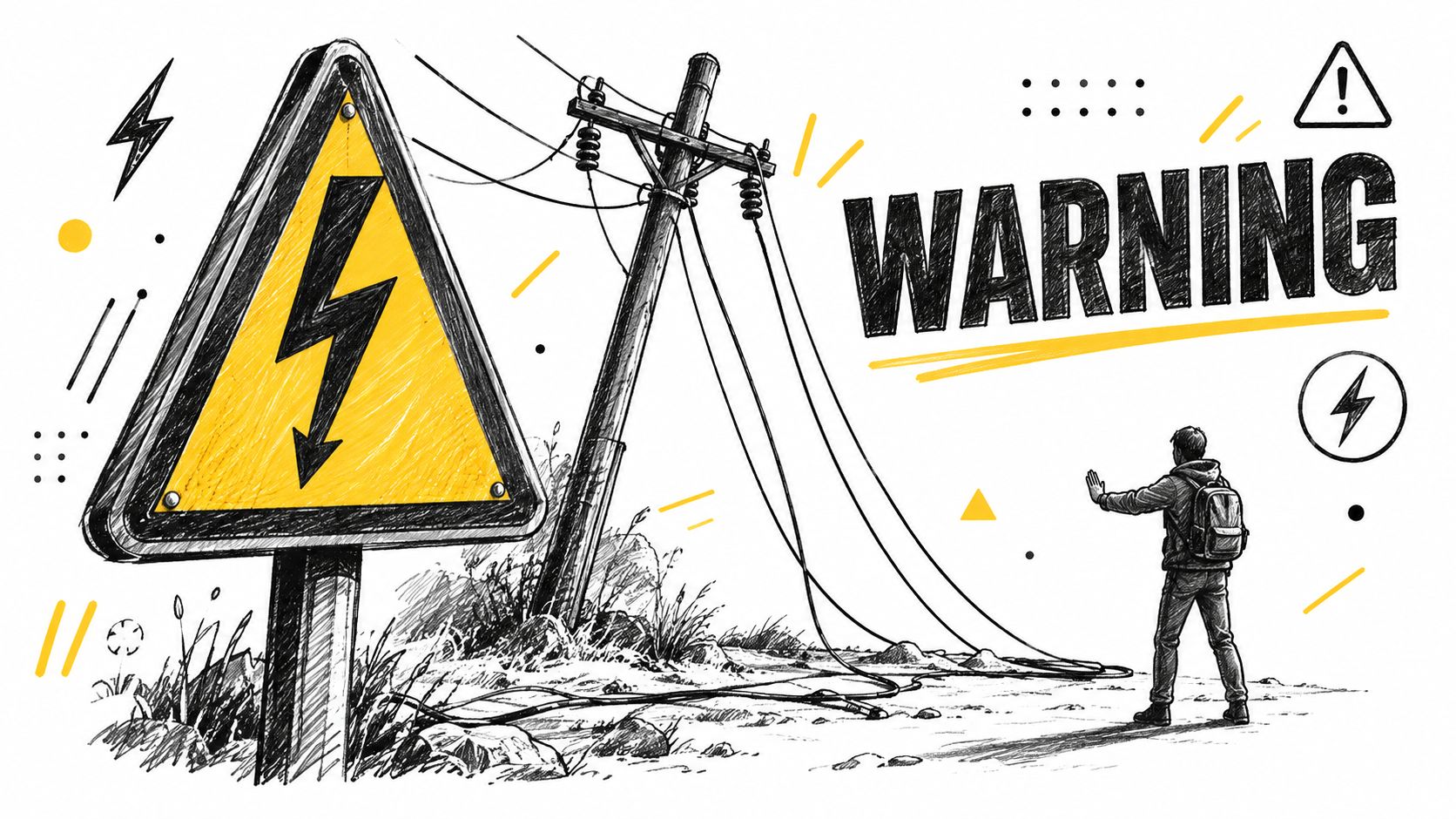
The following image illustrates an electrical hazard context. It doesn't replace a product-specific safety assessment.
Personal Harm in Maintenance Examples
These illustrative statements connect an action with a possible injury. Engineers must validate the actual hazard and protective measures before publication.
- Exposed terminals: WARNING: Do not touch the exposed terminals while the motor operates. Contact can cause electric shock and serious injury.
- Moving parts: WARNING: Keep hands away from the moving linkage. The linkage can crush fingers.
- Work at height: WARNING: Do not enter the unprotected platform. A fall can cause fatal injuries.
- Hot surfaces: WARNING: Do not touch the engine casing before it cools. The surface can cause burns.
- Flammable vapor: WARNING: Do not operate the pump near an open flame. Fuel vapor can ignite and cause serious injury.
- Stored energy: WARNING: Do not disconnect the pressurized line. Released fluid can cause injury.
These examples aren't complete maintenance procedures. Each equipment design may require additional controls, isolation steps, or verified conditions. Writers shouldn't invent those details.
The wording should identify the relevant exposure. “Dangerous equipment” doesn't explain whether the person faces crushing, shock, heat, or another hazard.
The ANSI Severity Distinction
Under ANSI Z535, WARNING identifies possible death or serious injury. CAUTION identifies possible minor or moderate injury. ANSI Z535.4 also associates WARNING with orange panels and CAUTION with yellow panels, as explained in the ANSI product safety label guidance.
That is an injury-severity classification, not an equipment-versus-person classification. A label appropriate under one system may therefore be inappropriate under another.
A writer must never choose CAUTION merely to soften a foreseeable fatal or serious injury risk. The consequence assessment controls the selection, not an editor's preference for less forceful wording.
Equipment failure doesn't cancel an associated personal injury risk. The writer must retain the personal-harm classification when the same condition also damages equipment.
A WARNING names a risk to people. It doesn't signal a stronger tone.
When CAUTION Is the Correct Signal Word
The damage-only test asks what can suffer harm if someone ignores the instruction. Under ASD-STE100, CAUTION applies when the answer is only machines, tools, or equipment.
This doesn't mean that equipment damage is unimportant. It means that the statement belongs to a different harm category. Repair cost or operational inconvenience doesn't turn equipment damage into personal injury.
ASD-STE100 Issue 9, Part 1, Section 7 provides the exact requirements for warnings and cautions. It distinguishes personal harm from equipment damage and requires an explanation of the risk or possible result.
Equipment-Only Examples
The following examples assume that the assessed condition presents no personal injury risk. That assumption must come from technical review, not from the writer's choice of label.
- Cover installation: CAUTION: Do not install the cover while the motor operates. Installing the cover can damage the motor.
- Water exposure: CAUTION: Do not spray water on the control board. Water can damage the circuits.
- Thread damage: CAUTION: Do not overtighten the fastener. Excessive tightening can strip the thread.
- Cable routing: CAUTION: Keep the cable clear of the housing joint. Closing the housing can pinch and damage the cable.
The fastener example illustrates classification, not a complete installation instruction. A real procedure may need an approved tightening value or another validated acceptance condition.
The cable example also requires technical review. If cable damage could expose a person to injury, the equipment-only assumption would no longer apply.
Why Milder Wording Isn't the Test
A common error is to label a burn or electric shock risk CAUTION because the expected injury seems limited. That reasoning imports a severity distinction from another system.
For an STE document, the writer must first identify whether personal injury is possible. A minor injury remains personal harm. The classification doesn't change because an editor considers the event unlikely or the wording excessive.
Damage-only test: CAUTION is appropriate only after the technical assessment excludes personal injury from the condition being described.
The consequence sentence should agree with the label. A CAUTION followed by “Contact can cause burns” contains a classification conflict.
Before publication, the reviewer should resolve that conflict against the official specification. Changing the consequence merely to preserve an existing label isn't an acceptable correction.
Mixed Risks and Other Standards That Use Different Rules
When one condition can injure a person and damage equipment, ASD-STE100 uses WARNING. The writer must not separate out the equipment consequence to justify a weaker classification.
A practical assessment records each possible harm. The reviewer identifies the worst realistic outcome, selects the applicable signal word, and checks the stated consequence.
The Issue 9 overview provides context for the current STE framework. Exact decisions still require the governing specification and a sound technical assessment.
Signal Word Meaning by Governing System
| System | WARNING Means | CAUTION Means | Basis |
|---|---|---|---|
| ASD-STE100 Issue 9 | Risk of injury or death | Risk of damage to machines, tools, or equipment | Type of harm |
| ISO 3864-2 | Possible death or serious injury | Possible minor or moderate injury | Injury severity |
| ANSI Z535.4 | Possible death or serious injury | Possible minor or moderate injury | Injury severity |
| FAA aviation alerting | Immediate flight-crew awareness and immediate response | Immediate awareness with less-urgent follow-up | Response urgency |
ISO 3864-2 distinguishes WARNING from CAUTION through possible injury severity. Its definitions cover serious or fatal harm versus minor or moderate injury. The ISO product safety label specification establishes that distinction.
ANSI Z535.4 uses the related severity hierarchy described earlier. Its CAUTION category must not be read as the STE equipment-only category.
Aviation Uses Response Urgency
FAA flight-crew alerting distinguishes immediate response from less-urgent follow-up. WARNING requires immediate awareness and response. CAUTION requires immediate awareness, followed by a less-urgent or subsequent response.
FAA guidance associates red with immediate awareness and action or decision. Amber or yellow indicates immediate awareness with future action or decision. These definitions appear in the FAA flightcrew alerting guidance.
A flight-deck alert category therefore doesn't automatically determine a maintenance instruction's signal word. The organization must identify which system governs each document or display.
For translators, the English word alone isn't enough. The translation record should preserve the governing definition, harm type, and required response.
- Document control: Name the governing standard for each document set.
- Translation review: Check meaning against that standard, rather than a familiar equivalent word.
- Conflict resolution: Refer disputed classifications to the technical reviewer and applicable specification.
When STE Guide's explanation and the official specification differ, the official specification is correct. An educational explanation cannot replace that authority.
Rewriting Warning and Caution Sentences in STE
- Name the harm. Identify personal injury, equipment damage, or both.
- Choose the signal word. Apply the governing system rather than the original sentence's tone.
- Write the action. State a clear command or condition.
- Explain the result. Use a separate, short sentence for the possible consequence.
- Check the language. Consult the dictionary guidance, then run the free STE checker before human review.
Before and After Signal-Word Rewrites
| Original Text | STE Rewrite | Signal Word | Reason |
|---|---|---|---|
| Be careful not to get water on the control board. | CAUTION: Do not spray water on the control board. Water can damage the circuits. | CAUTION | Harm is damage to equipment only. |
| Warning: the engine casing is hot, so be careful. | WARNING: Do not touch the engine casing before it cools. The surface can cause burns. | WARNING | Harm is personal injury. |
| Note: fuel vapor is flammable near the pump. | WARNING: Do not operate the pump near an open flame. Fuel vapor can ignite and cause serious injury. | WARNING | Fire risk includes personal injury, so WARNING applies. |
| Take care with the cover. It may scratch the paint. | CAUTION: Do not drag the cover across the paint surface. The paint can scratch. | CAUTION | Harm is damage to the finish only. |
The control-board rewrite replaces general care wording with a prohibited action. Its equipment-damage consequence supports CAUTION under the stated assumptions.
The engine-casing rewrite identifies the contact to avoid. Burns establish personal harm, so WARNING applies.
The fuel-vapor rewrite changes an informational note into a hazard statement. The stated possibility of serious injury requires the personal-harm category.
The cover rewrite identifies the movement that can damage the finish. CAUTION fits only while the assessed harm remains equipment damage.
Check Meaning Before Word Choice
These rewrites illustrate a method, not universal instructions for every product. A writer must confirm that each action actually controls the identified hazard.
For example, “before it cools” may need a measurable acceptance condition in an actual procedure. The engineer must supply that condition. The writer shouldn't invent a temperature or waiting period.
The ASD-STE100 dictionary guide explains how approved vocabulary works. A word's appearance in ordinary English doesn't establish approval for every technical meaning.
The writer should also keep commands separate. Combining disconnection, removal, and inspection in one sentence can obscure which action prevents the injury.
A checker can support this review, but it cannot establish that the technical instruction makes the task safe. The writer still checks the rule, and the engineer validates the hazard and protective action.
Confirm the Signal Word Before You Publish
- Classification: Confirm that every label agrees with the assessed harm.
- Consistency: Use the same signal word for the same assessed hazard across manuals, labels, and procedures under the same governing system.
- Translation: Preserve the signal word's defined meaning, harm type, and required action.
- Completeness: Check that the safety statement gives a command or condition and explains the possible result.
- Vocabulary: Confirm approved words and meanings before accepting the final wording.
A document-set review should compare related instructions, not inspect each page in isolation. An equipment manual and a service procedure can describe the same hazard differently.
The reviewer should investigate those differences. A different label may reflect a genuine difference in exposure, or it may reveal an inconsistent assessment.
Resources for the Final Review
- Draft triage: The free STE checker supports an initial review of draft wording.
- Sentence structure: The writing rules guidance explains controlled-language principles for procedures.
- Rewrite practice: The before-and-after examples illustrate changes from ambiguous wording to clearer instructions.
- Specification access: The official PDF access guide directs readers to the authoritative specification.
The STE Checker is free to use and checks the writer's own text for common STE problems. It is a heuristic tool, not an official ASD-STE100 conformity check.
It can miss problems or flag correct text. A clean result doesn't confirm the signal word, technical accuracy, or completeness of the safety instruction.
Record the Decision
The review log should identify the hazard, selected signal word, governing system, and unresolved questions. This makes the decision traceable without relying on an editor's memory.
For translated material, the reviewer should record any terminology decision that affects hazard meaning. The source and translated statements must preserve the same protective intent.
The final review should distinguish a language correction from a technical change. Replacing a word may require engineering approval when it changes the stated consequence or avoidance action.
The document controller should mark each signal word as confirmed in the review log. The controller should then send the complete document set to the designated reviewer.
STE Guide offers independent explanations, worked examples, and a free heuristic checker for ASD-STE100 writing. Documentation teams can visit STE Guide to practice warning and caution rewrites and locate the official specification before their next review.