You're reviewing a maintenance procedure, and the checker has flagged another passive sentence. Changing the wording looks easy until you realise the document never says who performed the action. Before you move a noun or replace a verb, you need to decide whether the rewrite will clarify the instruction or introduce information you can't verify.
Table of Contents
- The Editing Moment That Changes the Question
- How to Recognise a Real Passive Construction
- When Passive Voice Is the Better Choice
- A Six-Step Workflow to Convert Passive to Active
- Checking That Your Rewrite Did Not Break the Meaning
- What to Do When the Actor Is Missing
- A Practical Checklist Before You Submit
The Editing Moment That Changes the Question
Consider a hypothetical review session. Two technical writers are checking a service report alongside a maintenance procedure. One circles was and were throughout the documents and requests active-voice rewrites.
The other stops at this sentence: The equipment was damaged during transit. The report identifies the damage and when it occurred, but it doesn't identify who caused it. Rewriting it as The carrier damaged the equipment would assign responsibility without evidence.
That's a useful disagreement to have before approving a document.

Start with the communication job
The first writer has a reasonable concern: readers of procedures need to know what to do. The second writer is protecting the record's accuracy. Neither concern can be resolved by counting forms of be.
Compare those documents' purposes:
- A procedure directs action. The reader needs an instruction and, where necessary, an explicit responsible role.
- A service report records an event. The writer must distinguish established facts from assumptions.
- A condition statement describes status. The reader may need to understand the equipment's condition rather than the person who caused it.
The instruction to change passive to active voice is therefore incomplete. A better editing instruction is: decide what the sentence must communicate, then choose the construction that communicates it accurately.
Treat voice as a choice, not a verdict
Passive voice isn't an incorrect form awaiting repair. Both voices have historical roots in English, and the preference for active formulations belongs to a history of stylistic advice, not a grammatical prohibition. That distinction is supported by Language Log's discussion of passive-voice criticism.
Review principle: Approve the sentence that serves the reader's task without adding unsupported responsibility.
For a technical-writing review, an unclear action owner is a substantive problem. A well-focused passive report sentence is not defective only because it contains was. The important question is what the reader needs to know.
How to Recognise a Real Passive Construction
The data were recorded by the sensor. The data receive the action, while the sensor performs it. Compare The sensor recorded the data: the sensor now performs the action and is the grammatical subject. The event stays the same; the sentence changes which participant leads.
A reliable test starts with the relationship between the subject and the verb, not with a single word. Google's technical-writing guidance on active voice explains this distinction and notes why an omitted actor can make sentences harder to read.
Check the verb phrase and its subject
A passive construction often has a form of be followed by a past participle. The be forms include am, is, are, was, were, be, been, and being. Participles include recorded, closed, written, and removed. Some don't end in -ed, so check the word's role rather than its spelling.
Then ask what the grammatical subject does. In The data were recorded by the sensor, were recorded is the passive verb phrase: the data receive the action, and by the sensor names the actor. The actor phrase is optional. The valve was closed can still describe an action even though it does not say who closed it.
Read be and the participle in context
The combination of be and a participle is a clue, not a verdict. In The valve is closed, closed may describe the valve's current condition rather than an action. Context helps distinguish the readings:
| Example | What to check |
|---|---|
| The valve was closed by the operator. | The actor phrase identifies who performed the action. |
| The valve is closed. | Does the surrounding text describe a condition or an action? |
| The technician is ready. | Is alone does not make a sentence passive. |
That distinction protects meaning. Changing The valve is closed to Close the valve changes a description into an instruction; it does not change voice.
Use the video to practise checking whether a sentence describes an action or a state.
A checker's flag is a prompt to inspect the sentence. Confirm that the subject receives an action before deciding whether to rewrite it.
When Passive Voice Is the Better Choice
A lab report may focus on what happened to a sample, while a maintenance instruction must make clear who acts. The choice of voice depends on that purpose, not on a rule to replace every passive verb.
Passive constructions appear more often in writing than in speech. A British National Corpus analysis reported approximately 63 full passive constructions per million words in written texts, compared with approximately 9 per million in speech, as discussed in this review of passive constructions and comprehension.
The same review describes a study of undergraduate theses in which selected stance-verb constructions were 64.8% active and 35.2% passive. Those figures apply to the verbs selected for that study, not to every clause in academic writing. They are evidence of usage, not targets for your own writing.
Frequency alone does not show whether a sentence is clear. The review's experimental findings do not support treating every passive construction as a comprehension problem. Genre, audience, and information focus matter.
Decide what the reader needs first
Before changing the sentence, ask what the reader needs to notice. A useful test is to compare the actor's importance with the importance of the affected object, method, or result:
- Identify the actor. Can you establish who performs or performed the action?
- Check the actor's importance. Does the reader need to know who acted to understand responsibility or act correctly?
- Identify the topic. Is the sentence mainly about a person, an affected object, a method, or a result?
- Test the emphasis. Would putting the actor first help the reader, or draw attention away from the information they need?
Oxford's guidance on choosing active and passive voice recommends active voice for concision and clear responsibility, while recognizing that passive voice can keep attention on a method, result, or affected object.
Name an actor when that person or role adds relevant, verified information.
A procedure and a result description can refer to the same component but serve different purposes. In a procedure, readers may need to know who owns an action. In a result description, repeatedly naming the operator can pull focus from the object being discussed.
For writers using ASD-STE100, separate a general style choice from a standard-specific rule. This comparison of STE and Plain English helps clarify the difference. A sound decision serves the reader and follows the writing rules that apply.
A Six-Step Workflow to Convert Passive to Active
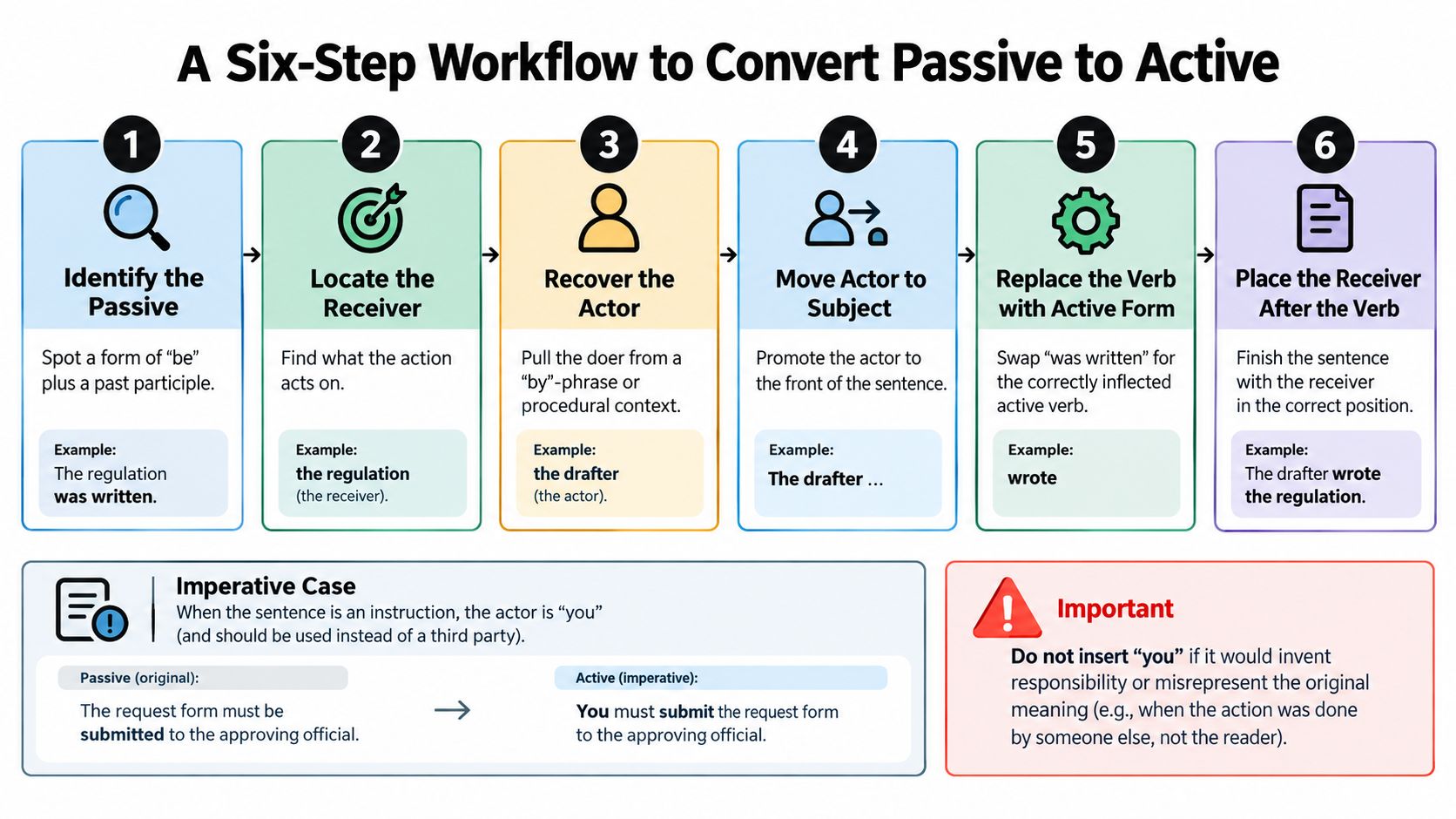
Once you've decided that active voice is appropriate, the conversion becomes a controlled grammatical operation. Start with a sentence that names both participants:
The regulation was written by the drafter.
The goal is to express the same event with the performer as the subject. NASA's writing standard recommends a who-does-what order to make responsibility clearer, while allowing passive constructions when the actor is unknown, unimportant, or obvious.
Follow the participants through the sentence
- Identify the passive construction. The verb phrase is was written. It reports a completed writing action in the past.
- Locate the receiver. The regulation receives the action. Keep that noun phrase intact while you rearrange the sentence.
- Recover the actor. The phrase by the drafter supplies the performer. You don't need to infer a role from outside the sentence.
- Move the actor to subject position. Begin the revision with The drafter. Remove by, which belonged to the passive structure.
- Use the correctly inflected active verb. Replace was written with wrote. Don't use writes, which would change the tense.
- Place the receiver after the verb. The complete revision is The drafter wrote the regulation.
Read both versions together. The drafter remains the performer, the regulation remains the receiver, and the action remains in the past.
Use the workflow graphic as a reference during practice.
Handle instructions without assigning the wrong role
Consider The request form must be submitted to the approving official. If the procedure establishes that the reader submits the form, write:
Conversion example: You must submit the request form to the approving official.
That revision retains must, the request form, and its destination. Notice that the approving official is the recipient, not necessarily the person who submits the form.
An imperative such as Submit the request form to the approving official also addresses the reader directly. Choose the form required by the document's instructional conventions rather than assuming every passive sentence needs an explicit you.
For a system action or a department-owned task, name the established performer instead. You is a responsibility assignment, not a convenient grammatical filler.
Consult the applicable technical-writing rule summaries when checking the revised sentence against STE requirements. A successful voice conversion still needs review for vocabulary, sentence structure, and instructional form.
Checking That Your Rewrite Did Not Break the Meaning
A sentence can become shorter while its instruction changes. For example, replacing The panel may be removed with Remove the panel turns permission into a command. Replacing The valve must not be opened with Open the valve reverses a prohibition. Those edits improve neither clarity nor accuracy.
Keep the original beside the revision as you review it. The comparison should work like a parts check: confirm that the sentence still carries the same responsibility, conditions, and consequences.

Start with the meaning-bearing details, not the word order:
- Actor and responsibility. Does the revised subject identify the same responsible person, role, department, or system? If the original does not name an actor, do not treat a plausible guess as evidence.
- Polarity and force. Preserve not, permission, and obligation. May does not mean must, and a prohibition cannot be dropped as if it were spare wording.
- Time and completion. Check whether the action remains completed, ongoing, or required, and whether its timing has changed.
- Object and conditions. Keep the same item, destination, quantity, prerequisites, and sequence.
For instance, The panel may be removed by the technician can become The technician may remove the panel. The actor and object stay the same, and permission remains permission. Changing may to must alters the requirement, even though the sentence is still active.
A clean conversion is not automatically a correct one. NASA's active-voice guidance favors direct instructions while recognizing that passive voice can be appropriate. Judge the edit by what the procedure requires, not by whether it reduces the passive count.
If you track passive clauses divided by total finite clauses, apply one consistent counting method and review flagged sentences for meaning. The result is a diagnostic, not a quota.
Acceptance criterion: A voice-only edit leaves responsibility, safety status, permissions, prohibitions, quantities, and sequence unchanged.
Use worked technical-writing examples to compare revisions. Mark any substantive change separately so a grammar edit does not disguise a change that requires engineering or procedural approval.
What to Do When the Actor Is Missing
The unit was inspected presents a different problem from a sentence with an explicit by phrase. There's no actor to move into subject position. Before rewriting, you need evidence or a clear reason to retain the original construction.
Don't fill the gap with the role that seems most likely. A technician, maintenance department, contractor, or automated system might perform an action, but plausibility isn't proof. The omitted-actor problem identified in Google's guidance above requires a responsibility check, not a guess.
Safe Rewrites When the Actor Is Missing
| Sentence type | Original example | Recommended rewrite | Why |
|---|---|---|---|
| Reported fact | The unit was inspected. | Maintenance inspected the unit, only if the record confirms this. Otherwise retain the original. | A completed-event report needs evidence for the named performer. |
| Instruction | The valve must be closed before start-up. | Close the valve before start-up, if the reader is the established performer. | The imperative directs the responsible reader and retains the prerequisite. |
| Process description | The specimen was heated to 80°C. | Retain the original. | The specimen and treatment are the focus; naming an operator may add nothing useful. |
| Warning or damage notice | The equipment was damaged during transit. | Retain the original when the responsible actor is unknown. | The notice communicates damage without assigning unsupported blame. |
The temperature in the process example is part of the illustrative sentence discussed in the previously linked passive-voice review. It's not a recommended operating value.
Recover responsibility from evidence
For a reported event, inspect the relevant service record or approved source material. For an instruction, check the procedure's scope and role assignments. If neither establishes an actor, flag the question for the document owner.
- Verified actor available. Use that person, role, department, or system as the subject.
- Actor irrelevant to the message. Keep the passive if it preserves the intended focus.
- Action owner required but unresolved. Request clarification rather than publishing an invented assignment.
Don't convert a past report into an imperative to escape the missing actor. Replace the valve doesn't mean the same thing as The valve was replaced. The first directs future action; the second records a completed event.
A retained passive can be the correct editorial outcome. An unresolved responsibility in a procedure, however, may require more than a grammatical revision.
A Practical Checklist Before You Submit
A disciplined review separates sentence classification, voice choice, and meaning verification. You don't need to rewrite every flagged construction. You need a reason for each change and a way to confirm that the revised wording remains accurate.
Run this checklist against the original and proposed revision, not against the revision alone. Keep the surrounding step, warning, or report paragraph visible so you don't lose its context.
Ask these questions in order
- What job does the sentence perform? Classify it as an event report, instruction, process description, or warning. Your mental test is whether the reader must act or understand something that happened.
- Is the actor established? Point to the named performer or the approved context that supplies the role. If you can't, mark responsibility as unresolved.
- Does the revision preserve the event? Compare the action, polarity, timing, permission, and affected object. Watch for a change from may to must, or from a condition to a command.
- Would inserting you assign a new task? Confirm that the document already makes the reader responsible. Don't transfer a system or departmental action to the user.
- Is the operational content unchanged? Check safety status, quantities, destinations, prerequisites, and sequence. Route any substantive alteration through the appropriate approval process.
Record decisions that reviewers can defend
Use short review notes such as Actor confirmed in service record, Retained for result focus, or Procedure owner must clarify responsibility. These notes make your reasoning visible without turning the review into a debate about personal style.
A heuristic checker can help locate candidates, and manual comparison can establish whether the edits are sound. Neither a clean checker result nor a reduced passive rate replaces that comparison.
When you change passive to active voice, judge progress by the quality of the resulting instructions and the accuracy of the record. Clearer wording is an improvement only if it remains true.
For practice, visit STE Guide, an independent educational resource with writing-rule explanations, worked examples, a structured learning path, and a free heuristic checker. Use it alongside your organisation's review process and the official specification to practise active-voice revisions, then verify each proposed change against the original responsibility and meaning.