Clarity in writing is the reader's ability to find, understand, and use the intended meaning, and that is different from just writing short sentences or using simple words. A document can be brief and still leave the reader unsure what to do next.
What makes one paragraph clear and another frustrating? The answer usually has less to do with style and more to do with whether the reader can act on the meaning without guessing.
Table of Contents
- A Working Definition of Clarity in Writing
- How the Idea of Clarity Evolved
- Three Measurable Criteria That Make Writing Clear
- STE-Aligned Techniques for Clearer Technical Writing
- Before and After Examples That Show Clarity at Work
- Clarity for Multilingual Readers and Translation
- A Practical Clarity Test for Your Own Drafts
A Working Definition of Clarity in Writing
Clarity in writing means a reader can find, understand, and use the intended meaning. That single sentence is a useful style-guide definition because it shifts attention from the writer's preferences to the reader's outcome. If the reader can't locate the right information, make sense of it, or apply it correctly, the writing isn't clear enough, even if it sounds polished.
The three reader jobs
The three jobs are simple to name and hard to fake. First, the reader must find the right information without hunting through extra words or awkward structure. Second, the reader must understand the intended meaning without having to infer hidden actors, conditions, or sequences. Third, the reader must use that meaning correctly in a real task, such as following a procedure, completing a form, or translating an instruction into action.
Practical rule: If a reader can repeat the meaning but still can't act on it, the writing is not fully clear.
That definition matters because people often confuse clarity with brevity, simplicity, or a low score on a readability formula. Those can help, but they're only proxies. A sentence may be short and still unclear if it hides the actor, uses an ambiguous term, or bundles several actions together.
A better test is whether the text gives the reader one intended meaning and one usable interpretation. In technical writing, that usually means explicit subjects, explicit actions, explicit conditions, and a structure that lets the reader move through the information in the right order. When you write with that target in mind, clarity becomes a performance standard, not a matter of taste.
How the Idea of Clarity Evolved
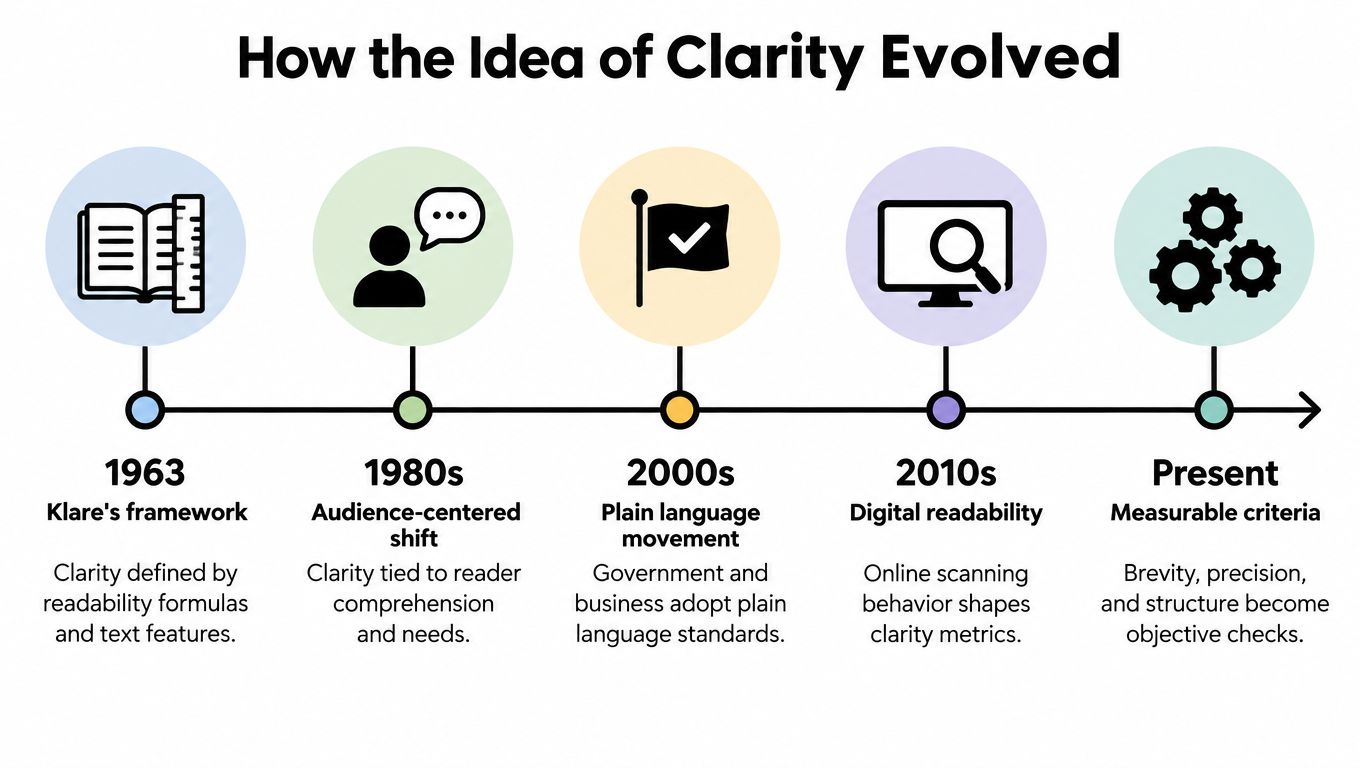
The modern view of clarity starts with George R. Klare's 1963 framework in The Measurement of Readability, which treated written difficulty as something you could study through vocabulary and stylistic features. That work helped establish a measurable way to look at text, but it also pointed to a larger truth: text alone doesn't explain comprehension. The reader matters too. Klare's foundational readability framework is still useful because it marks the first serious shift toward measurable writing features.
From text scores to reader outcomes
Later research identified factors such as average sentence length, familiar words, difficult words, syllable length, and explicit sentences as measurable clues to difficulty. Those measures still matter, but they don't capture everything. The audience's prior knowledge, the document's organization, and the technical context shape whether the reader understands what the text says. Traditional formulas calibrated to grade levels have been associated with only about 50% to 75% comprehension in some documentation research, which is a strong reminder that a readable-looking text can still fail its reader.
That's why the historical milestone isn't just better scoring methods. It's the move from treating readability as a property of the text alone to treating comprehension as an interaction between text and reader. In practical terms, clarity now means writing so that a real person can recover the intended meaning and act on it.
The policy side of that shift also matters. The United States Plain Writing Act of 2010 required federal agencies to write and present information the public can understand and use, and that set a strong operational standard for communication. A Federal Reserve review of plain-language projects then showed what that standard can do in practice. Rewriting documents with simpler language, shorter sentences, improved structure, and cleaner design made memos, agreements, and notices faster to understand and reduced staff time, including one letter that increased response from 43% to 66% and a staff-time saving equivalent to $4.4 million in 1999 dollars. The Federal Reserve review shows why clarity is not just cosmetic.
Three Measurable Criteria That Make Writing Clear
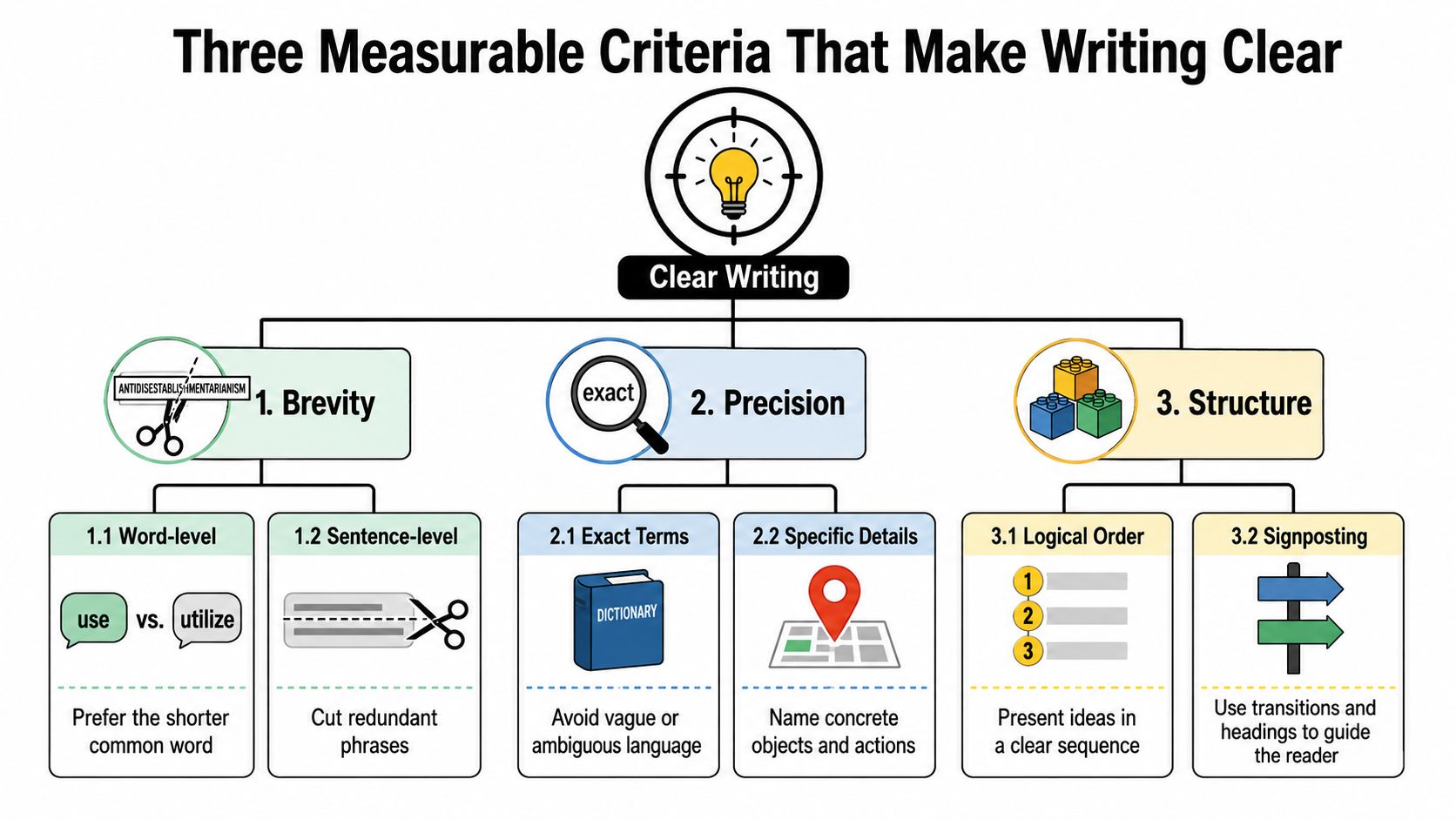
A useful way to judge clarity is to check whether the draft reduces reader effort in three ways: brevity, single-meaning words, and active voice. These aren't style decorations. Each one removes a specific kind of processing load.
Brevity that protects meaning
Brevity works at two levels. At the word level, prefer the shorter common word when it means the same thing. At the sentence level, keep one main idea in each sentence whenever possible, and treat sentences over 30 words with extra care. NASA's writing standards recommend an average sentence length of 20 words or fewer, along with simple, active, affirmative, declarative sentences and a “who-does-what” order. NASA's writing guidance shows why that structure helps.
Single-meaning words
Precision begins with word choice. A word that carries more than one likely meaning forces the reader to pause and sort out which sense you intended. In technical writing, that pause is expensive because the reader may be deciding whether a term refers to a part, a condition, a result, or a command. When a term is necessary, define it at first use and keep the sense consistent.
Active voice that shows the actor
Active voice is not about sounding lively. It makes the actor visible. That matters because readers need to know who performs the action, what gets acted on, and what happens next. Passive voice is sometimes acceptable when the actor is unknown or intentionally unimportant, but it should not be the default when responsibility or sequence matters.
A sentence is clear when the reader can point to the actor, the action, and the object without hesitation.
These three criteria work because they reduce ambiguity before the reader has to solve it. They don't guarantee clarity on their own, but they give you concrete checks you can apply while editing.
STE-Aligned Techniques for Clearer Technical Writing

Simplified Technical English turns clarity into a set of working rules. It uses approved vocabulary, one meaning per word, short sentences, active voice, one instruction per sentence, and simple tenses, as summarized in the STE writing rules overview. If you want a structured comparison between STE and plain English, the distinction is laid out clearly in this STE Guide comparison of STE and plain English.
How the rules map to clarity
Each rule reduces a different kind of reader effort. Approved vocabulary narrows the range of possible meanings. One meaning per word keeps a term from shifting sense across the document. Short sentences help the reader hold the full instruction in working memory, while active voice keeps the actor and action visible. One instruction per sentence matters in procedures, because two actions in one line can hide a dependency.
Simple tenses support the same goal. They keep events anchored in a predictable time frame, which helps the reader see whether an action is current, conditional, or completed. In maintenance and service writing, that timing matters as much as word choice. The rule set can look strict at first, but each rule removes a different source of confusion.
Why the rule set feels stricter than it is
STE is not meant to make prose sound mechanical. It is meant to make instructions recoverable and executable. That is why it works well in manuals, work cards, warnings, and troubleshooting steps. When a sentence violates the rules, the usual result is ambiguity, not just a style problem.
A short sentence can still obscure meaning if it drops a condition or splits a cause from its result. The better test is whether the reader can act without guessing. A qualified reader should be able to see what to do, in what order, and under what condition.
You can apply that logic even if you do not write to the full standard. STE is one practical way to operationalize clarity, because it turns a reader outcome into specific editing choices.
Before and After Examples That Show Clarity at Work
A sentence can get shorter and still become worse. That happens when shortening removes the actor, the condition, or the order of events that the reader needs. Technical writing suffers most when a tidy-looking sentence hides a real decision.
When longer is clearer
Take this maintenance sentence: “After inspecting the seal, tighten the bolts and record the reading if it is acceptable.” It sounds concise, but it leaves too much unresolved. Who inspects the seal? Who tightens the bolts? What does “it” refer to? Is recording conditional, and if so, conditional on what?
A clearer version may be longer: “Inspect the seal. Tighten the bolts to 25 N·m. Record the torque value. If the value is not 25 N·m, correct the installation.” The revised version is easier to use because it names the actor by implication, separates actions, and makes the condition visible.
When one sentence hides a safety issue
Here's another common pattern: “Check the cable and reconnect it if necessary.” That looks efficient, but it mixes inspection and action in a way that can blur the decision point. A reader can miss the fact that reconnection depends on the result of the check, not on preference or habit.
A safer rewrite splits the logic: “Check the cable. If the cable is loose, reconnect it. Verify the connection after reconnection.” The sentence count goes up, but the risk of misreading goes down.
Shorter is only clearer when it preserves the relationships the reader needs.
That's the test. If a shorter sentence deletes a condition, a sequence, or a responsibility, it may be less clear even if it looks cleaner on the page. The best revision is the one that makes the task easiest to complete correctly.
Clarity for Multilingual Readers and Translation
Clarity gets harder when the reader doesn't share the writer's assumptions. A sentence that feels obvious to a native speaker can be opaque to someone translating it, localizing it, or reading it through a different cultural lens. That's why clarity has to survive beyond the first language of the author.
Writing that survives translation
Recent research on global technical documentation reports that participants valued simple language for both human readability and machine-translation performance, and that short sentences and standardized syntax improved translation-memory matching. The practical lesson is straightforward. If you want your text to travel well, use consistent terminology, avoid idioms, and make conditions visible instead of implied. The multilingual technical documentation study points in that direction.
The hidden costs usually come from casual phrasing. An idiom can be clear to one group and nonsense to another. Inconsistent word senses can make a translation tool or a human translator choose the wrong equivalent. Implicit knowledge is even trickier, because the writer may assume the reader knows a local practice, a product habit, or an unspoken sequence.
A simple workflow for international clarity
Draft for one intended meaning. Test the draft with representative international users before translation. Inspect where terminology, sequence, or tone creates translation risk. Revise based on actual misunderstandings, not just a readability score.
That workflow matters because multilingual clarity isn't about writing “simpler” English for its own sake. It's about building text that stays stable when it moves across readers and languages. In technical content, that stability lowers confusion and makes downstream translation less fragile.
A Practical Clarity Test for Your Own Drafts
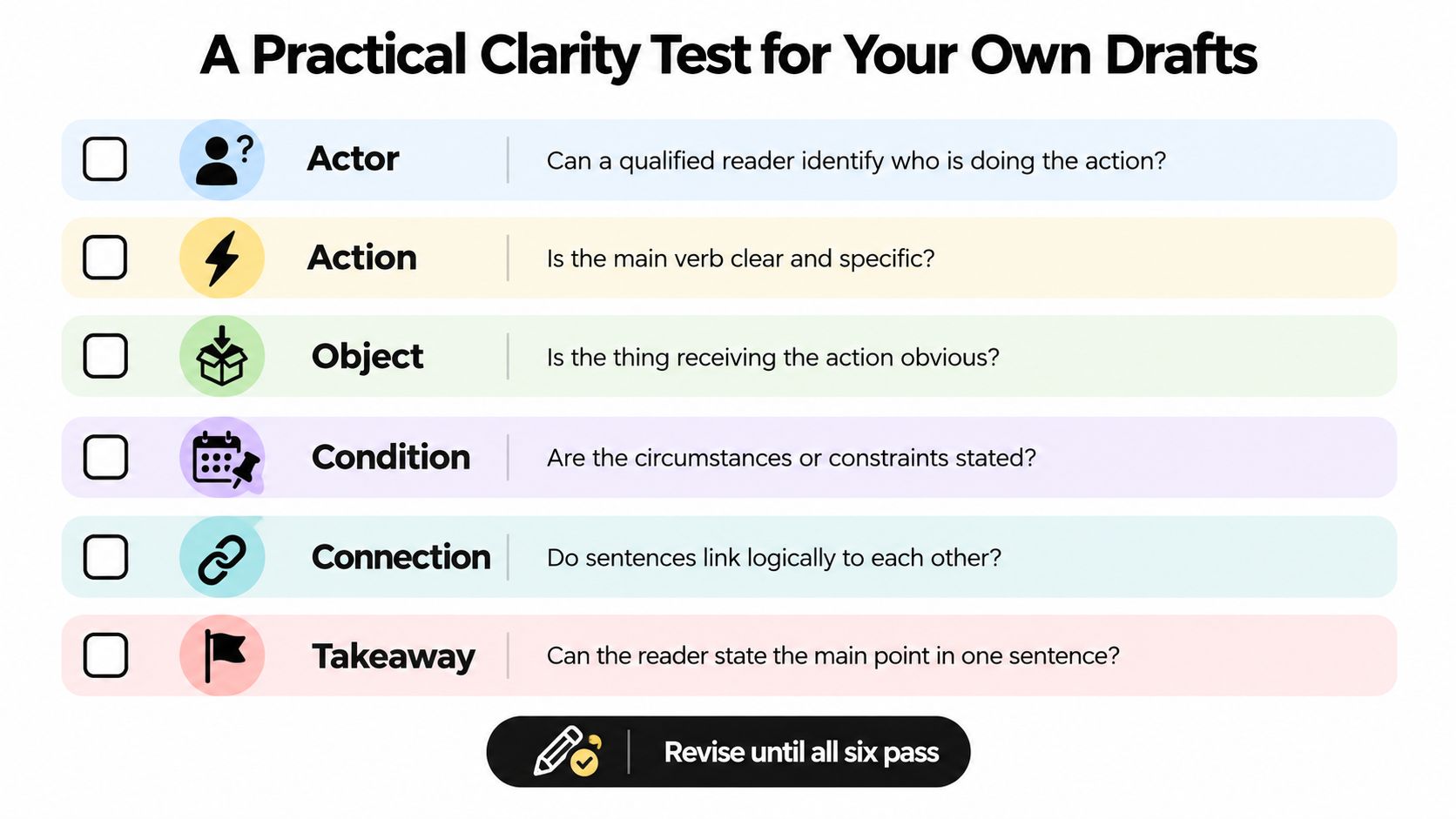
Use a six-part check on any draft: actor, action, object, condition, sequence, and expected result. If a qualified reader can identify each one without inference, the text is in much better shape. If one element is missing, add it where the reader first needs it.
The six-part check
- Actor: Can the reader tell who does the action?
- Action: Is the main verb specific and direct?
- Object: Is the thing receiving the action obvious?
- Condition: Are the limits, triggers, or constraints stated?
- Sequence: Do the steps appear in the order the reader must follow?
- Expected result: Can the reader tell what success looks like?
If the answer to any one of those is no, revise the sentence or split it into smaller steps. A readability formula won't reliably catch missing responsibility or hidden conditions, but this test often will.
For a quick draft review, STE Guide's free checker is one tool you can use alongside manual editing. It's not a substitute for judgment, but it can help you spot likely issues early.
Clarity shows up in outcomes. Readers ask fewer follow-up questions, onboarding gets easier, translation work becomes less fragile, and execution errors become less likely. That's why clear technical writing is worth treating as a craft skill, not a cosmetic preference.
If you want a practical way to apply these ideas to manuals, procedures, and global technical content, visit STE Guide for worked examples, rule summaries, and a free checker built around Simplified Technical English. It's a useful place to see how clarity, structure, and controlled language come together in real documentation.
Prepared with Outrank