
A writer opens a draft data module before a review. The XML passes the schema check. The reviewer still marks many sentences as unclear. Most marked sentences hide the actor. The reader cannot tell who removes, checks, or connects a part. S1000D Training can teach the file structure. Clear sentences need separate practice. The writer must find each passive form. The writer must then name the actor.
Table of Contents
- Passive Patterns and Active Rewrites at a Glance
- S1000D Training Stages and Required Skills
- Where S1000D Training Ends and Writing Rules Begin
- How to Find Passive Sentences in a Draft
- How to Rewrite a Passive Sentence Step by Step
- Special Cases Like Missing Actors and Warnings
- Check Rewrites and Verify Your Training Source
Passive Patterns and Active Rewrites at a Glance
| Passive pattern | Passive sentence | Active rewrite |
|---|---|---|
| Passive with a named actor | The fuse is replaced by the technician. | The technician replaces the fuse. |
| Passive with no actor | The valve is opened. | Open the valve. |
| Passive with a modal verb | The panel can be removed. | You can remove the panel. |
| Passive with 'should be' | The filter should be cleaned at each inspection. | Clean the filter at each inspection. |
| Passive with 'is used to' | The tool is used to measure torque. | Use the tool to measure torque. |
| Nominalized action | The inspection of the hose is performed by the crew. | The crew inspects the hose. |
How to Read Each Row
A named actor already sits after "by". The writer moves that actor to the front. A sentence with no actor often fits a procedure step. A command such as "Open" tells the reader to act.
A modal verb such as "can" keeps the meaning in the rewrite. The writer adds "you" and uses the active verb. A "should be" sentence often hides a direct instruction. The command form states the task and its interval.
An "is used to" sentence hides the person who uses the tool. The verb "Use" makes the action clear. A nominalized action turns a verb into a noun phrase. The writer restores the verb "inspects" and names the crew.
In procedures, the reader often performs the action. The subject can stay hidden in a command verb. In descriptive text, the writer names the technician, operator, or crew. Readers can compare more worked STE example pairs after a first scan.
Practical rule: If a sentence names an action and an actor, move the actor to the front.
The table gives a fast pattern match. The search method and rewrite steps appear later. A writer can mark a draft sentence beside one row first. That match shows the probable rewrite shape.
S1000D Training Stages and Required Skills
Effective training follows the order of production work. A learner first studies one data module. Later stages add links, metadata, validation, and revision control.
| Training stage | Learner task | Check |
|---|---|---|
| Data module basics | Identify the identification-and-status section, content section and DMC | Each module has a valid DMC and status |
| Information types and links | Relate data modules to publication modules and CSDB | Links resolve in the test publication |
| Legacy partitioning | Split a legacy publication into reusable units | Each unit has one clear context |
| Authoring and metadata | Select information type, build metadata, add applicability | Metadata matches the module content |
| Validation | Run schema and project BREX checks before assembly | Assembly passes schema and BREX checks |
| Lifecycle handling | Apply temporary revisions and change marking | Each change traces to a documented revision |
What Each Stage Proves
The data module forms the smallest self-contained unit. Its Data Module Code, or DMC, identifies the module. Publication modules then arrange data modules for delivery. The Common Source Database, or CSDB, stores and controls those objects.
Learners next split a legacy publication into reusable units. Each unit needs one clear context. Learners then select an information type and build status metadata. References and applicability connect the module to other content.
Validation needs two separate gates. The schema checks the XML structure. The project Business Rules Exchange, or BREX, checks permitted project choices. Exercises must use the project BREX, not a sample file.
Lifecycle practice covers temporary revisions, change marking, and version differences. Those tasks often cause errors in live projects. Trainers should measure module type, structure, metadata, references, and BREX faults separately.
Writers are not the only audience. Maintenance engineers, editors, localization specialists, quality reviewers, and managers need role-specific skills. Each role makes different decisions about content and delivery.
Where S1000D Training Ends and Writing Rules Begin
A data module can pass its structure checks and still contain unclear instructions. S1000D training addresses information structure and publication workflow. Writing rules address how each sentence communicates an action.
Two Different Controls
S1000D training usually covers data modules, project business rules, and publication workflow. ASD-STE100 covers vocabulary, grammar, sentence structure, and style. Active voice belongs to sentence-level writing practice, not XML structure. The scope of the S1000D specification helps writers distinguish these responsibilities.
Many projects use both systems. The contract and project business rules determine which requirements apply. A BREX can enforce project choices that a tool can check. The writer still decides who acts, which verb names the action, and what receives it.
The official ASD-STE100 Issue 9 specification was published in January 2025 and replaces earlier issues.
Training should use Issue 9 rather than an older handout. A provider should identify the issue used in exercises and assessments. Writers can check uncertain points against the official text.
STE Guide is a free, independent educational resource. Its explanations use the current official ASD-STE100 specification as their main source. The site's content is for general education, not a replacement for the specification. STE Guide does not represent ASD or host a copy of the PDF; it links to the official file.
To practise active voice, work sentence by sentence: identify the passive construction, name the actor when the context supports it, then check that the rewrite preserves the intended action.
How to Find Passive Sentences in a Draft
A reliable search beats a quick visual scan. The writer searches for known word patterns first. Each match then needs a meaning test.
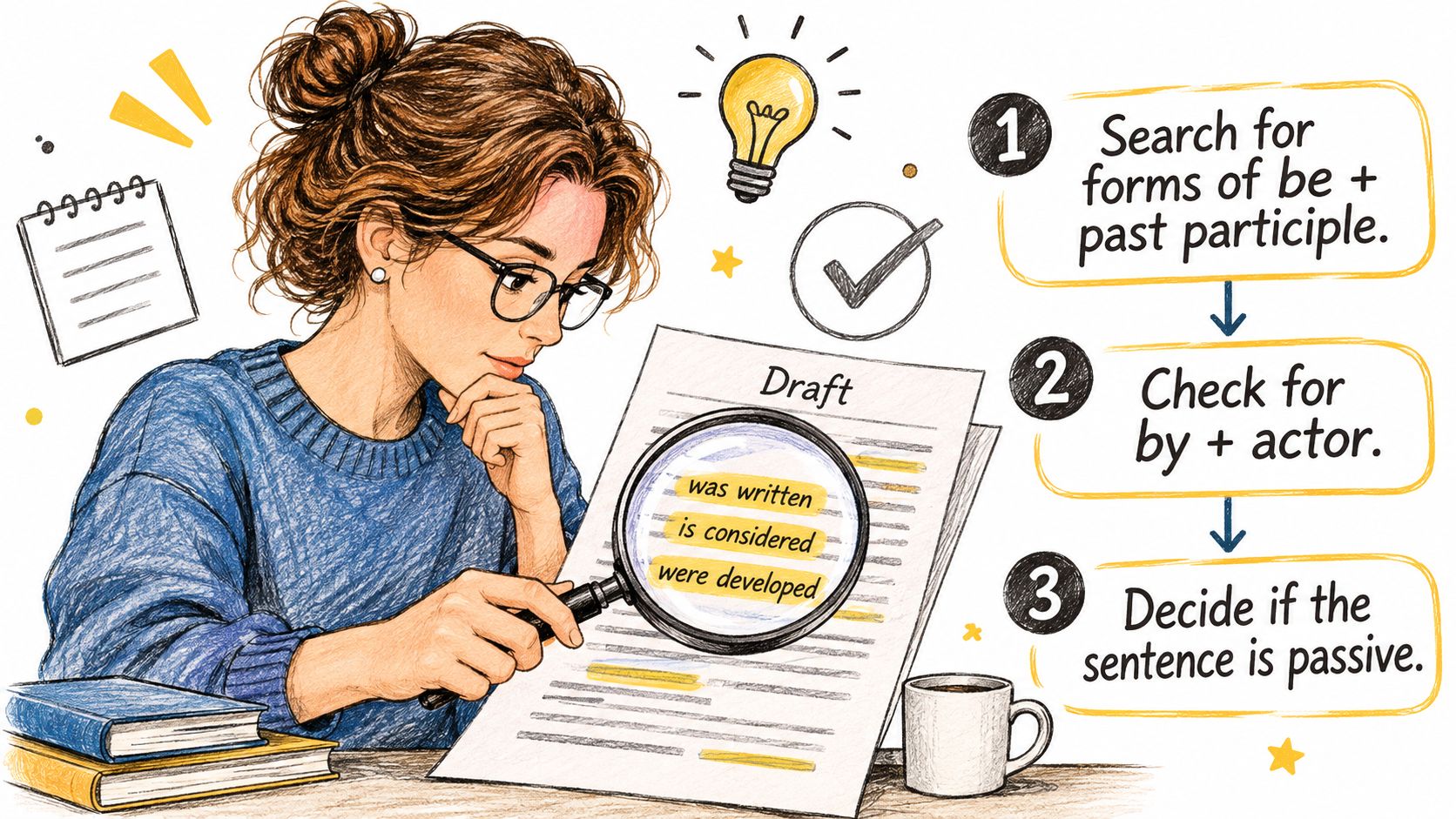
Six Search Steps
- Find a "be" form plus a past participle. Search for "is", "are", "was", "were", "be", "been", and "being". Check the next main word for forms such as "checked" or "written".
- Look for a "by" phrase. The phrase often names the actor. That name gives the writer the new subject.
- Mark sentences with no actor. The writer decides who must act. In a procedure, the reader often performs the task.
- Search for modal passives. Useful search strings include "can be", "must be", "should be", and "may be". Each string can hide a clear instruction or obligation.
- Search for fixed passive phrases. Check "is used to" and "is done by". Those phrases often add words without new meaning.
- Mark action nouns. Phrases such as "the removal of" hide the verb "remove". "The inspection of" can hide "inspect".
Test False Positives
Not every match describes an action. "The manifold is designed for high pressure" can describe a design state. The writer asks one question. Does a person or part perform an action in this sentence?
A word ending in "-ed" doesn't prove a passive form. "The closed valve stops the flow" uses "closed" as a modifier. The subject "valve" performs the action "stops". The writer keeps that sentence.
Highlight every probable match before rewriting. Count the matches and record the number for the next revision.
One colour keeps the scan consistent. The count gives the writer a simple progress record. A lower count alone doesn't prove clarity. Each rewrite still needs an actor and one clear action.
How to Rewrite a Passive Sentence Step by Step
The rewrite starts with meaning, not word order. The writer identifies the action first. The actor search comes next.
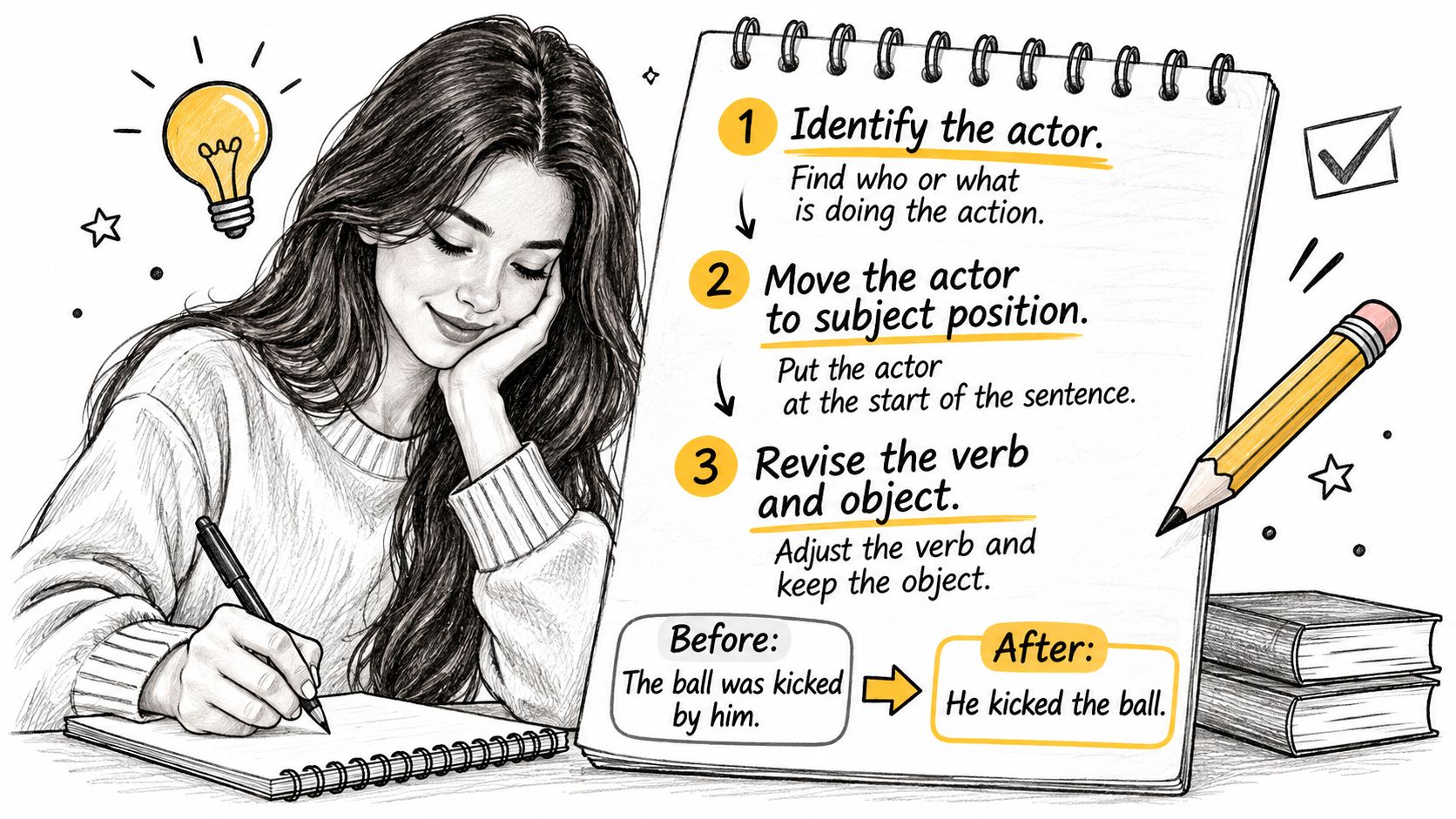
Seven Rewrite Steps
- Identify the actor. Ask who or what performs the action. The answer controls the new sentence.
- Make the actor the subject. "The fuse is replaced by the technician" names the technician. The rewrite becomes "The technician replaces the fuse".
- Use the active verb form. Keep the tense of the original sentence. A tense change can turn a completed record into a future task.
- Place the object after the verb. The pattern is actor, action, object. That order helps the reader scan quickly.
- Keep one action in the sentence. Split the sentence if two tasks remain. Each procedure step needs one clear result.
- Use a command if no actor appears. "The cover is removed" becomes "Remove the cover". The command fits a step the reader performs.
- Read the sentence aloud. Compare its meaning with the original. Stop if the rewrite changes the actor, timing, or result.
Three Worked Pairs
"The pump is started by pressing the switch" names a method, not a person. A command gives the clear action. The rewrite is "Press the switch to start the pump."
"Oil levels are checked by the operator every shift" names the actor. The writer moves "operator" to the front. The rewrite is "The operator checks the oil level every shift."
"The hose is connected to the inlet port" has no actor. The procedure context points to the reader. The rewrite is "Connect the hose to the inlet port."
Two Common Slips
- A retained "by" phrase: It can create a second possible subject. Remove it after the actor moves to the front.
- An accidental tense change: It can change an instruction into a record. Compare the verb time before approval.
The final check has three points. The sentence names an actor or uses a command. It contains one action. A command starts with the verb. Summaries on the STE verb writing rules explain the pattern in general terms. The official specification gives the exact rule wording.
Special Cases Like Missing Actors and Warnings
A warning carries more risk than a routine description. Its rewrite must keep the protective action first. Word order can affect the reader's sequence of actions.
Warnings and Conditions
"The power must be removed before the cover is opened" hides two actors. The safe rewrite is "Remove the power before you open the cover." The first command removes energy. The second clause permits access after that action.
Conditions need the same care. "If the light is red, the pump is stopped" mixes a signal with an action. The rewrite is "If the light is red, stop the pump." The condition stays first, and the command follows. Detailed guidance on warnings and cautions in STE addresses placement and wording choices.
Several Actions in One Sentence
"The filter is removed, cleaned and fitted again" contains three tasks. One passive verb pattern hides all three. The writer splits the sentence.
- First task: "Remove the filter."
- Second task: "Clean the filter."
- Third task: "Fit the filter again."
Each sentence now gives one instruction. A reviewer can check each result separately. A translator can also keep the sequence clear.
States and Unknown Actors
"The door is closed" can describe a condition. No person performs an action in that statement. The writer can keep it when the text reports a state. The writer changes it only when the text must instruct action.
An unknown actor needs a factual answer. The writer asks the subject-matter expert who performs the task. Guessing can assign work to the wrong role. A command works only when the procedure clearly assigns the task to its reader.
When a rewrite grows long, split it. When the actor is unknown, ask instead of guessing.
Passive forms can also create translation problems. Another language may force a choice about the actor. A clear active source sentence reduces that risk. It gives the translator the actor, action, and object in one order.
Check Rewrites and Verify Your Training Source
Each rewritten sentence needs a short final check. The actor is named, or the sentence is a clear command. The verb is active and describes one action. No stray "by" phrase remains. A warning keeps the safe action first.
The free STE Checker tool can flag probable issues early. The checker is a simplified heuristic tool. It isn't an official ASD-STE100 conformity check. A clean result doesn't approve the text. Writers can use the STE writing rules summaries for study. The official specification remains the authority for exact wording.
Training status also needs verification. The official ASD-STE100 training information identifies accredited trainers as STEMG members or partners, or trainers certified by UNINETTUNO University. STEMG members and partners can't certify other trainers. UNINETTUNO-certified trainers can give basic training but can't certify additional trainers. Other providers can offer uncontrolled training with no STEMG link.
Employers should verify the provider category before contract acceptance. Self-study and heuristic checkers don't provide official certification. The ASD STE 100 skill page offers a learning path, exercises, and an AI prompt template.
One useful task fits this week. Rewrite one page and count passive forms before and after. Run the checker, then compare doubtful points with Issue 9.
STE Guide gives writers free STE explanations, worked examples, and a heuristic checker for early draft review. Those resources support S1000D Training without claiming official certification or replacing project BREX checks. Visit STE Guide to practise the search, rewrite, and check method on a current data module.