
A maintenance writer reviews a step before release: The filter is replaced by the technician. The action is clear, but the actor appears last. The reader must reach the sentence's end to find who performs the work.
The active rewrite puts responsibility first: The technician replaces the filter. The subject performs the action instead of receiving it. This pattern helps writers separate the actor, action, and component during review.
Technical readers need more than short sentences. They need accurate roles, clear conditions, and the correct action order. A shorter sentence still fails if it assigns work to the wrong person.
The University of Oxford's science-writing guidance recommends active voice when writers need concision, clear subjects, or explicit responsibility. It also recognizes useful passive constructions.
The useful test isn't whether a sentence contains is. The useful test is whether its subject performs or receives the action.
For example, The pump is running uses active voice. The pump is inspected uses passive voice. Voice describes the relationship between the subject and action, not the sentence's tense.
The following active voice examples pair a passive sentence with a practical rewrite. Each pattern fits a different document type. The examples illustrate grammar, not approved maintenance, safety, or clinical procedures.
Table of Contents
- 1. Technician Replaces the Filter Without Hiding the Actor
- 2. Do Not Touch the Hot Surface With Direct Warnings
- 3. Operators Check the Oil Level Before Operation
- 4. The Application Saves the File Automatically
- 5. The Control Unit Stores the Fault Code
- 6. The Inspector Records the Torque Value
- 7. The User Cleans the Sensor
- 8. The System Sends an Alert for Translation
- How the eight active voice patterns differ by document type, benefit, and trade-off
- Turn These Patterns Into a Review Habit
1. Technician Replaces the Filter Without Hiding the Actor
Before: The filter is replaced by the technician.
After: The technician replaces the filter.
The rewrite moves the technician into the subject position. It removes the passive verb construction and places the filter after the action. Readers see the responsible role before the task.

This pattern works well when a maintenance document assigns tasks across different roles. A technician replaces a part, while an inspector checks the completed work. Naming each role prevents readers from treating those duties as interchangeable.
- Inspection: The seal is checked by the inspector becomes The inspector checks the seal. The rewrite makes inspection ownership explicit.
- Assembly: The bolts are tightened by the mechanic becomes The mechanic tightens the bolts. The rewrite connects the mechanic directly to the action.
Match the sentence to its purpose
A responsibility statement and a procedural instruction serve different purposes. The technician replaces the filter describes a role's work. Replace the filter directly instructs the assigned reader.
Every procedural step needs a clear actor, but it doesn't always need a repeated role name. A procedure can establish the technician's role before using imperative steps. A role change needs an explicit statement.
The technical instruction examples illustrate how direct steps differ from descriptions. The site's writing-rule explanations provide supporting guidance.
Exact ASD-STE100 requirements belong to the official specification, not an independent summary. A reviewer must also preserve approved tools, isolation requirements, and acceptance criteria when changing sentence structure.
2. Do Not Touch the Hot Surface With Direct Warnings
Before: The hot surface must not be touched by personnel.
After: Do not touch the hot surface.
The imperative addresses the person who encounters the warning. It removes the distant phrase by personnel. The reader receives a direct prohibition rather than a description of prohibited behavior.
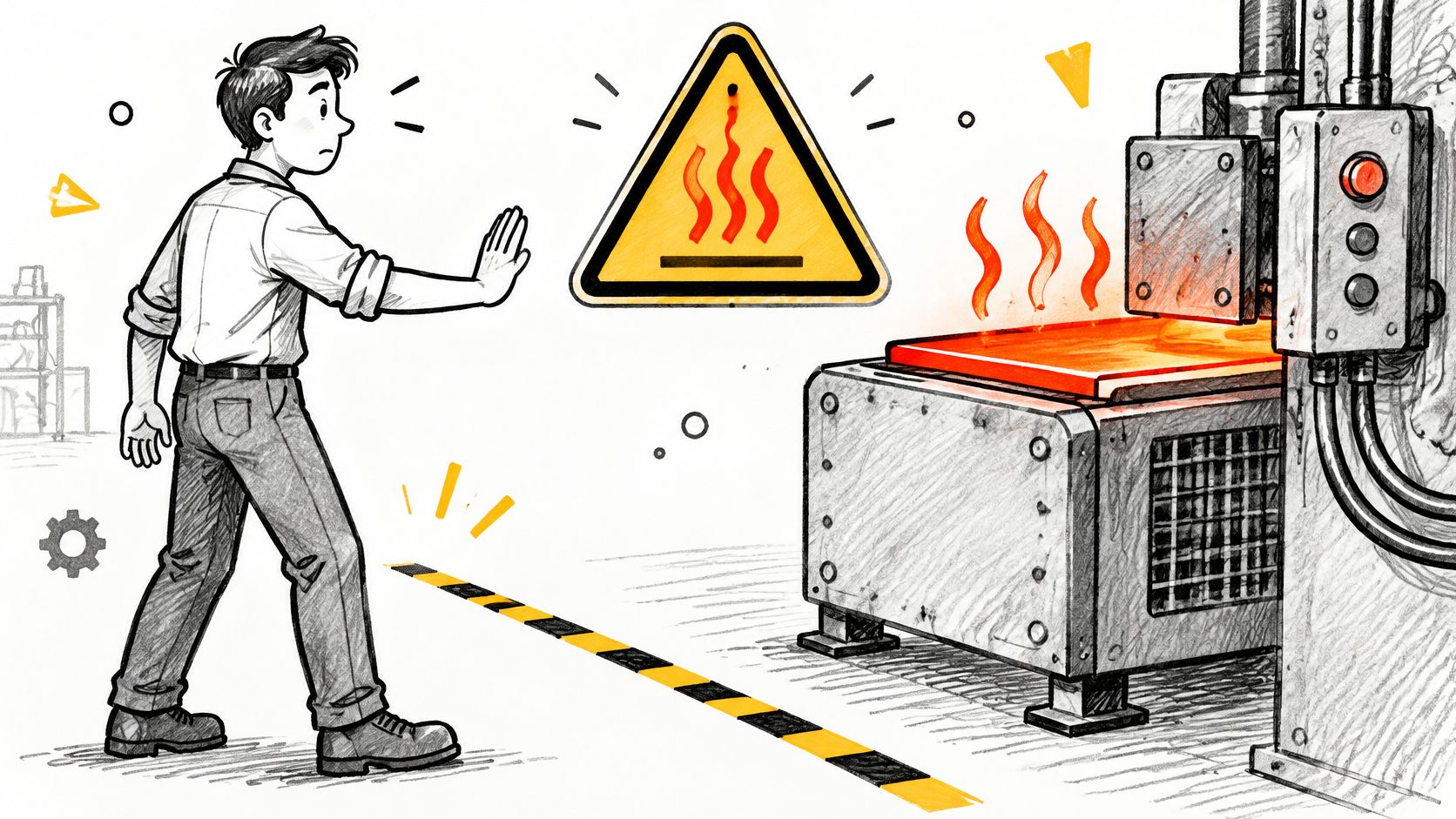
A warning still needs the correct hazard information. Active voice cannot explain an omitted consequence or replace a required isolation method. The approved safety procedure must supply those details.
Preserve the prohibition and its condition
Before: The pump must not be operated without the cover.
After: Do not operate the pump without the cover.
The rewrite preserves the condition without the cover. Removing that condition would change the instruction. Replacing must not with should not would also weaken the prohibition.
Before: Gloves must be worn by the operator.
After: Wear gloves.
The imperative works when the warning clearly applies to the operator reading it. The document must still specify the correct glove type where necessary.
Safety review: A direct warning must preserve the hazard, required action, and applicable condition. Shorter wording alone doesn't make it safe.
Before: The power supply must be isolated before the cover is removed.
After: Isolate the power supply. Then remove the cover.
Separate commands expose the action order. Actual equipment instructions must define the isolation method and any required verification before removal.
The passive-to-active conversion guide provides further editing patterns. Reviewers should compare every warning rewrite against the approved safety content, not just its grammar.
3. Operators Check the Oil Level Before Operation
A checklist can name a task without assigning it. That becomes a problem when operators, maintenance staff, and supervisors share the same document. Each reader needs a clear responsibility.
Before: The oil level is checked before each flight.
After: Operators check the oil level before each flight.
The rewrite adds the actor before the verb. The timing remains unchanged. The role is illustrative and must match the approved operating procedure.
- Departure check: The tire pressure is verified before departure becomes The operator verifies the tire pressure before departure.
- Shift record: The fuel level is recorded after each shift becomes The operator records the fuel level after each shift.
- Routine service: The coolant is topped up by the crew each morning becomes The crew tops up the coolant each morning.
Each rewrite assigns an action without changing its stated timing. However, a writer must confirm an omitted actor before adding one. Sentence editing doesn't authorize a new allocation of duties.
Keep role names and timing stable
A manual shouldn't alternate between operator, crew member, and user unless those terms identify different roles. Consistent role names help reviewers compare the checklist with training and responsibility documents.
Short timing phrases often fit naturally at the sentence's end. However, a critical condition may need earlier placement so readers encounter it before acting.
The FAA's user-friendly-document guidance connects active voice with clear responsibility and distinguishes obligations, permissions, and recommendations. Voice and requirement strength need separate checks.
An active sentence doesn't prove that a check occurred. The record still needs the applicable result, equipment identification, and completion evidence.
4. The Application Saves the File Automatically
Before: The file is saved automatically by the application.
After: The application saves the file automatically.
The application becomes the subject because it performs the action. The rewrite distinguishes automatic software behavior from a user's task. Readers don't need to infer who saves the file.

Consider a help topic that explains saving and license validation. If both sentences start with the affected object, readers may miss the distinction between local and server actions.
Before: The changes are stored by the software every five minutes.
After: The software stores the changes every five minutes.
This hypothetical rewrite preserves the example interval. A published help topic must use the product's actual behavior, not an editorial assumption.
Distinguish the application from its services
Before: An error message is displayed by the system.
After: The system displays an error message.
Before: The license key is validated by the server.
After: The server validates the license key.
These rewrites identify different actors. However, the system may remain too broad when readers need to diagnose a failure. The writer should name the application, service, or server that performs the action.
A stable component name usually works better than a temporary release name. The terminology must also match diagrams, interface labels, and support documentation.
Active voice doesn't require every sentence to describe an action. A status statement such as The connection is unavailable isn't automatically passive. Reviewers should correct unclear meaning rather than remove every form of be.
5. The Control Unit Stores the Fault Code
Diagnostic writing needs careful actor identification. A location isn't always an actor, and a receiving component doesn't necessarily create the information it stores. An active rewrite must preserve those distinctions.
Before: The fault code is stored in the control unit.
After: The control unit stores the fault code.
The active sentence identifies the component as the actor. This rewrite works only when technical information confirms that the control unit performs the storage operation.
Verify the component before changing the grammar
Before: The diagnostic code is saved in the ECU.
After: The ECU saves the diagnostic code.
The writer should define electronic control unit (ECU) before using the abbreviation, unless the document already provides that definition. The component name must match the vehicle's documentation.
Before: A warning lamp is switched on by the controller.
After: The controller switches on the warning lamp.
The original sentence already identifies the actor. Moving that actor forward clarifies the controller's action without adding new technical information.
A passive sentence can reveal a missing technical fact. The writer must resolve that gap before choosing an active subject.
Before: The sensor value is sent to the module.
After: The sensor sends the value to the module.
This rewrite requires verification. A gateway or another controller might transmit the value instead. The noun sensor describes the value's source, but it doesn't prove the transmission path.
The terminology and dictionary guidance can support vocabulary review. Project terminology still needs its own approved definitions.
A clear actor helps technicians follow component behavior. It doesn't establish a fault's cause or justify replacing the named component.
6. The Inspector Records the Torque Value
Before: The torque value is recorded by the inspector.
After: The inspector records the torque value.
The rewrite places the responsible role before the recording action. Reviewers can distinguish the person who makes the entry from the person who performs the work. Those roles may differ.
In an energy-sector inspection procedure, that distinction supports traceability. A technician may tighten a connection while an inspector records the measured result. The document shouldn't assign both actions to the inspector without confirmation.
- Measurement entry: The pressure reading is logged by the engineer becomes The engineer logs the pressure reading.
- Operational check: The valve position is confirmed by the operator becomes The operator confirms the valve position.
- Approval: The result is signed off by the supervisor becomes The supervisor signs off the result.
Each pair moves the existing actor into subject position. The benefit is explicit action ownership. The wording still needs to match the quality plan's role names and approval authority.
Separate instructions from completed records
A procedure may state The inspector records the torque value. A completed record may state The inspector recorded the torque value. Both sentences use active voice.
The FAA Human Factors Technical Writer's Guide distinguishes voice from tense and explains how to move a named agent into subject position.
Active wording doesn't establish who completed an entry. The record must retain the required identity, date, equipment reference, and result.
A recording instruction should also identify where the value belongs. Adding a field name can improve usability more than removing another word. Grammar review and record design should support the same task.
7. The User Cleans the Sensor
Medical device instructions must distinguish patients, clinicians, and service staff. A broad role such as user can hide important differences in training and authorization. The manual should define its intended readers before assigning tasks.
Before: The sensor is cleaned with a dry cloth by the user.
After: The user cleans the sensor with a dry cloth.
The rewrite moves the user before the action. It keeps the cleaning method unchanged. This grammar example doesn't establish that a dry cloth suits any particular device.
Preserve the approved method and user role
Before: The cover is removed by the clinician before use.
After: The clinician removes the cover before use.
The actor becomes immediately visible. The timing remains attached to the same action. A writer must not substitute patient or user merely to simplify the role name.
Before: The battery is replaced by the user every month.
After: The user replaces the battery every month.
The interval belongs to this hypothetical language example. Actual replacement instructions must retain the manufacturer's approved interval and service restrictions.
Before: The device is sterilized by the nurse after each patient.
After: The nurse sterilizes the device after each patient.
The rewrite preserves the actor and timing. It doesn't confirm that the device permits sterilization or that a nurse performs this task.
Clinical boundary: Cleaning, disinfection, and sterilization describe different processes. A grammar edit must never substitute one for another.
The guide to clarity in technical writing explains why clear wording requires more than short sentences. Device specialists must verify methods, materials, role assignments, and task order.
Active voice can expose those decisions for review. It cannot establish clinical suitability or regulatory compliance.
8. The System Sends an Alert for Translation
Before: An alert is sent to the operator by the system.
After: The system sends an alert to the operator.
The active rewrite separates the sender, action, message, and recipient. A translator can identify each relationship directly. The sentence also gives reviewers a clear basis for checking who receives the alert.

Clear source text reduces avoidable ambiguity, but it doesn't guarantee an accurate translation. Translators still need context, approved terminology, and access to relevant interface information.
Keep each actor distinct
- Controller action: A notification is generated by the controller becomes The controller generates a notification.
- Interface action: The message is shown to the user by the app becomes The app shows the message to the user.
- Device action: The data is transmitted to the server by the device becomes The device transmits the data to the server.
Each rewrite identifies who performs the action. The recipient remains distinct from the sender. This matters when a device creates information, a server processes it, and an application displays it.
The source writer should avoid replacing every component name with system. That simplification can remove information the translator needs.
Stable terms also matter. Alternating between alert, notification, and message can imply different product functions. If the terms mean different things, the terminology record should explain the distinction.
The worked technical-English examples provide additional sentence patterns for practice. Translation review must still evaluate natural target-language grammar rather than copy English word order.
An accurate active source sentence makes responsibility explicit. A qualified translator must preserve that relationship, even when the target language expresses it differently.
How the eight active voice patterns differ by document type, benefit, and trade-off
Use the table as a working filter during review. Pick the row that matches the document type, then use the review question to test whether the active rewrite is doing the right job.
| Pattern | Document type | Main benefit | Review question | Main trade-off |
|---|---|---|---|---|
| 1. Technician Replaces the Filter Without Hiding the Actor | Maintenance instructions | Clarifies who is responsible for each step | Does the sentence name the role that performs the step? | Requires consistent role names |
| 2. Do Not Touch the Hot Surface With Direct Warnings | Safety warnings | Makes hazards and required actions clear | Does the warning lead with the prohibited or required action? | Can sound abrupt if tone is not controlled |
| 3. Operators Check the Oil Level Before Operation | Pre-operation checklists | Makes checks easier to follow and audit | Can the operator tell what to check before starting? | Role names must match organizational terms |
| 4. The Application Saves the File Automatically | Software documentation | Clearly describes system behavior | Does the sentence show whether the product or the user acts? | Product names and interface terms need consistency |
| 5. The Control Unit Stores the Fault Code | Automotive diagnostic documentation | Clarifies component actions and cause and effect | Is the component action separated from the technician response? | Component names can vary by model |
| 6. The Inspector Records the Torque Value | Energy inspection records | Supports accountability and traceability | Does the sentence connect the inspector to the recorded value? | Added responsibility can overstate the scope of the inspection |
| 7. The User Cleans the Sensor | Medical device instructions | Reduces ambiguity in user steps | Is the intended user different from service or clinical staff? | Intended user and regulatory requirements need confirmation |
| 8. The System Sends an Alert for Translation | Translation and localization source text | Reduces the risk of meaning loss across languages | Will the actor, message, and recipient stay distinct after translation? | Some languages may prefer passive structures |
A strong pattern answers one review question cleanly. If a sentence needs several answers at once, split the action before changing the voice.
Turn These Patterns Into a Review Habit
A useful review starts with the task itself. The reviewer identifies the actor, action, affected object, and applicable condition. Missing information needs technical confirmation before rewriting.
A search for is, are, was, were, and be can locate possible passive constructions. Those words aren't proof of passive voice. Reviewers must inspect the full verb and its relationship to the subject.
Review meaning before reducing words
Compare the original and revised sentences side by side. The actor, requirement strength, timing, method, and technical limits must remain accurate. A shorter rewrite fails if it changes any of those details.
Separate actions deserve separate attention. A sentence may use active voice while combining isolation, removal, inspection, and recording. Dividing those tasks can make the procedure easier to follow and review.
The same principle applies to responsibility. Naming the operator doesn't help if several operators share a task. The document needs enough context to identify the correct role.
Clear responsibility matters more than mechanical conversion. An editor must never invent an actor to eliminate passive voice.
Passive voice can remain useful in general technical prose when the actor is unknown or irrelevant. A report may need to describe damage without assigning an unsupported cause. Controlled-language requirements may impose stricter limits.
Combine automated review with technical judgment
The free STE checker provides a first pass for probable wording issues. Its heuristic results aren't an official conformity assessment. A reviewer must assess each suggestion against the task and applicable standard.
A final pass works best as a short checklist matched to the patterns:
- Each maintenance step names its actor, as in the technician replacing the filter.
- Each warning states the hazard and the required action, as with the hot surface.
- Each record identifies who captured the data, as in the inspector's torque value.
- Each source sentence stays clear enough for translation, as with the system alert.
The last check is the simplest. Pick one rewritten sentence, for example The inspector records the torque value, and ask who acts, what changes, and which condition applies. If the sentence answers all three without inventing detail, the rewrite holds.
STE Guide explains active voice through definitions, original before-and-after examples, and practice resources. Technical writers can visit STE Guide to practice these rewrites and find guidance toward the official specification.