A technician reads a maintenance step: The cover is removed. The technician can't tell whether to remove it or confirm that someone else already did.
That uncertainty matters more than the grammar label. A useful review of passive voice in technical writing starts with responsibility, not a count of passive verbs.
Table of Contents
- Why Passive Voice Needs a Rule in Maintenance Text
- When Passive Voice Is Acceptable and How to Decide
- How to Diagnose Passive Voice in a Maintenance Draft
- Before and After Rewrites for Maintenance Procedures
- Single-Instruction Troubleshooting Steps and Templates
- Common Draft Problems and How to Fix Them
- Run a Passive Voice Review on One Procedure First
Why Passive Voice Needs a Rule in Maintenance Text
A passive construction usually combines a form of be with a past participle. The sentence puts the affected object first and may omit the actor.
In The cover is removed, the cover receives the action. The sentence doesn't identify the person who removes it.
Passive voice isn't automatically an error. Accessibility Standards Canada's plain-language standard allows it for unknown actors, important receivers, or processes that clearly form the focus.
Responsibility matters more than a grammar label
Broad advice to always use active voice misses an important distinction. An instruction assigns work; a description explains an object, result, or event.
Technicians need executable steps. Inspectors need clear evidence of completion, while translators and reviewers need an unambiguous relationship between actors and actions.
An unnamed actor can delay work or encourage unsafe delegation. A translator may also interpret a required action as an existing condition.
Practical rule: A maintenance reader shouldn't need to infer responsibility from grammar alone.
The official ASD-STE100 specification controls its requirements. This independent explanation uses its own wording, not reproduced rules or dictionary entries.
The practical aids below include a verdict table, diagnostic workflow, decision tree, rewrites, troubleshooting templates, fixes, and a review checklist.
When Passive Voice Is Acceptable and How to Decide
Use active voice when a person or system must perform an action. For general technical prose, passive voice can suit unknown actors, object-focused events, or descriptions.
ASD-STE100 imposes a narrower condition. An object-first sentence isn't automatically acceptable merely because it reads naturally.
Recommended voice by maintenance sentence type
| Sentence type | Recommended voice | Reason | Example |
|---|---|---|---|
| Procedure step | Active | A command tells the reader directly what to do | Remove the cover. |
| Warning about a required action | Active | Starts with a clear command to the reader | Isolate the electrical power before you open the panel. |
| Procedure step written as a passive statement | Active | A passive statement can read as a condition, not an instruction | Open the panel. |
| Result or state with a known actor | Active | The actor performs the action that creates the result | The technician keeps the seal dry during storage. |
| Event with an unknown cause | Passive allowed | The actor is unknown, so the form doesn't invent one | The bracket was damaged during transport. |
| Description of a part or material | Passive allowed | The sentence describes the object, not an action | The housing is made of aluminum. |
In STE procedures, the reader is the actor. Write each step as a command, such as Remove the cover. Name a role or system, such as the technician or the controller, in descriptive text that explains who or what does an action.
The material-description row needs care. It describes composition rather than directing manufacture, but its wording still needs review against the applicable specification.
A direct alternative is The housing material is aluminum. That wording avoids a possible passive construction without inventing a manufacturer.
Apply the specification before a style preference
ASD-STE100 Issue 9 requires the active voice in procedures and restricts the passive voice in descriptive text. Check the exact wording and any permitted exceptions in the official specification.
The agent is the person or thing that performs the action. It can be a technician, operator, controller, valve, or other responsible system.
The technician tightened the bolt identifies the agent. The bolt was tightened hides it, although both sentences describe the same completed action.
The bracket was damaged during transport can remain passive when the cause is unknown. Naming a carrier, worker, or handling device without evidence would change the technical record.
A general plain-language argument, such as an important receiver, doesn't by itself justify passive voice in STE text. A writer must distinguish general plain-language advice from the requirements of a controlled-language specification.
When STE Guide's explanation and the official specification differ, the official specification is correct.
Context still matters during editing.
A reviewer must assess both responsibility and the information the reader needs to follow.
Use a sentence-level decision tree
The following questions form a working aid, not an official compliance test. The specification gives the exact requirements.
Does a person or system perform a required action?
If yes, use the active voice. In a procedure, write the step as a command. For an event description, continue the assessment.Does the procedure identify the actor?
If yes, name that actor. Don't replace a known role with a vague reference such as someone or personnel.Is the actor unknown or irrelevant to the reader?
If neither applies, name the actor in active voice. If either applies, examine the sentence's purpose.Does the reader need the object's state or result?
Object-first wording may help in general prose. Under ASD-STE100, check passive descriptive wording against the limits in the official specification.Could an omitted actor delay work or create a safety risk?
If yes, resolve responsibility before approving the sentence. Use active voice and separate different actions.
A missing role isn't permission to invent one. If the maintenance plan doesn't assign responsibility, the writer needs an engineering or procedural decision.
For The panel is opened, the action is clear but responsibility isn't. In a procedure step, the rewrite becomes Open the panel. If the task needs a specific role, state that role in the task introduction.
The writer must also decide whether the sentence requests work or reports completion. A completion record may need a different tense and a record of the actual performer.
A clear actor doesn't repair a crowded instruction. Each instruction should contain one action.
The final decision therefore combines grammar, sentence function, procedural ownership, and risk. A passive percentage can't make that decision.
How to Diagnose Passive Voice in a Maintenance Draft
A structural check locates candidates. A reader test reveals whether those candidates cause operational confusion.
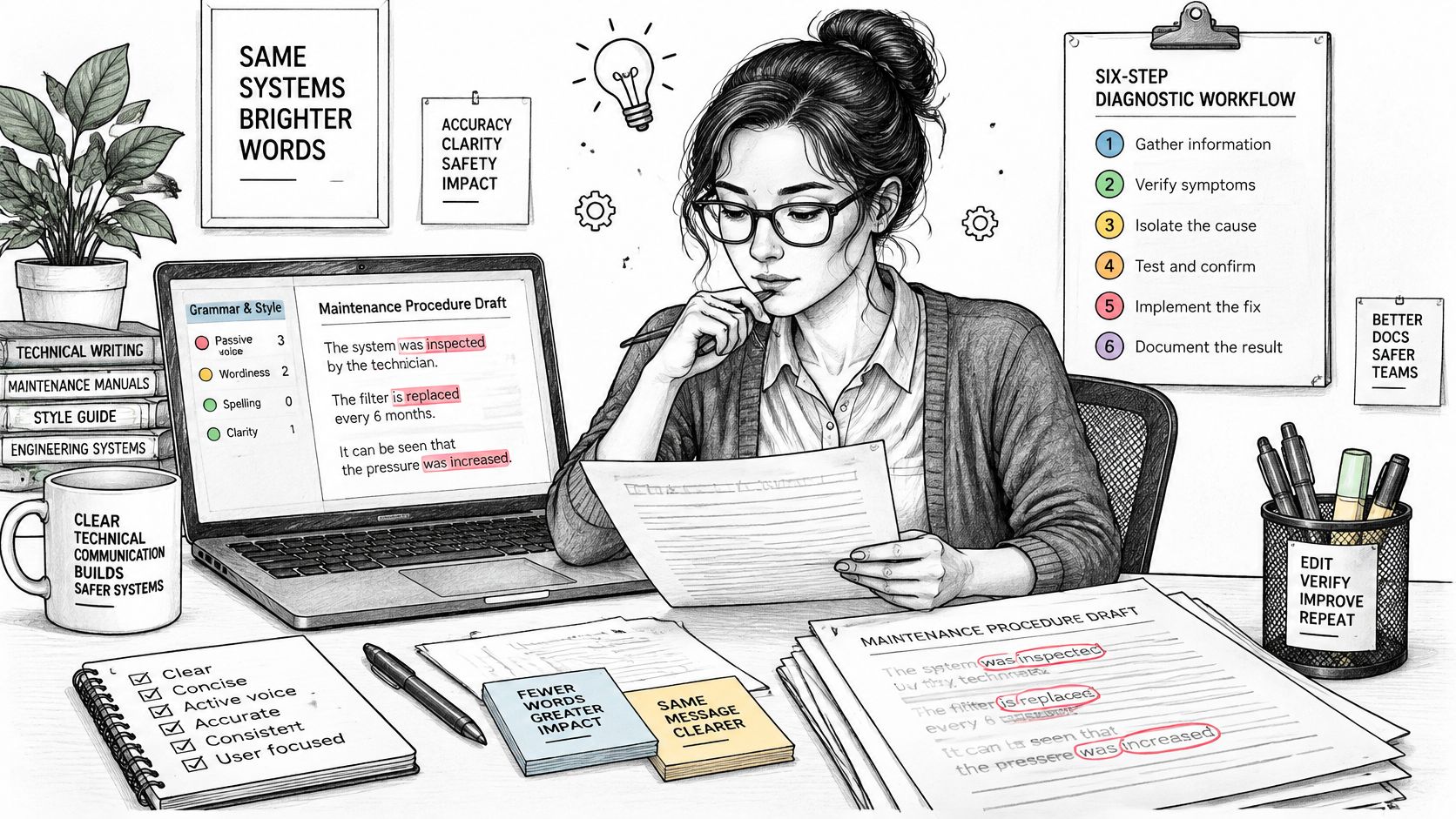
Run the diagnostic workflow
Find candidate constructions. Search for forms of be followed by past participles, using a grammar checker or search pattern. The verb guidance supports this manual review.
Separate states from actions. Remove genuine state adjectives such as is ready from the passive list. Check is shown in context; it commonly expresses a true passive, not an adjective.
Classify each remaining sentence. Mark it as an action instruction, result or state, background explanation, or unknown-actor event. Record its purpose before changing its form.
Assess operational risk. For each instruction, check whether the omitted actor creates ambiguity, unsafe delegation, or delayed execution. Confirm responsibility from the procedure rather than guessing.
Revise failed instructions. Apply the decision tree to instructions with unclear ownership. Review retained descriptions separately against the governing language requirements.
Test representative sentences. Ask target readers to identify the actor, action, object, condition, and expected result. Set an accuracy target beforehand and record errors separately for active and retained-passive items.
Classify a short draft excerpt
| Flagged sentence | Class | Review action |
|---|---|---|
| The access door is opened. | Action instruction | Identify who must open it. |
| The pressure is controlled by the regulator. | Background explanation | Consider making the regulator the subject. |
| The casing was damaged during shipment. | Unknown-actor event | Confirm that the cause remains unknown. |
The classifications prevent unrelated sentences from receiving the same mechanical edit. A description doesn't become an instruction merely because both contain passive verbs.
An ALWD article reviewing voice and readability evidence reports no comprehension difference among 161 second-year chiropractic students reading similarly readable active and passive research texts.
That audience isn't a maintenance team. The finding supports testing actual task understanding rather than assuming that voice alone determines comprehension.
Common pitfalls need explicit review:
- Percentage-only assessment: A lower passive count doesn't establish safer instructions.
- Forced active wording: An unnecessary actor can distract from an object-focused description.
- Ignored structure: Long sentences, embedded clauses, and poor information order can remain after a voice change.
Before and After Rewrites for Maintenance Procedures
The panel is opened and the cover is removed contains separate actions without an identified performer. The rewrite assigns both actions and separates their execution.
Before and after rewrites for maintenance sentences
| Before | After | Why the change |
|---|---|---|
| The panel is opened and the cover is removed. | Open the panel. Remove the cover. | Two actions become two commands, with one action in each. |
| The fluid level is checked before flight. | Before flight, check the fluid level. | The passive statement becomes a command, and the condition comes first. |
| The bolt is tightened to the specified torque. | Tighten the bolt to the specified torque. | The command makes the required action explicit. |
| Electrical power must be isolated before the cover is removed. | Isolate the electrical power. Then remove the cover. | The commands split the sequence into steps in the correct order. |
| The seal was damaged during transport. | Keep as written. | The actor is unknown, so the passive form doesn't invent one. |
| The housing is made of aluminum. | Keep as written. | The sentence describes the object, not an action. |
The last row records a general editorial choice, not automatic ASD-STE100 acceptance. A controlled-language review may instead select The housing material is aluminum.
The electrical-power rewrite illustrates sequence only. An approved maintenance procedure must retain its actual isolation method, verification requirements, and warning format.
Build an executable sentence
A useful drafting order for a step is condition, action verb, object. For example, Before flight, check the fluid level follows that order. The reader is the actor, so the step starts with the condition or with the command verb.
The verb states the work, the object identifies its target, and the condition limits when it applies.
This order isn't a reason to bury a safety precondition. If the reader must establish a condition before acting, that condition belongs before the executable step.
The worked instruction examples provide further practice with clear actions and sentence structure.
A rewrite can change emphasis even when it preserves the basic event. An active warning puts the required action first, which can help during a safety-critical task.
A result description may need a different emphasis. If the reader tracks damage to a seal, inventing a handling actor would weaken the record rather than clarify it.
Verify meaning after the rewrite
The writer should apply the decision tree to each revised sentence. The reviewer must check tense, obligation, sequence, and technical meaning, not just the disappearance of a passive verb.
Reading the sentence aloud to a target reader can expose awkward role names or confusing references. The reader should explain the required action rather than merely approve the wording.
Localized text needs its own review. A voice change can alter translation output, including the apparent actor, action sequence, or strength of an obligation.
Meaning check: A successful rewrite preserves the maintenance requirement while making its execution easier to identify.
Single-Instruction Troubleshooting Steps and Templates
A fault-isolation step needs a condition, an assigned action, and an expected result. These elements don't all belong in one sentence.
Use a fault-isolation template
| Element | Template |
|---|---|
| Precondition | If [condition applies], [action verb] [object]. |
| Expected result | The [indicator or component] [expected response]. |
| Next decision | If [result applies], [next action]. |
The writer includes a precondition only when the reader must confirm it before acting. Otherwise, an unnecessary condition can obscure a direct instruction.
The action uses a specific verb as a command. A separate result sentence lets the technician compare the observed response with the expected response.
The procedure-writing guidance supports further work on instruction structure. The template supplies a drafting pattern; the official specification supplies the exact rules.
Compare fault-isolation wording
Before: The circuit is checked when the lamp stays off.
After: If the lamp stays off, check the circuit.
The revision assigns the check and states its trigger. The approved procedure must still define the actual test method and acceptable result.
Before: The connector is cleaned and dried, then reinstalled.
After: Clean the connector. Dry the connector. Install the connector.
Separate actions help a reviewer identify missing methods or acceptance conditions. For example, the drying instruction may need a defined condition before reinstallation.
End each branch with an action
A compact branch draft might read:
If the result is not within the expected range, stop and record the reading. If the result is within range, go to the next step.
The failure branch still contains separate actions. The final procedure should separate them:
- Outside range: Stop the procedure. Record the reading.
- Within range: Go to the next step.
Each branch must end with a named action or a clear stop condition. The writer should replace next step with an exact step reference in the finished procedure.
A target reader should identify which step follows each possible result. Any unanswered result needs a defined branch before publication.
Common Draft Problems and How to Fix Them
A reader who asks who performs a step has identified a responsibility problem. Replacing the passive verb helps only if the writer names the correct role.
Draft symptoms, likely causes and fixes
| Symptom | Likely cause | Fix |
|---|---|---|
| Reader asks who performs the step | The passive form hides the actor | Write the step as a command. In descriptive text, name the role or system. |
| Warning reads weak or unclear | Object comes first and the required action is buried | Start the warning with the required action as a command. |
| Rewritten sentence reads oddly | The object is the true topic of the sentence | Consider object-first wording, subject to the governing specification. |
| Many passives flagged in a clean draft | The reviewer groups state adjectives and participial forms together | Separate genuine adjectives, such as is ready, from passives; check is shown in context. |
| Translators disagree on the action | Unclear actor and several verb forms in one step | Use a command with one action per step. |
| Checker flags a correct sentence | Heuristic false positive | Check the flag manually against the rules and examples. |
Is shown deserves particular attention. In The wiring route is shown in the diagram, the construction commonly has passive grammar, even though it directs no maintenance action.
A reviewer should therefore separate grammatical classification from editing priority. A true passive can describe background information, while a non-passive sentence can still hide responsibility.
Recognize repairs that make wording worse
For general prose, an object-focused result may read better with the object first. Under ASD-STE100, that preference doesn't override the restriction on passive descriptive writing.
An actorless event also needs accurate uncertainty. Replacing an unknown cause with the technician creates unsupported responsibility.
Another weak repair replaces must be inspected with needs to be inspected. The second phrase remains passive and may weaken the obligation.
- Preserve obligation: Keep the original requirement's strength during revision.
- Preserve ownership: Confirm the responsible role from the maintenance process.
- Preserve function: Keep descriptions distinct from executable instructions.
Treat automated flags as review candidates
The STE Checker is a heuristic tool that can miss problems or flag correct text. Its output doesn't establish compliance or prove that a sentence needs revision.
Each flag needs a manual check against the applicable rules and examples. An unflagged sentence still needs technical review.
Before accepting a difficult rewrite, the reviewer should ask a target reader to explain it. The useful answer identifies the same actor, action, and condition as the approved requirement.
Run a Passive Voice Review on One Procedure First
- Assigned actions: Each action step is a clear command, and the task states any required role.
- Justified retention: Each retained passive has a documented reason from the verdict table and meets the applicable specification.
- Clear warnings: Each warning starts with a clear command.
- Separate execution: Each instruction sentence contains one action.
- Accurate classification: The review doesn't count genuine state adjectives as passive verbs.
- Reader understanding: A target reader can identify the actor, action, object, condition, and expected result.
Failed checks need specific repairs, not a general request to improve clarity. The symptom table provides a practical way to select the repair.
An ownership failure requires a responsible role. A sequencing failure requires separate steps, while a classification failure requires grammatical review.
Keep a sentence-level review record
| Field | Entry to record |
|---|---|
| Sentence ID | Stable identifier from the draft |
| Sentence type | Instruction, result, explanation, or unknown-actor event |
| Voice used | Active, passive, or non-passive state |
| Reason for the voice | Responsibility, unknown agent, or descriptive function |
| Reviewer decision | Accept, revise, or obtain technical clarification |
A stable identifier lets engineers and translators discuss the same sentence. The reason field prevents later reviewers from reversing a deliberate choice without checking its purpose.
The reviewer decision should distinguish language repairs from missing technical information. A writer can't resolve an unassigned maintenance duty through grammar alone.
Start with a manageable procedure
A useful pilot is a procedure with about ten steps. The reviewer runs the diagnostic workflow, applies the decision tree, and records each sentence.
The revised procedure then needs comparison with the official specification. The pilot should also include reader questions about actions and branch outcomes.
The free STE checker offers a heuristic first pass, not a replacement for the specification. Its flags need the same manual review as other automated suggestions.
Further reference pages include the writing rules, worked examples, and dictionary guidance.
The official PDF guidance page directs readers to the controlling text. STE Guide doesn't host the specification.
STE Guide is an independent educational resource, not an official ASD-STE100 source. It doesn't represent ASD.
STE Guide offers rule explanations, worked examples, and a structured learning path for technical writers. Readers can visit STE Guide to practice sentence-level voice decisions and locate guidance on the official specification.