A maintenance writer drafts a step for replacing a filter: “Remove the cover: check for pressure before you loosen the fitting.” The colon makes the warning look like part of a sequence, but the sentence doesn't clearly tell the technician when to check pressure or whether the warning applies before the cover comes off. A small punctuation choice has blurred an important instruction.
Using the colon correctly is not just a matter of memorizing examples. It means deciding what relationship the mark should express, then checking that the sentence makes that relationship clear. In technical writing, a colon can introduce a list, an explanation, a quotation, or a result. One rule governs those sentence-level uses: the words before the colon should form a complete sentence. A short editing test can help you check that rule and decide whether the colon improves the instruction.
That decision matters in maintenance procedures, where a reader needs to distinguish a required action from a condition or warning. Simplified Technical English (STE) prioritizes unambiguous instruction structure over stylistic variety. A grammatically acceptable colon may still be the wrong choice if a period or a separate step would make the task easier to follow.
Table of Contents
- Why the Colon Trips Up Technical Writers
- The Independent-Clause Rule That Decides Everything
- The Four Jobs a Colon Can Do in a Procedure
- Worked Examples With STE-Style Corrections
- Capitalization, Spacing, and Specialized Uses
- When the Right Move Is to Remove the Colon
- Colons in Translations, UI Strings, and AI-Revised Text
- A One-Page Colon Checklist for Technical Editors
Why the Colon Trips Up Technical Writers
The writer in the opening scenario may have chosen a colon because it seemed to organize the instruction. But punctuation can't substitute for a clear sequence. If the reader has to guess whether to check pressure before or after removing the cover, the sentence needs a structural edit, not just a different mark.
General grammar advice often focuses on the situations where a colon is allowed. That's useful, but it doesn't answer the editing questions that matter in a procedure: Is the first part a complete sentence? Does the second part explain it, or does it add another action? Would a numbered step or a separate warning make the relationship clearer?
Editing priority: A colon can be correct and still make a procedure harder to use. Choose the structure that makes the action, condition, and warning easiest to distinguish.
This guide treats the colon as a decision, not a decoration. You'll learn the independent-clause rule, recognize four jobs a colon can do, and apply a test that catches a common error: placing a colon between a verb and its object. You'll also see when a heading, list, or separate sentence is clearer.
The colon has changed roles over time. It developed from a mark associated with pauses in reading aloud into a punctuation mark that helps show how written information fits together. Encyclopaedia Britannica's account of punctuation describes this historical shift. In current technical text, a colon should signal a clear relationship, not merely a pause. The procedure should still make sense to a reader who scans it quickly.
The Independent-Clause Rule That Decides Everything
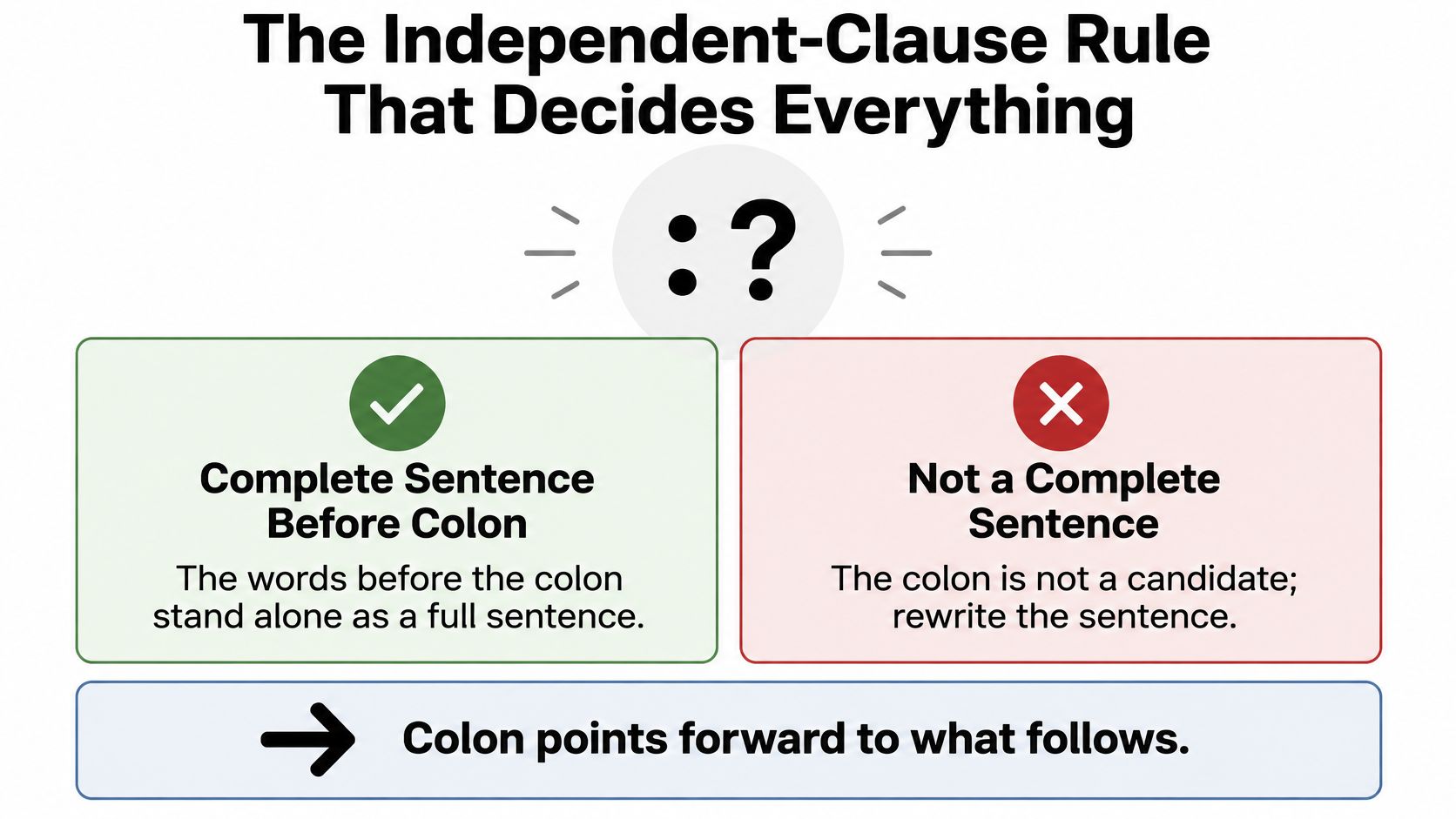
A colon is a candidate only when the words before it form a complete sentence. That complete part is called an independent clause. It can stand on its own, even though the colon points the reader toward related information that follows.
The colon isn't a general-purpose upgrade for a comma. It tells the reader that what follows will specify, explain, illustrate, or list something in the complete statement before it. University writing guidance also warns against using a colon between a verb or preposition and its complement (UMBC's punctuation guidance).
Apply the delete test
Read the words before the colon. Then delete everything after it. If what remains can't stand alone as a complete sentence, don't use the colon. Rewrite the lead-in so it's complete, or use another construction.
Wrong: “The procedure requires: a clean cloth and a replacement seal.”
Before the colon, “The procedure requires” leaves the reader waiting for the object of requires. It isn't a complete sentence.
Right: “The procedure requires the following items: a clean cloth and a replacement seal.”
Now the words before the colon form a complete statement. The colon introduces the details that identify the required items.
Here's a common procedure-writing error:
Wrong: “The inspection found: a damaged seal.”
The verb found already takes its object, so the colon splits the verb from the information that completes it.
Right: “The inspection found one defect: the seal was damaged.”
The first clause stands on its own. The second part explains the defect.
Pin this rule: Delete what follows the colon. If what remains isn't a complete sentence, rewrite.
For more practice applying short, controlled sentences to technical content, compare the examples in STE writing rules.
The Four Jobs a Colon Can Do in a Procedure
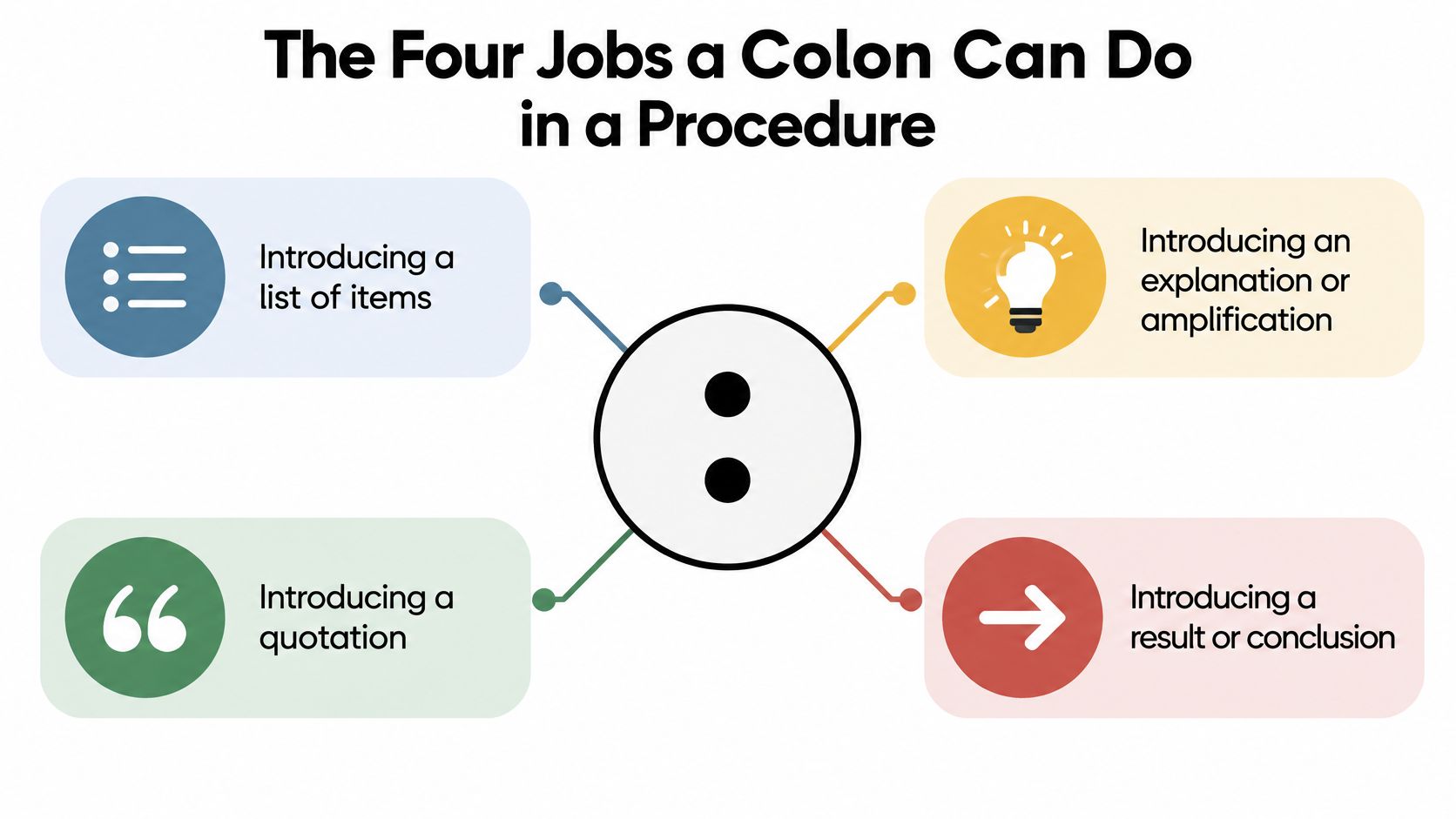
A colon's sentence-level purpose is to direct attention to related information that follows. Merriam-Webster describes it as chiefly introducing a list, explanation, quotation, or amplification, and also notes its numerical and bibliographic functions (Merriam-Webster's colon definition). In procedures, those introductory uses can be grouped into four practical jobs.
Introduce a list
Use it when: A complete statement introduces several items.
Example: “Prepare the following tools: a wrench, a clean cloth, and a seal pick.”
Avoid: “Prepare: a wrench, a clean cloth, and a seal pick.”
The second version breaks the verb from its object. Revise the lead-in instead of inserting a colon after the verb.
Introduce an explanation
Use it when: The following words explain or clarify the complete statement.
Example: “The valve is not ready for removal: pressure remains in the line.”
The second clause gives the reason. If the next sentence merely adds an unrelated instruction, a colon won't show a meaningful connection. Write the steps separately.
Introduce a quotation
Use it when: A complete statement formally introduces quoted text, such as a warning from an approved source.
Example: “The service label gives this instruction: ‘Keep the port covered during removal.’”
Avoid: “The label says: ‘Keep the port covered.’”
The words “The label says” set up the quotation through the verb says. A colon can unnecessarily split the verb from its complement. Follow the document's quotation and style rules, and choose punctuation that fits the sentence.
Introduce a result or conclusion
Use it when: A complete statement sets up a result that follows directly from it.
Example: “The indicator stayed on after the reset: the fault remains active.”
If the result is a separate action or a warning with its own scope, give it a separate sentence or step instead of making it look subordinate to the first statement.
Ratios and time notation are different functions. They aren't sentence introductions, so don't use the four jobs above to decide whether a colon belongs in a notation such as 2:1.
Worked Examples With STE-Style Corrections
Use this table to diagnose the problem before you edit. Some examples break the independent-clause rule. Others use a grammatically possible colon but obscure the instruction's structure. STE-style example pairs can help you see how a sentence changes when you make its action and scope explicit.
| Original sentence | Why the colon fails | STE-friendly correction |
|---|---|---|
| “Before you start: disconnect the power.” | “Before you start” is not a complete sentence. The colon follows an introductory phrase. | “Before you start, disconnect the power.” |
| “Remove: the damaged cover.” | The colon separates the verb from its object. | “Remove the damaged cover.” |
| “The required tools are: a wrench and a cloth.” | The verb are already leads into its complement. The colon isn't needed. | “The required tools are a wrench and a cloth.” Or: “Prepare these tools: a wrench and a cloth.” |
| “Remove the cover: warning, pressure may remain in the line.” | The colon makes the warning look like part of the action sequence. Its scope is unclear. | “Warning: Pressure may remain in the line. Remove the cover only when it is safe to do so.” |
| “Inspection steps:” | A heading already signals the material that follows. The colon adds little and may conflict with heading style. | “Inspection steps” |
| “The technician must check these conditions: pressure, temperature.” | The colon promises a list, but the sentence doesn't tell the reader whether the listed conditions are complete. | “Check the pressure and temperature.” If the list is incomplete, name that: “Check these conditions, at minimum: pressure and temperature.” |
A list doesn't become complete just because a colon introduces it. If the reader needs to know whether an item list is exhaustive, say so in the lead-in. If the sentence includes separate actions, conditions, or warnings, consider separating them.
Capitalization, Spacing, and Specialized Uses
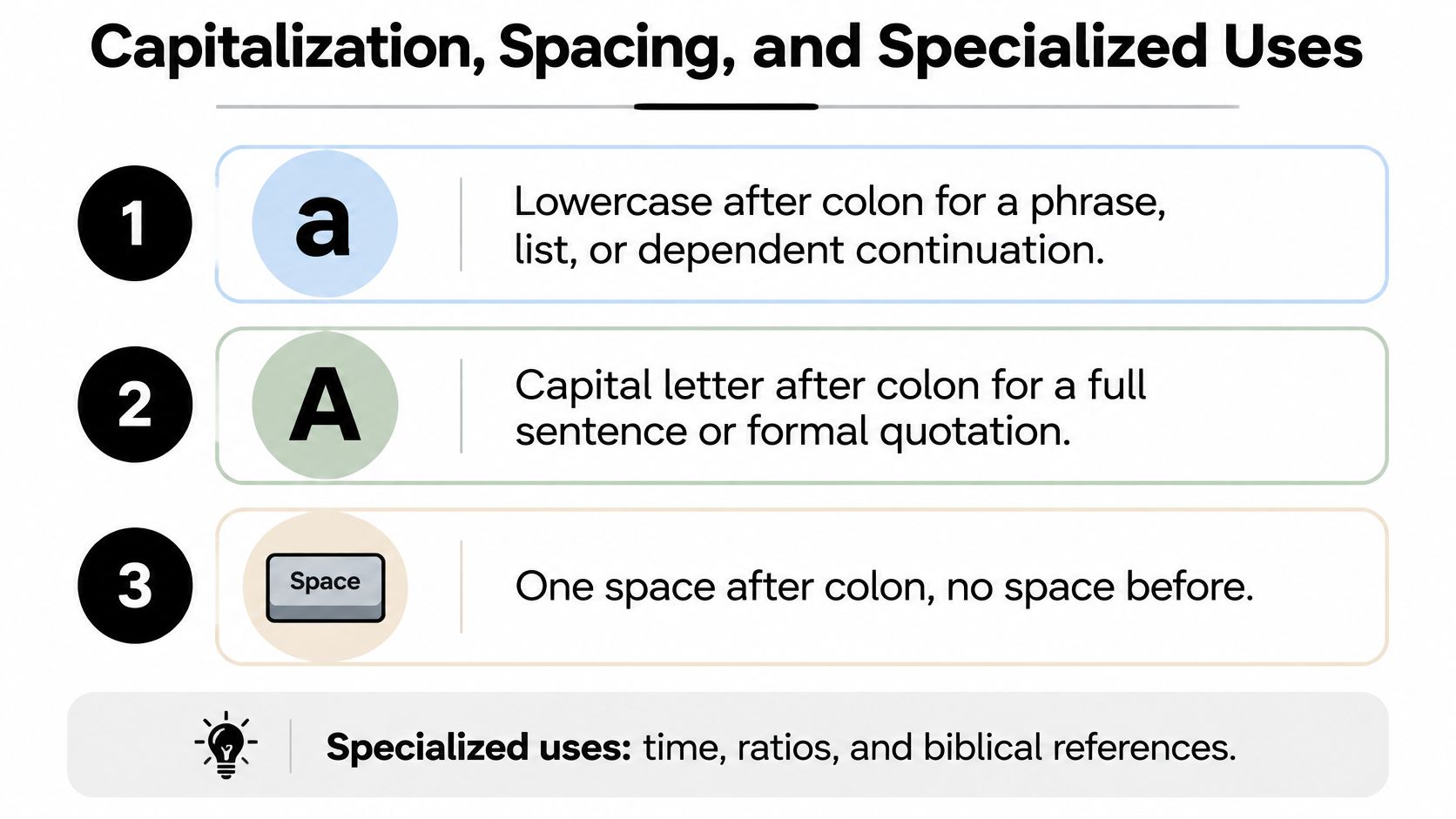
After a colon, choose capitalization based on what follows. Use lowercase when the colon introduces a phrase, list, or dependent continuation. Use a capital letter when it introduces a complete sentence, a formal quotation, or a proper noun. Style guides can differ, so Penn State's guidance on capitalization after a colon is useful when you need to set a document policy. Apply that policy consistently in headings, warnings, and procedures.
Lowercase: “Record the following data: pressure, temperature, and time.”
Capital: “The cause was clear: The seal had failed.”
A colon also normally takes one space after it and no space before it in English text: “Check the setting: 2.5 bar.” Follow your organization's house style if it gives a different instruction. Consistent spacing helps prevent avoidable variation in a technical document.
Some colons separate standardized information rather than introduce an explanation. In time notation, the mark separates fields, as in 1:15 or 8:25:30. In a ratio, 4:1 is read “four to one.” Bibliographic references may also use a colon between a journal volume and page number. These forms have their own conventions; don't apply the independent-clause test to them as if they were sentence punctuation.
A heading often needs no colon. “Inspection steps” already tells the reader that instructions follow. Add a colon only if the heading style calls for one, not because a colon always belongs before a list.
When the Right Move Is to Remove the Colon
A colon can pass a grammar check and still make the instruction less clear. In controlled technical writing, clarity matters more than stylistic variety. Sometimes the best edit is to remove the colon.
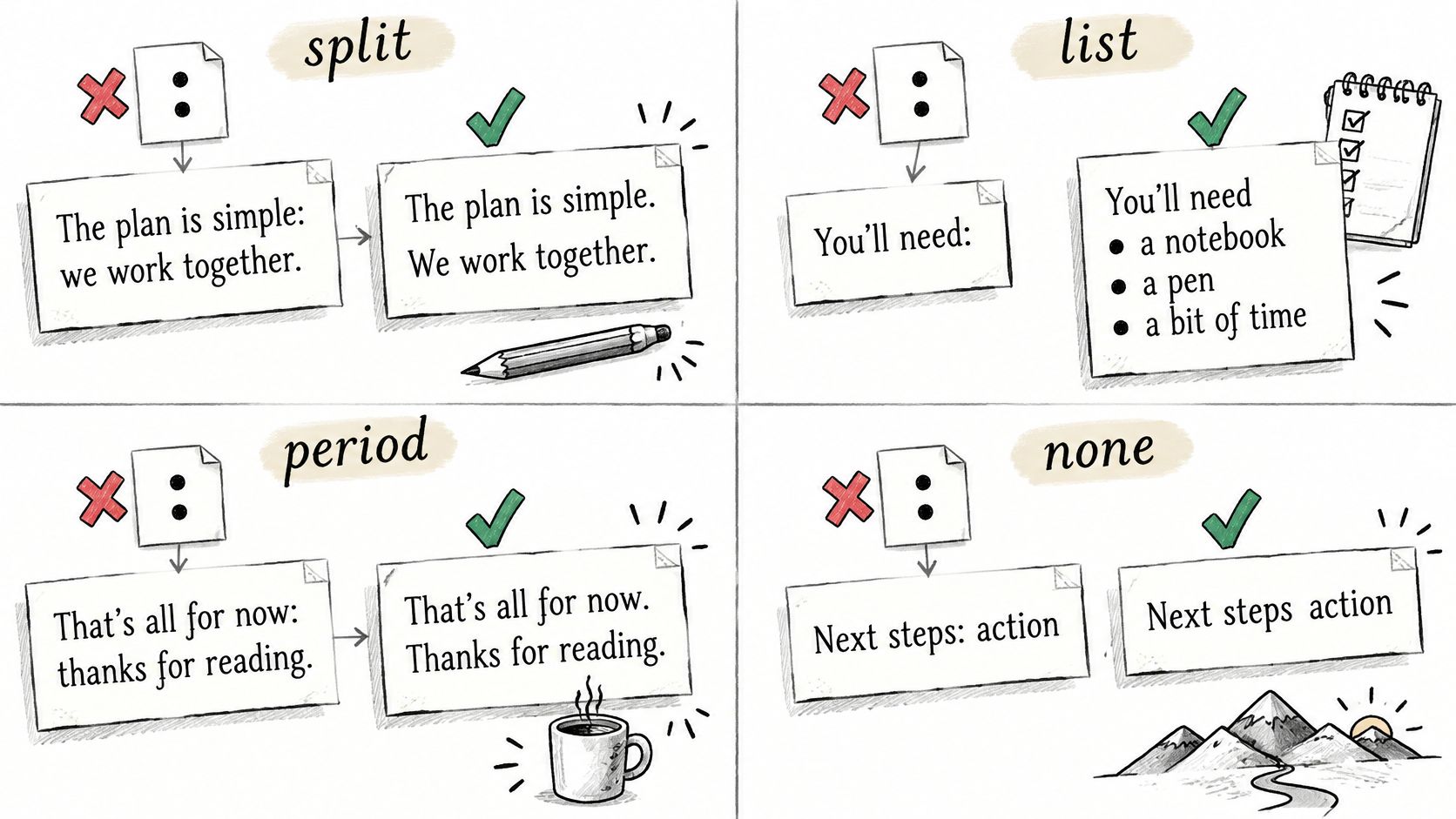
Four reasons to revise
- The colon introduces a single item without adding clarity. "The approved tool is: a torque wrench." Write "Use the approved tool, a torque wrench." Or, if the point is to give the instruction, write "Use a torque wrench."
- The colon tucks a warning into an action. "Open the access panel: electrical power may be present." The warning can be missed as part of the step. Separate it: "Warning: Electrical power may be present. Do not open the panel until the equipment is safe."
- The colon splits a verb from its object. "Inspect: the cable connector." Remove it: "Inspect the cable connector."
- The colon adds ceremony to a one-step instruction. "Press the reset button: wait for the indicator to go off." If these are distinct actions, write them as separate steps. A colon doesn't make their order or conditions clearer.
A warning may need to apply to every step in a procedure, or only to one action. If punctuation leaves that scope uncertain, revise the structure. Use a separate warning block, a numbered sequence, or a direct sentence that names the action and condition. That's disciplined editing, not wasted punctuation.
For a short explanation of colon punctuation, this video can supplement your review:
Colons in Translations, UI Strings, and AI-Revised Text
English punctuation habits don't always transfer cleanly into another language. A colon that introduces a list in an English procedure may become awkward or misleading after translation, especially in a short interface label, safety warning, or procedure heading. Ask a language specialist to review the localized sentence as written, not just the English source.
AI tools and automated checkers can produce punctuation that looks polished without identifying what the colon means. Is it introducing a list, an explanation, a label and value, or a sentence boundary? A checker can flag a pattern, but it can't reliably determine whether the colon gives a maintenance instruction the right scope.
Before approving translated or AI-revised text, check whether the words before the colon form a complete clause, whether a promised list is complete, and whether the colon hides more than one action. If any answer is unclear, ask a qualified reviewer to rewrite the text.
A One-Page Colon Checklist for Technical Editors
Keep this checklist beside your style guide. Use it during the final review of procedures, warnings, interface text, and maintenance instructions.
- Check the first part. Does everything before the colon form a complete sentence? Delete what follows and read the remaining words by themselves.
- Name the colon's job. Does it introduce a list, explanation, quotation, or result? If you can't name the relationship, revise the sentence.
- Check for a split. Does the colon sit between a verb and its object, or between a preposition and its complement? Remove it or rewrite the lead-in.
- Review the information after it. Does the text explain or specify the first part? Does a list look complete, or should you state that more items may follow?
- Check the warning's scope. If a warning follows an action, can the reader tell which action or condition it applies to? Separate it if the relationship is unclear.
- Apply your style policy. Check capitalization and spacing. Treat ratios, times, and bibliographic notation as specialized formats.
- Try the cleaner version. Read the sentence with a colon, then read it as two sentences or as a direct instruction. Keep the version that's easiest to follow.
For a broader controlled-language framework, consult the official ASD-STE100 specification through the source provided by your organization. The STE Guide heuristic checker can flag possible writing issues for review, but it isn't an official conformity assessment tool. For every colon in your draft, ask: Can the first part stand alone? Does the second part specify, explain, or enumerate it? Is the sentence clearer with the colon than without it?
A colon should show a clear relationship. If it doesn't, rewrite the sentence.
Visit STE Guide to explore practical explanations of Simplified Technical English, worked examples, and a structured learning path. Use its free heuristic checker to flag possible issues in a draft, then review each suggestion against the intended instruction.